Populist Sentinel
Breaking News

Trump’s BBC Fight Turns on the Network’s Own Paper Trail ★ Redistricting Wars Continue: SCOTUS Blocks New Missouri Congressional Map Favoring GOP ★ President Donald J. Trump Stares Down Iran, Rejects Ceasefire Proposal ★ California Gov. Gavin Newsom Calls for More Extremism and Division to Defeat President Trump ★ San Francisco Mayor Daniel Lurie Demands Robotaxi Regulation After July 4th Traffic Incidents ★ WOKE UP NORTH: Canada School Staff Asked to 'Confront' White Supremacy ★ Supreme Court Restores Federal Voter Citizenship Checks ★ Trump Gets Big Tech to Sign AI Safety Accord Without a New Federal Bureaucracy ★ INVASION: 1.8 Million More Muslims Enter U.S. After 9/11 Attacks ★ DOJ Targets Midterm Election Fraud ★ The AI Boom Is Making It Harder to Learn How Computers Work ★ Trump Administration Plans to Take Veto Power Over National Institutes of Health Grant Money ★ Kamala Harris Campaigns with Abdul El-Sayed as Democrats Go Full Commie ★ ITALY VS. ISLAM: PM Giorgia Meloni Promises to Ban Islamic Veils, Cut Foreign Students ★ Trump Administration Champions the Digital Frontier as Globalists Fight for Control ★ Justice Department Expands Illegal Voting Crackdown ★ COMMON SENSE: San Francisco DA Brooke Jenkins Calls to Expand Pretrial Detention ★ FBI And Congress Target Birth Tourism ★ Postal Audit Reveals Massive Ballot Handling Failures ★ Falsely Accused Brothers in Whitmer Kidnapping Sue State of Michigan ★ Trump’s BBC Fight Turns on the Network’s Own Paper Trail ★ Redistricting Wars Continue: SCOTUS Blocks New Missouri Congressional Map Favoring GOP ★ President Donald J. Trump Stares Down Iran, Rejects Ceasefire Proposal ★ California Gov. Gavin Newsom Calls for More Extremism and Division to Defeat President Trump ★ San Francisco Mayor Daniel Lurie Demands Robotaxi Regulation After July 4th Traffic Incidents ★ WOKE UP NORTH: Canada School Staff Asked to 'Confront' White Supremacy ★ Supreme Court Restores Federal Voter Citizenship Checks ★ Trump Gets Big Tech to Sign AI Safety Accord Without a New Federal Bureaucracy ★ INVASION: 1.8 Million More Muslims Enter U.S. After 9/11 Attacks ★ DOJ Targets Midterm Election Fraud ★ The AI Boom Is Making It Harder to Learn How Computers Work ★ Trump Administration Plans to Take Veto Power Over National Institutes of Health Grant Money ★ Kamala Harris Campaigns with Abdul El-Sayed as Democrats Go Full Commie ★ ITALY VS. ISLAM: PM Giorgia Meloni Promises to Ban Islamic Veils, Cut Foreign Students ★ Trump Administration Champions the Digital Frontier as Globalists Fight for Control ★ Justice Department Expands Illegal Voting Crackdown ★ COMMON SENSE: San Francisco DA Brooke Jenkins Calls to Expand Pretrial Detention ★ FBI And Congress Target Birth Tourism ★ Postal Audit Reveals Massive Ballot Handling Failures ★ Falsely Accused Brothers in Whitmer Kidnapping Sue State of Michigan ★ Trump’s BBC Fight Turns on the Network’s Own Paper Trail ★ Redistricting Wars Continue: SCOTUS Blocks New Missouri Congressional Map Favoring GOP ★ President Donald J. Trump Stares Down Iran, Rejects Ceasefire Proposal ★ California Gov. Gavin Newsom Calls for More Extremism and Division to Defeat President Trump ★ San Francisco Mayor Daniel Lurie Demands Robotaxi Regulation After July 4th Traffic Incidents ★ WOKE UP NORTH: Canada School Staff Asked to 'Confront' White Supremacy ★ Supreme Court Restores Federal Voter Citizenship Checks ★ Trump Gets Big Tech to Sign AI Safety Accord Without a New Federal Bureaucracy ★ INVASION: 1.8 Million More Muslims Enter U.S. After 9/11 Attacks ★ DOJ Targets Midterm Election Fraud ★ The AI Boom Is Making It Harder to Learn How Computers Work ★ Trump Administration Plans to Take Veto Power Over National Institutes of Health Grant Money ★ Kamala Harris Campaigns with Abdul El-Sayed as Democrats Go Full Commie ★ ITALY VS. ISLAM: PM Giorgia Meloni Promises to Ban Islamic Veils, Cut Foreign Students ★ Trump Administration Champions the Digital Frontier as Globalists Fight for Control ★ Justice Department Expands Illegal Voting Crackdown ★ COMMON SENSE: San Francisco DA Brooke Jenkins Calls to Expand Pretrial Detention ★ FBI And Congress Target Birth Tourism ★ Postal Audit Reveals Massive Ballot Handling Failures ★ Falsely Accused Brothers in Whitmer Kidnapping Sue State of Michigan

Back to news
news

Trump Gets Big Tech to Sign AI Safety Accord Without a New Federal Bureaucracy

TJ Markle

Author

September 29, 2026
4 min read
Trump Gets Big Tech to Sign AI Safety Accord Without a New Federal Bureaucracy

White House brings rival technology giants together behind voluntary safeguards as Trump pushes to keep America ahead in the global AI race

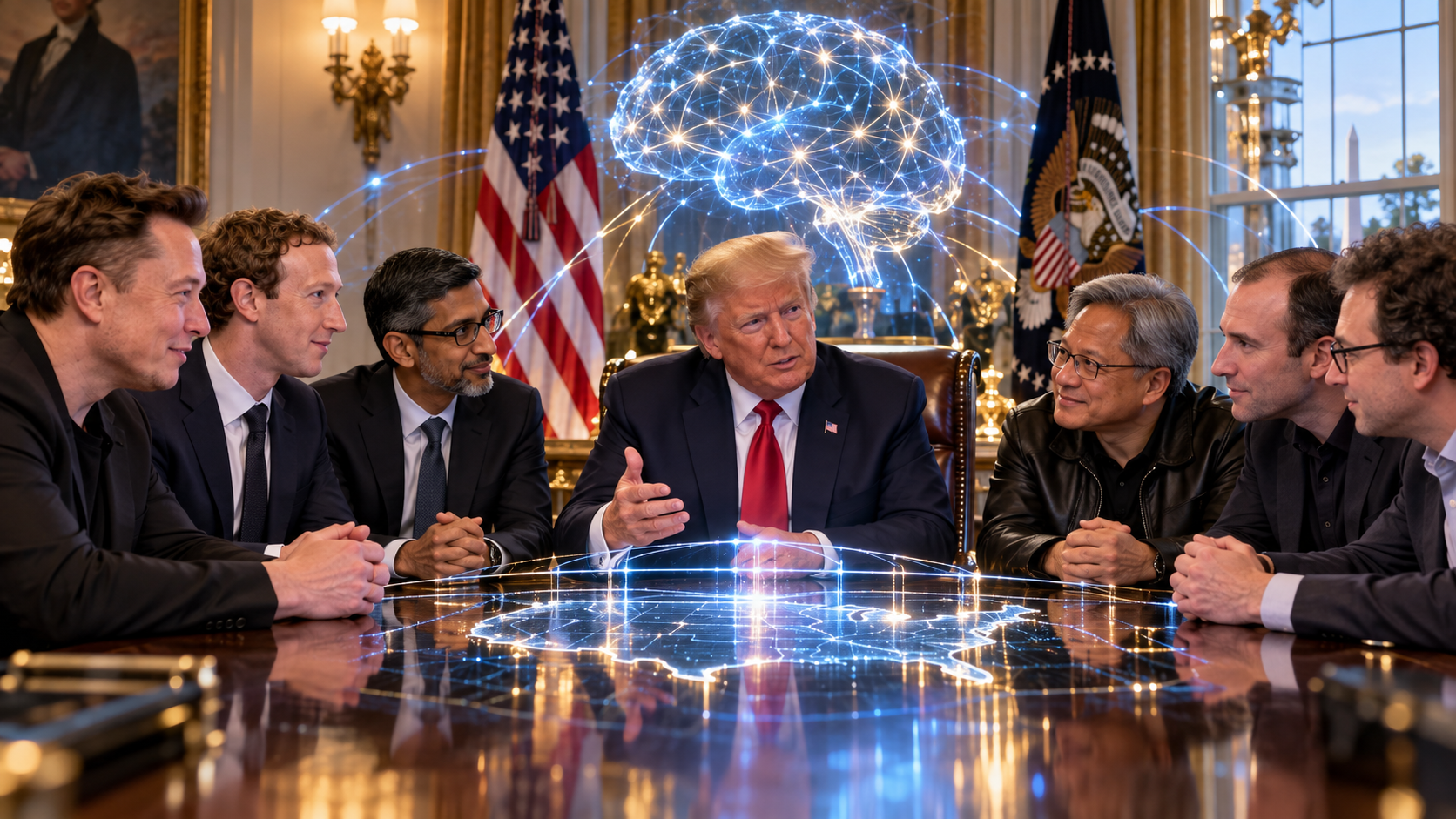
WASHINGTON — President Donald Trump brought some of the biggest names in technology to the White House Tuesday and emerged with something Washington has struggled to produce for years: a common set of commitments on the development of advanced artificial intelligence.

Executives from several of the country’s leading technology companies signed what Trump called a “morally binding” agreement establishing voluntary standards for the development of increasingly powerful AI systems. The accord does not carry the force of federal law, but the White House says it creates a framework for greater oversight without imposing a sprawling new regulatory structure on an industry moving at extraordinary speed.

Trump compared the agreement to a constitution and said it was intended to provide protection as AI grows more capable.

The approach reflects a broader strategy that has defined the administration’s AI policy: keep American companies moving quickly, require greater responsibility from the firms building the technology and avoid regulations the White House says could slow U.S. innovation while China continues its own aggressive AI push. A June executive order similarly argued that American leadership depends on avoiding overly burdensome regulation while accelerating responsible AI development.

The agreement, formally called the White House Accord on Superintelligence, was signed after a meeting that included executives from companies that normally compete fiercely with one another.

Among those appearing with Trump were Anthropic CEO Dario Amodei, Tesla and SpaceX CEO Elon Musk, OpenAI President Greg Brockman, Google CEO Sundar Pichai, Meta CEO Mark Zuckerberg and Nvidia CEO Jensen Huang.

House Speaker Mike Johnson said the accord establishes principles, standards and expectations for the industry, including stronger internal controls and layers of internal and external review.

The result is a model that relies heavily on industry accountability rather than a new federal regulatory regime.

That distinction matters.

Artificial intelligence is advancing faster than Congress has been able to write comprehensive legislation governing it. Washington also faces an unusual problem: many of the people who understand the most advanced systems best work for the companies actually building them.

Trump’s approach is to bring those companies into the process rather than slow them down with a large new bureaucracy.

The administration has also framed AI development as a national-security competition. Trump has repeatedly emphasized the importance of keeping the United States ahead of China, and his administration has made American technological leadership a central part of its AI policy.

At the same time, the agreement acknowledges that the technology carries risks.

Amodei, whose company Anthropic has repeatedly warned about the dangers of increasingly capable AI systems, said Tuesday that those risks remain “very real.” But he also said industry and government must work together so the United States can both succeed and develop the technology safely.

Trump is also considering a roughly 10-member committee to oversee the AI sector, although the structure and authority of that group have not yet been fully detailed.

The White House meeting therefore amounted to more than another technology summit.

It represented a wager on a distinctly different model of governing AI: set national expectations, bring the industry's most powerful competitors to the same table, demand safeguards and oversight — but leave enough room for American companies to keep building.

There are legitimate questions about how effectively a voluntary agreement can be enforced, particularly when companies are competing for enormous financial and technological advantages. The details released so far also leave important questions about how outside reviews will work and what happens if a company fails to live up to its commitments.

But the direction of the policy is clear.

Rather than beginning with restrictions, Trump is beginning with competition and cooperation: keep the United States at the front of the AI race, put responsibility directly on the companies developing the technology and reserve heavier government intervention for problems that cannot be handled through the emerging framework.

For an industry changing almost by the week, the White House is betting that America can pursue AI safety without surrendering the speed that helped give it the lead in the first place.

Trump’s gamble is straightforward: America should not have to choose between leading the AI revolution and controlling its risks. By putting the country’s most powerful technology companies on the record and demanding that they police the systems they are racing to build, the White House is trying to preserve both speed and accountability.
About the Author

TJ Markle

Publisher

Share this article:
Populist Sentinel

Your trusted source for local and national news. Delivering accurate, unbiased reporting since 2024.

Company

  • Contact
  • Privacy Policy
  • Terms of Service

Newsletter

Stay informed with the latest news delivered to your inbox.

© 2026 Populist Sentinel. All rights reserved.

Trusted • Independent • Accurate

base44
Edit with Base44