


For more than a century, the United States operated without a permanent federal income tax, financing its government primarily through tariffs and taxes on commerce. Today, individual income and payroll taxes account for more than 86 percent of federal revenue. An examination of America’s financial history reveals how war, political ambition and the expansion of government fundamentally transformed the relationship between Washington and the American taxpayer.
When George Washington assumed the presidency in 1789, the newly established United States faced a financial crisis that threatened its very existence. The country had accumulated substantial debts during the Revolutionary War, its financial credibility was precarious, and the federal government had inherited few reliable mechanisms for generating revenue. Yet the solution adopted by America’s founding generation bore little resemblance to the financial apparatus that governs the nation today. There was no federal income tax, no payroll withholding, no Social Security or Medicare tax, and no Internal Revenue Service collecting detailed financial information from millions of households. Instead, the government financed its operations primarily through tariffs imposed on imported goods, supplemented by targeted domestic taxes and the sale of federally owned land.
Between 1789 and 1800, approximately 88 percent of federal government revenue came from customs duties. During the decade preceding the Civil War, that figure exceeded 90 percent. More than two centuries later, the proportions have almost completely reversed. According to the Congressional Budget Office, the federal government collected approximately $5.4 trillion during fiscal year 2026, of which $2.846 trillion came from individual income taxes and another $1.812 trillion from payroll taxes. Together, these two categories accounted for approximately 86.2 percent of all federal receipts. Corporate income taxes contributed just 7.1 percent, while customs duties, once the financial foundation of the American government, generated approximately 3.2 percent.
This extraordinary transformation represents one of the most consequential, yet frequently overlooked, developments in American political and economic history. A nation that originally financed its government principally through taxes on commerce gradually constructed a system dependent upon the personal earnings, investments and employment of its citizens. That transition did not occur through a single legislative act or constitutional amendment. It unfolded across generations, accelerated by wars, economic catastrophes, political conflicts and the creation of government programs that dramatically expanded Washington’s financial obligations.
A Nation Born in Tax Revolt
The irony of America’s modern tax system is that the country itself emerged from a rebellion in which taxation played a central role. Britain’s efforts to recover the financial costs of the Seven Years’ War through measures such as the Stamp Act of 1765, the Townshend Acts of 1767 and the Tea Act of 1773 generated widespread resistance throughout the American colonies. Colonial merchants, farmers and political leaders objected particularly to Parliament’s assertion that it could impose taxes upon people who had no elected representation in that legislative body. The dispute ultimately became a broader confrontation over sovereignty, political authority and the rights of citizens.
The Declaration of Independence explicitly condemned King George III for imposing taxes without colonial consent. But independence did not eliminate the need for taxation; it merely transferred the responsibility to American institutions. Under the Articles of Confederation, the Continental Congress lacked independent authority to levy taxes and had to rely heavily upon financial contributions requested from individual states. Those contributions were frequently inadequate, leaving the national government struggling to pay its debts and maintain its operations. The experience directly influenced the drafting of the Constitution, which granted Congress broad authority to collect taxes, duties, imposts and excises.
On July 4, 1789, Washington signed the Tariff Act, among the first pieces of legislation enacted by the new federal government. Alexander Hamilton, the nation’s first Treasury secretary, understood that customs duties offered an efficient means of generating revenue without constructing an extensive bureaucracy to monitor the financial affairs of individual Americans. Merchants importing goods through Boston, New York, Philadelphia, Charleston and other American ports paid duties on their merchandise, providing the government with the resources necessary to maintain its military, operate its courts, conduct foreign relations and service its Revolutionary War debts.
Historical Treasury accounts reveal just how extensively the early government depended upon international commerce.
America’s original sources of federal revenue
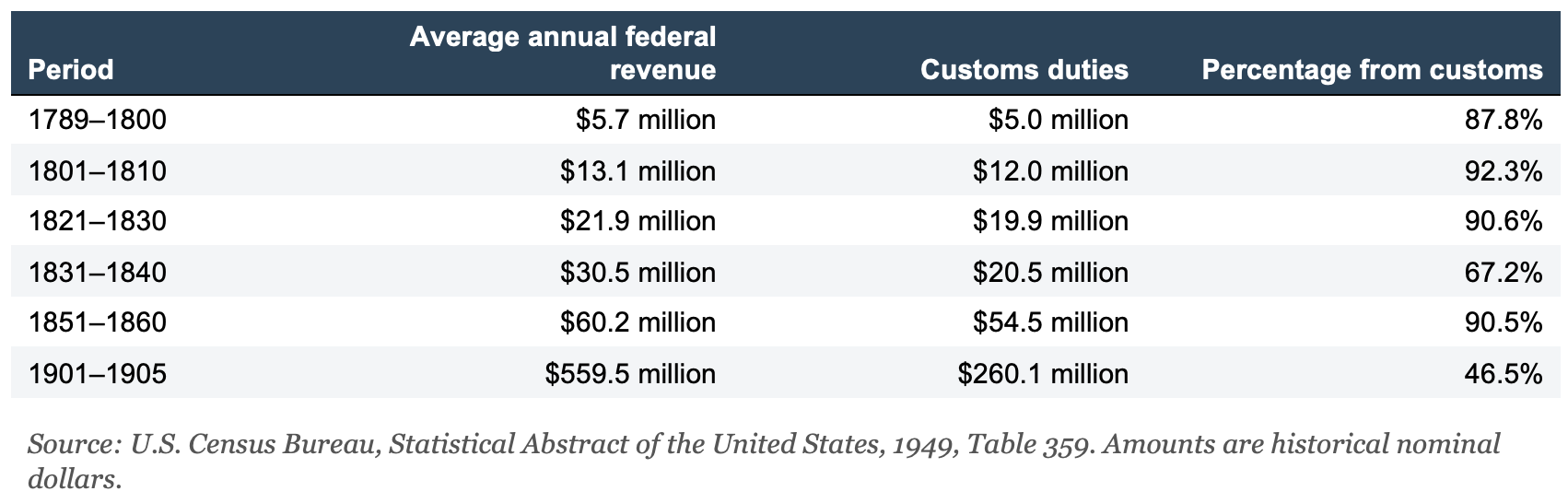
Public-land sales also played a significant role during America’s westward expansion. Between 1831 and 1840, approximately 24.5 percent of federal receipts came from selling government-owned land. The federal government was effectively converting part of the nation’s vast territorial holdings into operating revenue, although that expansion also involved the displacement and dispossession of Indigenous populations.
The difference between the original federal government and its modern counterpart was not merely the method of collecting revenue, but the size of government itself. According to a Congressional Research Service examination of federal revenues, Washington’s annual collections averaged approximately 1.8 percent of the nation’s gross domestic product during the period from 1820 through 1862. In fiscal year 2026, federal receipts represented approximately 16.8 percent of GDP, while expenditures reached 22.9 percent. Relative to the national economy, the federal government now collects more than nine times the share of economic output it did during much of the early republic.
The First Federal Income Tax Was a Wartime Measure
America’s original revenue system was not without controversy. In 1791, Hamilton persuaded Congress to impose an excise tax on domestically distilled spirits, provoking intense resistance among farmers and distillers in western Pennsylvania. Whiskey was not simply a recreational product in frontier communities; it was a valuable commodity that could be transported, traded and stored more easily than grain. The tax became particularly unpopular among smaller producers who believed the government was favoring wealthy commercial interests at their expense. By 1794, resistance had escalated into the Whiskey Rebellion, prompting Washington to mobilize militia forces to restore federal authority.
The rebellion established an important precedent: the federal government possessed both the legal authority and the political willingness to impose internal taxes upon its citizens. Nevertheless, internal taxation remained relatively limited for decades. President Thomas Jefferson’s administration dismantled much of the early internal revenue system, and although additional taxes were introduced during the War of 1812, many were subsequently repealed. For much of the period preceding the Civil War, ordinary Americans lived without a recurring federal income tax.
That changed in 1861, when President Abraham Lincoln confronted the enormous financial cost of preserving the Union. Tariffs alone were incapable of financing the military mobilization required to fight the Confederacy. Congress enacted the nation’s first federal income-tax legislation, followed in 1862 by a more extensive revenue law that imposed a 3 percent tax on annual incomes above $600 and a 5 percent rate on incomes exceeding $10,000. Congress also established the Office of the Commissioner of Internal Revenue, the organizational predecessor of the modern IRS.
The Civil War transformed federal finance almost overnight. By 1865, internal taxes accounted for approximately 63 percent of federal revenue, with excise taxes producing the largest portion. These taxes helped finance the war alongside extensive government borrowing. Unlike the permanent income-tax system Americans recognize today, however, the Civil War income tax was allowed to expire in 1872. Congress retained several other forms of internal taxation, particularly taxes on alcohol and tobacco, but the federal government returned to financing much of its operations through consumption and commerce rather than individual earnings.
Between 1863 and 1913, customs duties generated approximately 49 percent of federal revenue, while excise taxes supplied roughly 40 percent. In other words, close to nine-tenths of the government’s revenue during that half-century came from these two sources. The modern income tax was still decades away from becoming the principal financial instrument of the American government.
1913: The Constitutional Turning Point
By the late nineteenth century, the American economy had changed dramatically. The rise of railroads, industrial conglomerates, financial institutions and manufacturing empires produced extraordinary concentrations of wealth. Industrialists such as John D. Rockefeller, Andrew Carnegie and J.P. Morgan accumulated fortunes on a scale unimaginable to the founding generation. Meanwhile, farmers and working-class Americans argued that the tariff-based revenue system disproportionately burdened consumers while allowing wealthy individuals to retain enormous personal incomes.
Congress attempted to establish a new income tax in 1894, imposing a 2 percent levy on annual incomes exceeding $4,000. The following year, however, the Supreme Court struck down key provisions of the law in Pollock v. Farmers’ Loan & Trust Co., concluding that certain taxes on income derived from property were direct taxes that had not been apportioned among the states as constitutionally required. Supporters of income taxation responded by pursuing a constitutional amendment that would eliminate the apportionment obstacle.
The 16th Amendment was ratified on February 3, 1913, granting Congress explicit authority to tax income without apportioning the resulting obligations among the states according to population. Later that year, President Woodrow Wilson signed legislation establishing the new federal income tax while simultaneously reducing tariffs. The objective was not initially to create a mass taxation system, but to replace a portion of the government’s dependence on consumption taxes with a progressive levy directed principally at higher-income Americans.
The original permanent federal income tax was remarkably modest. The basic rate was 1 percent, with graduated surtaxes increasing the highest marginal rate to 7 percent. Individuals generally received a $3,000 exemption, while married couples qualified for a $4,000 exemption. Those figures placed the overwhelming majority of American households outside the income-tax system. According to the National Archives, fewer than 1 percent of the American population initially paid federal income taxes. IRS records show that approximately 358,000 individual income-tax returns were filed for 1913.
What the amendment ultimately created, however, was a permanent constitutional foundation upon which future Congresses could build a vastly more expansive revenue system. Although the original rates and exemptions shielded ordinary wage earners, nothing in the amendment required Congress to maintain those limits. Lawmakers could subsequently increase tax rates, broaden the definition of taxable income, reduce exemptions and extend taxation to millions of additional Americans without another constitutional amendment.
How Two World Wars Transformed the American Taxpayer
The First World War provided the initial opportunity to exercise that expanded authority. As Washington mobilized military resources on an unprecedented scale, Congress rapidly increased income-tax rates and imposed additional taxes on corporate profits. The highest marginal individual income-tax rate increased from 7 percent in 1913 to 77 percent in 1918. Federal income-tax filings grew from approximately 358,000 in 1913 to more than seven million by 1920. Although tax rates were subsequently reduced during the administrations of Warren Harding and Calvin Coolidge, the underlying income-tax system survived.
The Great Depression brought another expansion of federal responsibilities. As unemployment soared and millions of Americans lost their savings, homes and livelihoods, Washington introduced extensive relief programs and began restructuring the nation’s economic safety net. The Social Security Act of 1935 was particularly consequential because it established an entirely separate mechanism for taxing employment. Beginning in 1937, employees and employers each contributed 1 percent of covered wages, creating a combined payroll tax of 2 percent on the first $3,000 of annual earnings.
Unlike the individual income tax, which could exclude lower-income households through exemptions and deductions, payroll taxes reached workers across a much broader range of earnings. The eventual expansion of Social Security, the addition of disability benefits and the establishment of Medicare in 1965 transformed employment taxes into one of the federal government’s largest and most dependable revenue sources. These contributions were associated with government benefit programs, but for workers they also represented an additional recurring deduction from wages.
It was World War II, however, that permanently transformed income taxation from a relatively limited obligation into a mass system affecting the American middle class. Congress sharply expanded the number of individuals subject to income taxes, lowered exemptions and increased rates. The Congressional Research Service estimates that the number of individual taxpayers increased from approximately 17.5 million in 1941 to 42.6 million in 1945. At the upper end of the income distribution, the highest marginal rate reached 94 percent in 1944, although that rate applied only to the portion of taxable income falling within the highest bracket.
The most consequential administrative innovation came in 1943 with the Current Tax Payment Act, which established modern federal income-tax withholding. Rather than requiring employees to accumulate money and periodically remit taxes themselves, the government required employers to deduct income taxes directly from wages and transfer the proceeds to Washington. The system improved collection efficiency and provided the Treasury with a steady flow of revenue throughout the year. It also fundamentally altered the experience of taxation for American workers, who increasingly understood their earnings in terms of take-home pay rather than gross compensation.
The emergency eventually ended, but the financial infrastructure developed to fight the war remained. Income-tax rates declined, yet broad participation and automatic withholding became permanent features of American economic life.
The Great Transfer: Where Washington Gets Its Money
The most compelling evidence of America’s fiscal transformation can be found in the federal government’s own historical budget records. During the twentieth century, corporate income taxes, individual income taxes, payroll taxes and excise taxes experienced dramatic changes in their relative contributions. The proportion of revenue obtained from corporations declined considerably following the postwar period, while individual income and employment-related taxes became increasingly dominant.
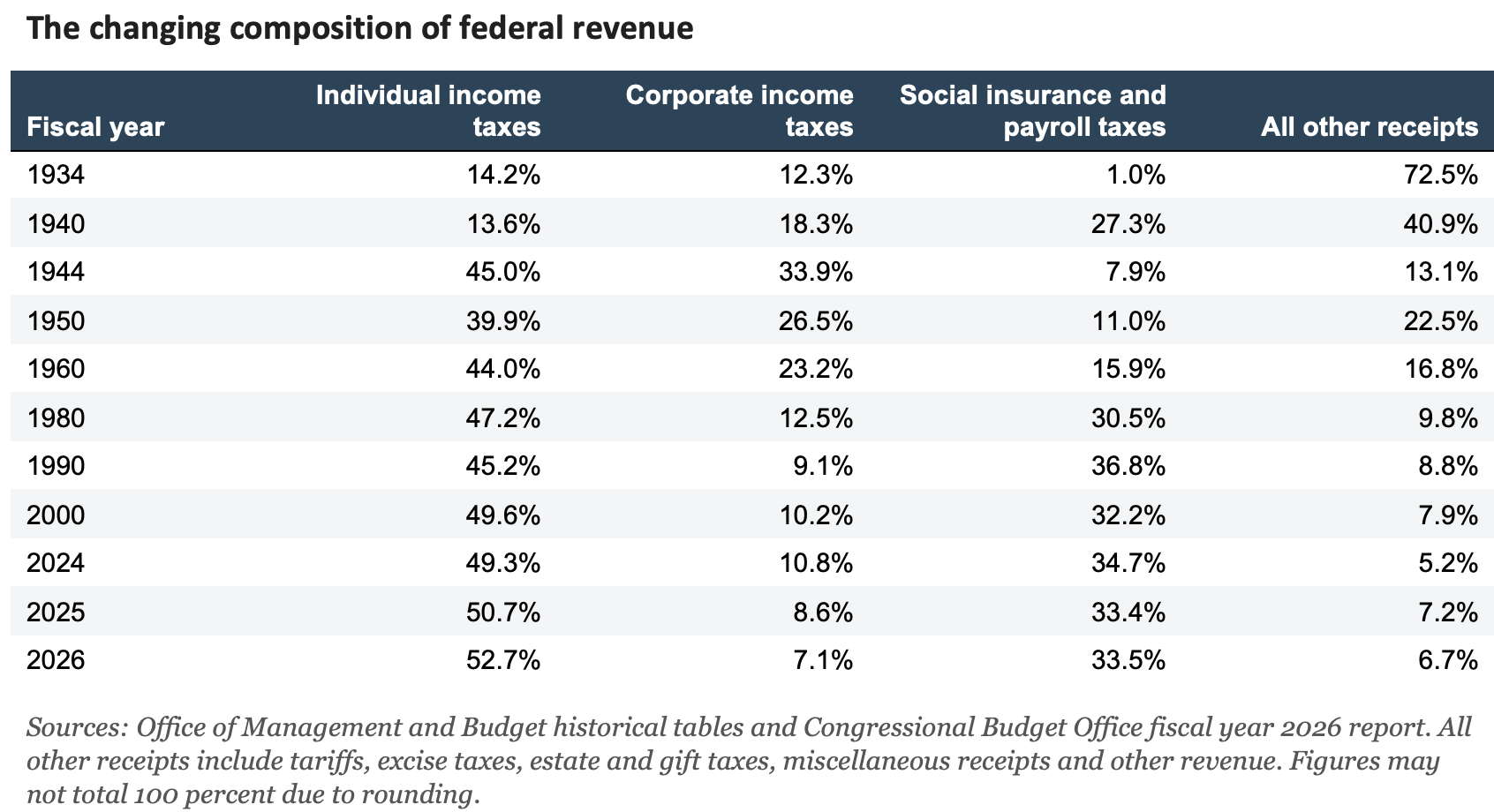
In 1950, corporations supplied more than one-quarter of all federal receipts, while individual income and social insurance taxes together accounted for approximately 51 percent. By 1980, the corporate share had fallen to 12.5 percent, while individual and social insurance taxes together represented nearly 78 percent. By 2026, those two categories had grown to more than 86 percent of federal revenue, while the corporate share had declined to approximately 7 percent.
Several developments contributed to this transformation. Corporate tax rates were reduced over successive decades, businesses increasingly adopted legal structures under which profits were taxed as individual income, and lawmakers introduced numerous deductions, credits and incentives affecting corporate tax liabilities. Globalization also created opportunities for multinational corporations to organize operations across different tax jurisdictions. At the same time, the expansion of Social Security and Medicare produced enormous increases in payroll-tax collections.
The 2017 Tax Cuts and Jobs Act reduced the federal statutory corporate income-tax rate from a maximum of 35 percent to 21 percent. Subsequent legislation further modified the deductions available to corporations. In fiscal year 2026 alone, corporate income-tax collections declined by approximately $71 billion, or 15.6 percent, partly reflecting expanded investment deductions and changes in the timing of payments on previously untaxed foreign profits. Individual income-tax receipts, meanwhile, increased by approximately $189 billion.
The declining corporate share does not mean that businesses contribute only through corporate income taxes. Employers also remit payroll taxes, and owners of pass-through businesses pay individual income taxes on business profits. Nevertheless, the federal government’s increasing reliance on personal income and employment-related taxes is unmistakable.
The Expanding Tax on American Employment
Perhaps the most significant development for ordinary working Americans has been the growth of payroll taxation. When Social Security taxes were first collected in 1937, the combined employee-and-employer contribution amounted to just 2 percent of covered wages. Today, the standard combined Social Security and Medicare tax rate is 15.3 percent, with employers and employees each responsible for 7.65 percent. Self-employed Americans generally pay both portions, subject to applicable adjustments and deductions.
Historical growth of combined Social Security and Medicare taxes
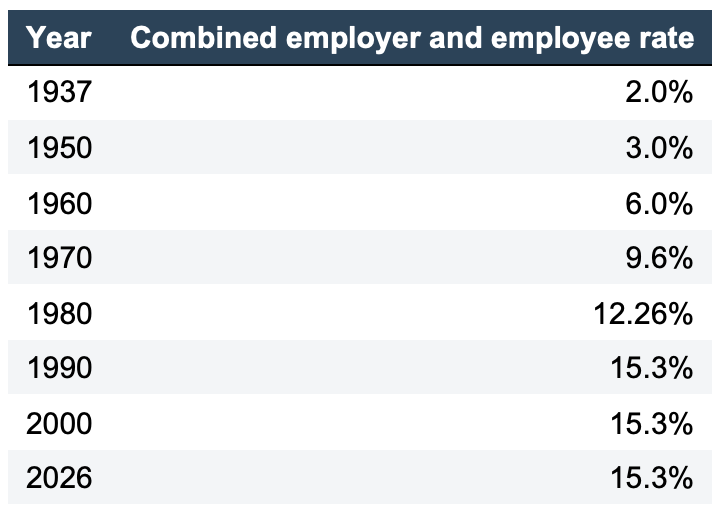
An employee earning $80,000 annually ordinarily has $6,120 deducted from wages for Social Security and Medicare, before paying any federal individual income tax. The employer contributes another $6,120, bringing the combined standard payroll-tax payment to $12,240. Although the employer is legally responsible for its own contribution, economists generally conclude that a substantial portion of employer payroll taxation is ultimately borne by employees through its effect on compensation.
These taxes are particularly important when comparing the financial obligations of middle-income households with those of wealthy Americans. In 2026, Social Security taxes apply to covered annual earnings up to $184,500. Income above that threshold is exempt from the Social Security portion, although Medicare taxes continue to apply to covered wages. Moreover, most investment income is not subject to ordinary employment taxes. Consequently, a household earning most of its income through salaries may face a considerably different payroll-tax burden from one receiving substantial capital gains, dividends or other investment returns.
The structure reflects the original design of Social Security as a contributory insurance program rather than a conventional income tax. Nevertheless, as employment taxes have grown into a principal source of federal revenue, their impact on the nation’s working population has become increasingly significant.
Who Really Pays America’s Taxes?
The political debate over taxation frequently produces competing claims that appear contradictory. Proponents of lower taxes on higher-income Americans argue that the wealthy already pay a disproportionately large share of federal income taxes. Critics contend that major corporations and wealthy investors benefit from tax provisions unavailable to ordinary wage earners. Both arguments can contain elements of truth, depending upon which taxes and income sources are being examined.
According to an analysis of IRS statistics published by the Tax Foundation, the top 1 percent of federal income-tax filers earned approximately 20.6 percent of reported adjusted gross income in 2023 but paid 38.4 percent of federal individual income taxes. The top 10 percent accounted for approximately 70.5 percent of individual income-tax collections, while the bottom half accounted for just 3.3 percent.
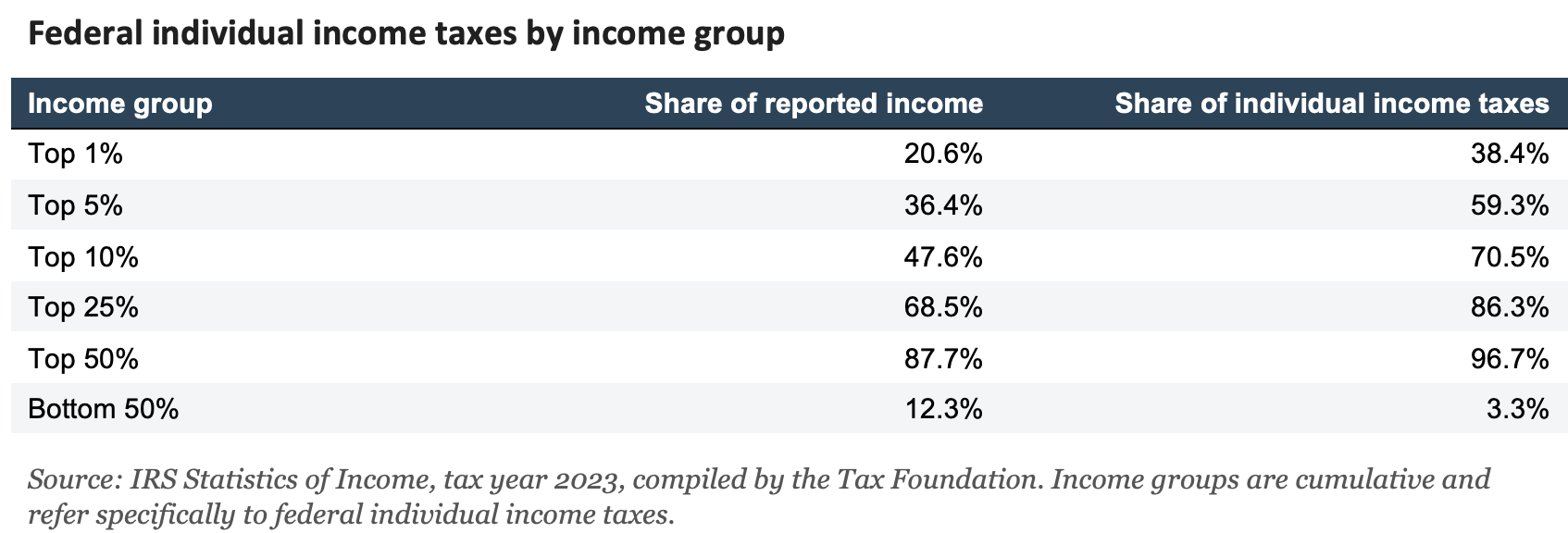
Those statistics, however, exclude payroll taxes, most excise taxes, tariffs and state and local taxation. When additional federal taxes are considered, the distribution changes. According to the Congressional Budget Office, the wealthiest 20 percent of households accounted for approximately 55 percent of the federal taxes included in its distributional analysis in 1979. By 2023, their share had increased to approximately 70 percent. During the same period, the top 1 percent’s share increased from 14 percent to 26 percent.
The explanation involves both tax policy and the concentration of income. Between 1979 and 2023, the proportion of income before taxes and transfers received by the top 1 percent increased from approximately 9 percent to 16 percent. Higher-income households consequently generated a larger share of tax collections, even though the CBO found that average federal tax rates declined across income groups during that period.
The distinction is essential. A wealthy taxpayer can pay a lower effective tax rate than under an earlier tax regime while contributing a larger share of total government revenue because that taxpayer’s income has increased disproportionately.
Similarly, the widespread assertion that Americans who owe no federal individual income tax pay nothing to the government is misleading. Many of those individuals pay Social Security and Medicare taxes, federal fuel taxes and other consumption-related levies. They may also pay substantial state and local taxes through property assessments, rent, sales taxes and other charges. A complete examination of American taxation must therefore extend beyond income-tax returns.
Could America Return to a Tariff-Based Tax System?
The revival of tariffs as a major component of American economic policy has renewed interest in whether Washington could restore elements of its original revenue structure and substantially reduce its reliance on income taxation. Advocates argue that tariffs can generate government revenue while encouraging domestic manufacturing, protecting strategic industries and reducing dependence on foreign suppliers. Critics warn that tariffs can increase consumer prices, provoke retaliatory trade measures and raise production costs for American companies dependent on imported materials.
The historical argument for tariffs is compelling, but the contemporary financial arithmetic presents enormous obstacles. In fiscal year 2024, customs duties generated approximately $77 billion. That amount increased to $195 billion in 2025 before declining to approximately $173 billion in 2026. Even at the higher 2025 level, tariff collections represented less than 4 percent of total federal receipts.
Furthermore, tariffs are not simply taxes paid by foreign governments. Customs duties are legally collected from importers, who may attempt to recover those costs through higher prices. Foreign manufacturers may absorb a portion of the cost, and importers may accept lower profit margins, but American businesses and consumers can ultimately bear substantial financial consequences. Federal Reserve research examining recent tariffs has documented increases in retail prices and changes in household purchasing behavior.
Replacing the $2.846 trillion generated by individual income taxes in 2026 would require tariff revenues more than 16 times greater than those actually collected that year. Replacing both individual income and payroll taxes would require approximately 27 times current customs receipts. Such a transformation could not realistically be achieved merely by restoring historical tariff schedules, particularly because higher tariffs would alter import volumes, supply chains and consumer behavior.
The most important distinction is that the federal government of 1790 did not finance nationwide retirement and health insurance programs, maintain hundreds of military installations or administer the extensive regulatory and public-service infrastructure of the modern United States. Returning to a primarily tariff-financed government would require a fundamental restructuring of federal spending and obligations, not simply a different method of collecting taxes.
Washington’s $5.4 Trillion Tax Machine
Despite enormous changes in tax policy over the past century, Washington’s revenue system remains heavily concentrated in two principal categories. The Congressional Budget Office’s fiscal year 2026 report, released November 9, provides a detailed accounting of the modern government’s financial dependence.
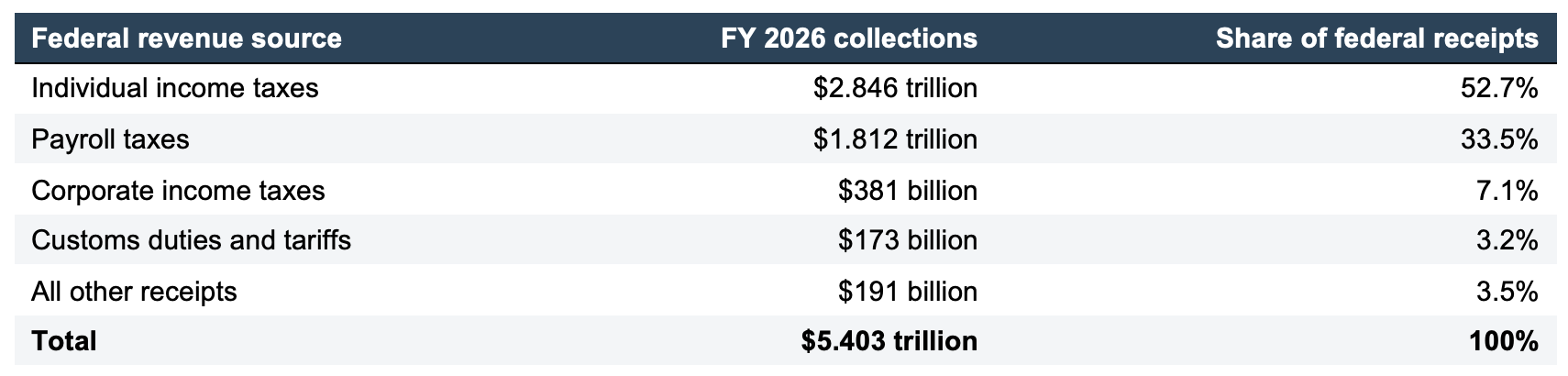
What makes these figures particularly remarkable is that even $5.4 trillion in annual collections is no longer sufficient to finance the federal government’s operations. Washington spent approximately $7.4 trillion during fiscal year 2026, producing a deficit of almost $2 trillion. Social Security, Medicare and Medicaid collectively accounted for approximately $3.45 trillion in expenditures. Military activities represented another $917 billion, while net interest on the national debt reached approximately $1.14 trillion.
Interest payments alone exceeded the federal government’s military expenditures and amounted to approximately three times its corporate income-tax collections. More than one-fifth of all federal receipts was equivalent to the cost of servicing existing debt rather than directly financing new government services. Approximately 27 percent of total federal expenditures remained uncovered by current revenue and had to be financed through borrowing.
This introduces another category into America’s increasingly complicated tax debate: future generations. Federal borrowing allows today’s government to finance expenditures without immediately collecting an equivalent amount from present taxpayers. The financial consequences, however, persist through interest payments, refinancing requirements and the possibility of higher future taxes or reductions in public services.
The Government America Built — and the Price of Maintaining It
The history of American taxation is ultimately inseparable from the history of American government. The country’s founding generation established a comparatively limited federal institution financed principally through international commerce. The Civil War introduced an emergency income tax. The industrial revolution and progressive movement produced the political momentum behind the 16th Amendment. Two world wars transformed income taxation into a mass system, while the Great Depression and subsequent expansion of social insurance permanently incorporated employment taxes into the nation’s financial structure.
Each generation inherited the institutions and obligations created by its predecessors. Programs introduced in response to immediate crises frequently survived those crises, while the revenue mechanisms established to finance them became permanent components of American life. The cumulative result is a government whose financial relationship with its citizens extends from the moment they earn a paycheck to the moment they purchase goods, sell investments, operate businesses or transfer wealth to their heirs.
The most revealing historical comparison is not simply that Americans originally lived without a permanent federal income tax. It is that the federal government once obtained approximately nine of every ten dollars from customs duties, whereas today it obtains more than eight of every ten dollars from individual income and employment-related taxes. In the intervening centuries, Washington has expanded its responsibilities, its revenue-collection capabilities and its financial obligations beyond anything the founding generation could reasonably have anticipated.
Whether those developments represent necessary modernization, excessive government expansion or some combination of the two remains at the center of America’s political divide. But beneath the competing ideological arguments lies a financial reality that cannot be ignored: a federal government collecting more than $5 trillion annually, spending more than $7 trillion and accumulating nearly $2 trillion in additional deficits cannot resolve its long-term financial challenges simply by adjusting individual tax brackets or imposing new tariffs.
More than 237 years after the nation’s first Congress convened, Americans continue to confront the same fundamental questions that challenged Washington, Hamilton and Jefferson: what responsibilities should the federal government assume, what should those responsibilities cost, and who should be required to pay for them?
The answers have changed dramatically since 1789. The financial consequences of those decisions will continue to shape the lives of American taxpayers for generations to come.
Research Sources
• U.S. Census Bureau — Statistical Abstract of the United States, 1949, Historical Federal Receipts
• Congressional Research Service — U.S. Federal Government Revenues: 1790 to the Present
• National Archives — The 16th Amendment
• Office of Management and Budget — Historical Federal Budget Tables
• Congressional Budget Office — Summary for Fiscal Year 2026
• Congressional Budget Office — The Distribution of Household Income, 2023
• Social Security Administration — Historical Social Security and Medicare Tax Rates
• Tax Foundation — Federal Individual Income Tax Statistics, Tax Year 2023
• Federal Reserve — Paying More and Buying Less: 2025 Tariffs and U.S. Household Spending