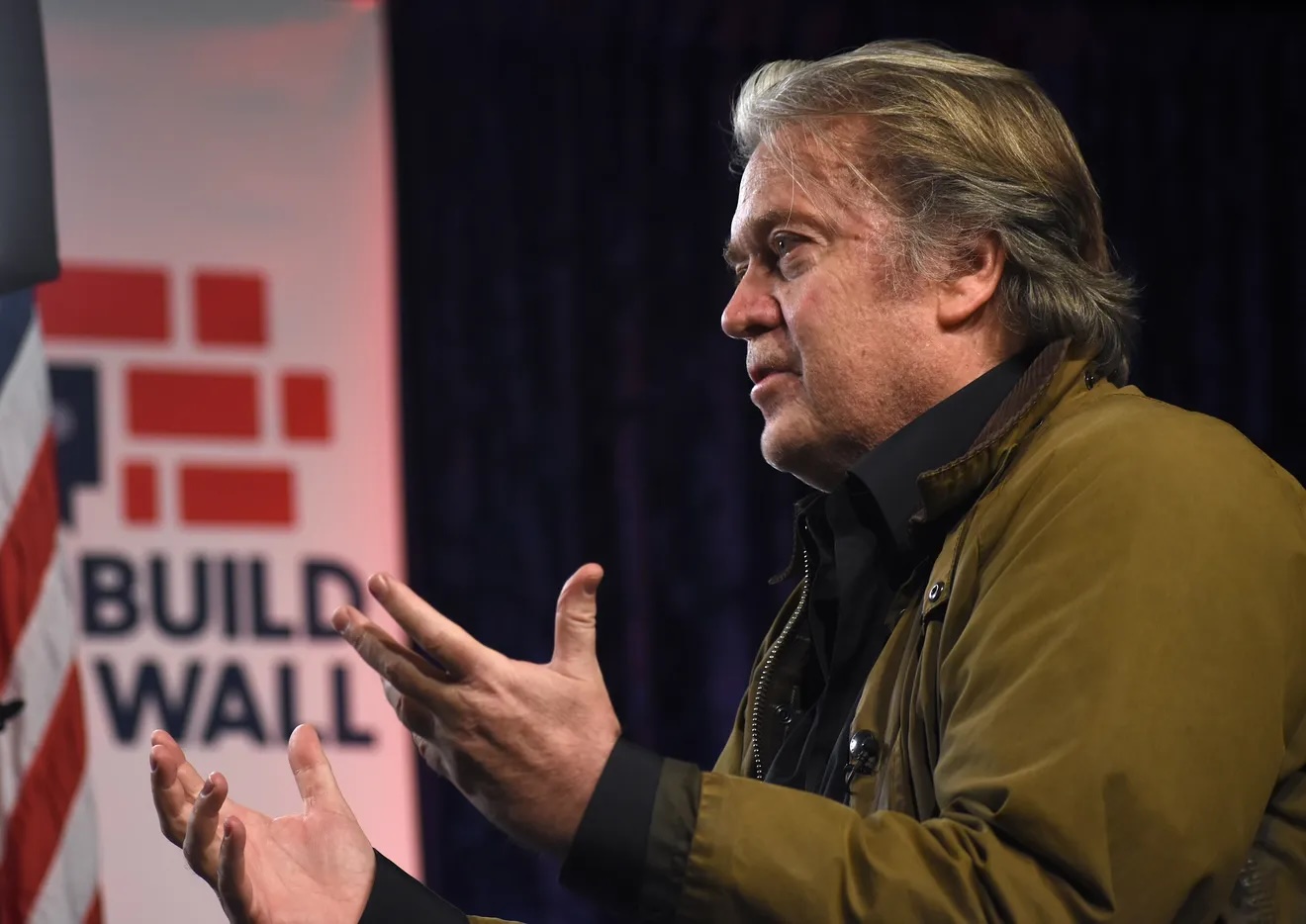
Steve Bannon had a remarkably diverse and financially successful career long before he became associated with President Donald J. Trump, with 2017 White House ethics filings reporting assets valued between roughly $9.5 million and $48 million (some estimates up to $56 million) from consulting (including his firm Bannon Strategic Advisors), entertainment ventures such as film production companies, and real estate holdings. All information is based on public record.
So, is the van out of cash? How exactly did he get entangled in what critics call a grift: the 'We Build the Wall' fundraiser, plead guilty to felony fraud, and yet serve no prison time while his co-conspirators received prison sentences?
These actions involve documented instances of fraud, as evidenced by Bannon's guilty plea to scheme to defraud in the We Build the Wall case (admitting to misleading donors who believed their money would solely fund border wall efforts) and the allegations in the ongoing civil lawsuit (Barr v. Bannon et al.) regarding the memecoin promotion.
These cases raise pointed questions about his actual net worth and why someone with his resources would exploit his media platform and loyal audience to push fundraising or investment schemes that, according to legal claims, funnel benefits to himself and associates instead of delivering on promises. Such patterns align squarely with the classic definition of grifting: securing money through dishonest deception and fraud.
His wealth stemmed from an elite education: he earned a B.A. in urban affairs from Virginia Tech (1976), an M.A. in national security studies from Georgetown University (1983), and an M.B.A. from Harvard Business School (1985). Bannon served as a U.S. Navy officer from 1977 to 1983 (including Pentagon duty as a special assistant to the chief of naval operations), worked as an investment banker at Goldman Sachs (focused on media/entertainment mergers and acquisitions, rising to vice president by the late 1980s), founded Bannon & Co. in 1990 (a boutique firm specializing in Hollywood/media deals), executive produced multiple films in the 1990s and later (e.g., via Bannon Film Industries), served as acting director of Biosphere 2 (1993–1995), founded the Government Accountability Institute (2012), and became executive chairman of Breitbart News in 2012, significantly expanding its influence in conservative media.
Given Bannon’s established credentials, resources, and financial security, the question persists: Why would someone in his position allegedly redirect donor funds from the "We Build the Wall" campaign—explicitly promoted as a patriotic private effort to build border wall sections with assurances that 100 percent of contributions would go toward construction and no personal gain for organizers—toward personal enrichment?
Prosecutors alleged that Bannon and his partners diverted significant sums, including over $1 million routed through his nonprofit as detailed in the federal indictment, despite public promises otherwise. This apparent disconnect between his proven success and involvement in the scheme continues to fuel criticism of his influence and enduring support in certain right leaning circles.
The "We Build the Wall" campaign was led by disabled Iraq War veteran Brian Kolfage, who partnered with Steve Bannon, Andrew Badolato, and Timothy Shea. The effort, initially pitched as a grassroots patriotic push, turned into a grift in the eyes of prosecutors and critics alike—organizers raised about $25 million via GoFundMe and a nonprofit, explicitly promising donors transparency and that every dollar would fund border wall construction with no salaries or personal gain for organizers.
Bannon helped boost visibility significantly, using his media platform and connections to drive traffic and donations through podcasts and interviews, framing it as a private-sector solution to government inaction and attracting hundreds of thousands of supporters (many of whom were small donors).
Prosecutors alleged the group defrauded donors by secretly diverting large sums for personal luxury expenses such as boats, cars, jewelry, and home renovations through shell companies and fake invoices, despite public assurances otherwise, resulting in only a few miles of wall constructed.
By August 2020, federal prosecutors in the Southern District of New York filed charges against Bannon and his three co-defendants for conspiracy to commit wire fraud and conspiracy to commit money laundering, each count carrying a potential maximum sentence of 20 years in prison.
Bannon was arrested on August 20, 2020, in an early morning raid. Federal agents, including U.S. Coast Guard personnel and postal inspectors, boarded the 150 foot superyacht Lady May, owned by Bannon's longtime associate, exiled Chinese billionaire Guo Wengui (also known as Miles Guo), while it was anchored off Westbrook, Connecticut, in Long Island Sound. Bannon was taken into custody aboard the vessel around 7 a.m. without incident. Guo was present but not arrested or charged, as the case was unrelated to him.
The 2020 federal indictment alleged that, contrary to explicit promises of no personal compensation, Bannon diverted over $1 million through a nonprofit for personal expenses while concealing the misuse.
Trump pardoned Bannon on the federal charges in January 2021 on his last full day in office, nullifying them though presidential pardons apply only to federal offenses, not state crimes. New York state pursued parallel accusations, indicting Bannon in September 2022 on charges including money laundering and conspiracy.
In February 2025, Bannon pleaded guilty in the New York case to one count of scheme to defraud in the first degree (a class E felony), effectively admitting to misleading donors who believed their contributions would go entirely toward border wall construction.
Under the plea deal with Manhattan District Attorney Alvin Bragg, Bannon received a three-year conditional discharge, no prison time unless he commits another crime during that period, and is barred from leading or fundraising for New York charities.
His legal team negotiated the outcome by emphasizing his age (71), the prior federal pardon, and agreement to plead to a lesser felony while dropping more serious charges; prosecutors avoided a lengthy trial and secured a conviction without appeal risks.
Many view this as a grifter taking advantage that did no time for the crime, with unequal justice, contrasting with his co-conspirators' fates: Kolfage and Badolato pleaded guilty and received prison sentences (Kolfage over four years), while Timothy Shea was convicted at trial and received more than five years.
Law professor Jonathan Turley, a frequent Fox News contributor, commented primarily on the federal charges and pardon. In a January 2021 Fox News op-ed on Trump's final pardons, Turley described the Bannon pardon as one of the more "ugly" examples, noting that Bannon had not yet gone to trial on serious fraud claims (wire fraud and money laundering conspiracies, each potentially carrying up to 20 years) and highlighting the disparity where Bannon was pardoned but his co-defendants were not—calling it more akin to a "raw personal favor" than principled clemency.
In a September 2020 blog post on jonathanturley.org, Turley wrote that Bannon "needs a defense, not a conspiracy theory" ahead of the federal trial, rejecting Bannon's framing of the charges as purely political retaliation and urging substantive legal arguments instead.
Turley has not made prominent public comments on the New York state case, the 2022 indictment, or the 2025 plea and discharge outcome.
Bannon's involvement in the "We Build the Wall" campaign sparked intense controversy and has only exemplified the scandals that have long shadowed him. Little did his followers know, this high-profile fraud case, where millions in donor funds were allegedly diverted for personal gain, was merely the tip of the iceberg in his string of legal battles and public controversies.
Bannon's associations with Jeffrey Epstein, the convicted sex offender and financier who died in 2019, have raised eyebrows about his networks and judgment. Newly released Justice Department files in January 2026 confirmed and expanded on that relationship, revealing hundreds of texts and emails from 2017 to 2019 in which Bannon advised Epstein on rehabilitating his image amid sex trafficking allegations.
Author Michael Wolff, who chronicled much of this in his 2021 book Too Famous and discussed it in interviews and writings, has provided key validation through his direct observations and access. Wolff described how Bannon conducted media training sessions with Epstein, coaching him on responses to allegations—such as sticking to the message that he was "not a pedophile," maintaining eye contact with the camera to avoid seeming "stupid" or "creepy," and presenting himself as engaging, natural, and sympathetic.
Early public hints appeared as far back as 2018, including media reports of Bannon visiting Epstein's townhouse, and some emails surfaced in late 2025, such as November 2025 BBC coverage of 2018 messages discussing travel and politics.
Amplifying the information to a much broader audience, in July 2025, Elon Musk helped highlight Bannon's ties to Epstein in a short tweet; this was well before the full January 2026 DOJ document release.
The full extent, including the volume of communications, Bannon's image rebuilding advice, recorded interviews such as a bizarre multi-hour session questioning if Epstein saw himself as the devil himself, and their chummy exchanges right up to Epstein's July 2019 arrest, was initially exposed in the massive U.S. Department of Justice release of over three million Epstein-related documents on January 30, 2026.
The Epstein files reveal a close working relationship between Steve Bannon and Jeffrey Epstein spanning roughly 2017 to 2019, involving frequent texts, emails, and recorded conversations, during which both Epstein and Bannon mocked President Donald Trump and Bannon responded, “It’s beyond borderline 25th Amendment.”
The phrase "my dems" in Jeffrey Epstein's 11:11:10 pm text message to Steve Bannon (from the released Epstein files) has been widely interpreted in media and social commentary as implying that Epstein viewed certain Democrats as his personal contacts, allies, or individuals he had influence over; possibly politicians, donors, or figures in Democratic circles with whom he communicated or had relationships.