
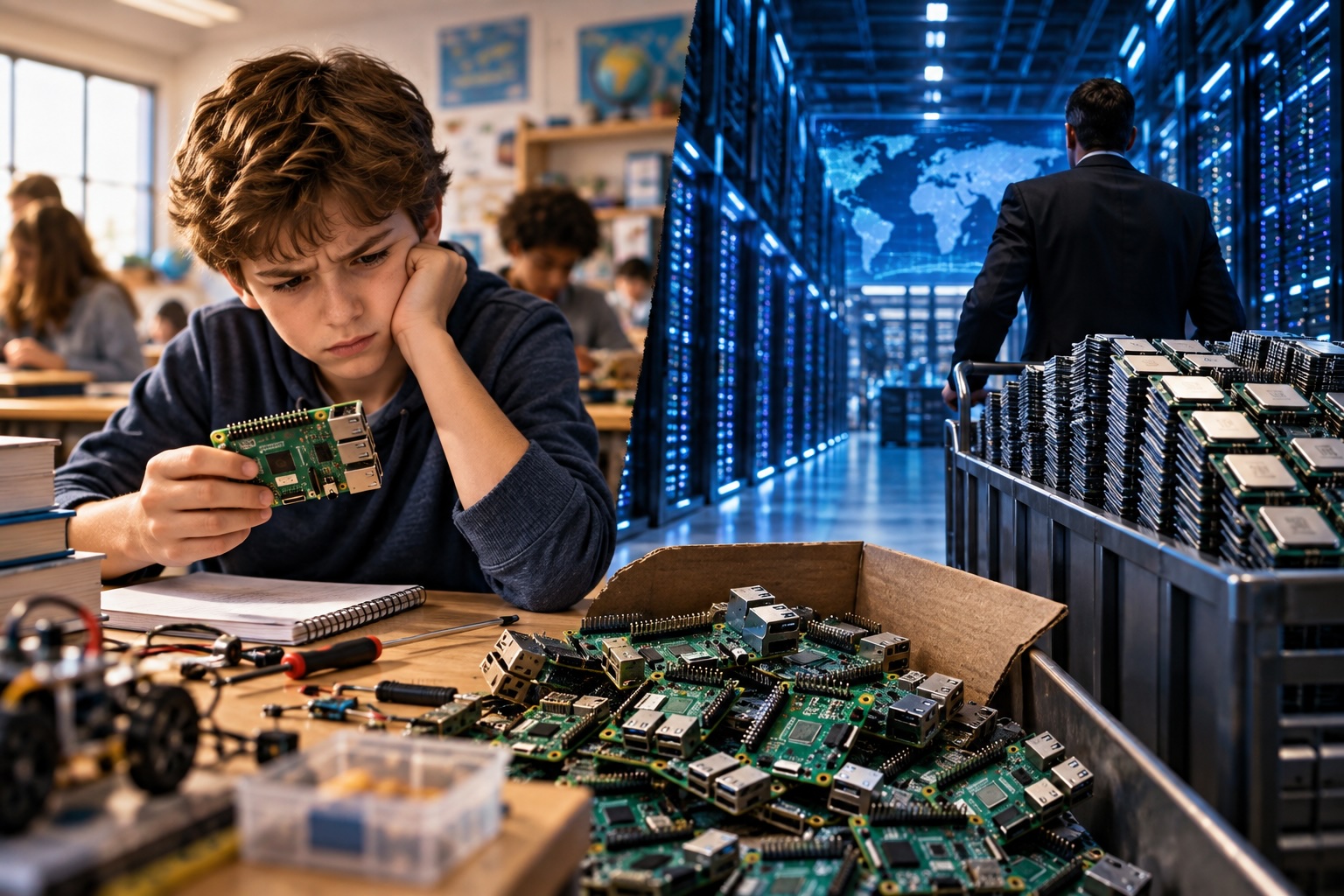
For more than a decade, Raspberry Pi helped put real computing power into the hands of students, hobbyists and aspiring engineers for the price of a dinner. Now the artificial-intelligence boom is helping drive up the cost of the memory those machines depend on, raising a question Washington has barely begun to confront: What happens when the race to build the world's most powerful computers makes it harder for ordinary people to learn how computers work?
When the first Raspberry Pi went on sale in 2012, its most remarkable feature was not its processor, its memory or its bare green circuit board. It was the price. For $35, a student could own a real computer, load Linux onto it, write software, connect sensors and motors, build a robot, experiment with electronics or simply figure out what happened when code left the screen and began controlling something in the physical world.
That low price was not incidental. It was the point.
The people behind Raspberry Pi wanted to reverse a trend that had been quietly reshaping computing education. Personal computers had become more powerful, polished and sealed. Children were increasingly surrounded by technology while having fewer opportunities to take it apart, modify it or understand what was happening underneath the case. Raspberry Pi was designed to put experimentation back within reach.
It worked.
Over the next 14 years, the Raspberry Pi became far more than a classroom novelty. Schools used it to teach programming and electronics. Robotics clubs built projects around it. Hobbyists turned it into weather stations, security systems, servers and home-automation devices. Small manufacturers and startups began embedding Raspberry Pi boards and Compute Modules into commercial products. A computer originally intended to make programming more accessible became one of the most recognizable platforms for practical computing education in the world.
Now the economics that made that possible are being strained by an industry with very different priorities and vastly deeper pockets.
Artificial intelligence is consuming enormous amounts of computing infrastructure. That requires advanced processors, huge data centers and, critically, vast quantities of memory. The result is a scramble for semiconductor manufacturing capacity that has helped push the price of some ordinary computer memory sharply higher.
Raspberry Pi has been unusually candid about what is happening. The company says the cost of the LPDDR4 memory used in its Raspberry Pi 4 and Raspberry Pi 5 computers increased sevenfold in a single year. That does not mean Raspberry Pi computers themselves became seven times more expensive, an important distinction that is often lost when the shortage is discussed. But the increase in memory costs has been large enough to force repeated price increases across several models.
The 16GB Raspberry Pi 5 is the clearest example. It launched in January 2025 at $120. Its official price is now $305.
For a technology company, an extra $185 may be trivial. For a school buying dozens of machines, a community robotics program operating on donations or a parent trying to give a child something more useful than another game console, it is not.
And that is where the story becomes larger than Raspberry Pi.
The Classroom Is Competing With the Data Center
AI companies are not literally buying up Raspberry Pi processors. The giant data centers being built by Microsoft, Amazon, Google, Meta and others rely on highly specialized accelerators, particularly chips from Nvidia and AMD, that are far more powerful and expensive than anything found in a Raspberry Pi.
But all of those systems depend heavily on memory, and memory manufacturing is not limitless.
The most advanced AI chips use high-bandwidth memory, or HBM, which can feed enormous amounts of data into processors at very high speed. As demand for AI systems has exploded, semiconductor manufacturers have devoted more capacity and investment to the kinds of memory used in servers and accelerators because that is where some of the strongest demand and highest margins now exist.
Raspberry Pi itself pointed to that pressure in 2025, saying that "insatiable demand" for high-bandwidth memory used in AI systems was competing for manufacturing resources with the more conventional LPDDR memory used in its own computers. At the time, Raspberry Pi said its memory costs had already risen sharply. The increases continued through 2026 until the company reported that the price of LPDDR4 had multiplied sevenfold over a year.
That does not mean a memory factory simply stops making one Raspberry Pi chip and starts making one Nvidia chip instead. Semiconductor supply chains are far more complicated than that. Different memory technologies require different processes, packaging and production lines. But the economic effect is unmistakable: manufacturers are pouring capital and capacity toward the most profitable areas of the market, and the AI infrastructure boom is exerting enormous pressure across the memory industry.
For a school district, there is no realistic way to compete with that demand. A teacher ordering 30 computers for an engineering class is operating in the same broad semiconductor economy as companies planning data-center investments measured in billions of dollars.
The teacher loses.
Why These Little Computers Matter
To someone who has never built anything with one, a Raspberry Pi can look like a cheap hobby board. That description misses why the device became so important.
A student can learn programming on a laptop, but a small single-board computer introduces another layer of understanding. Attach a motor and programming becomes robotics. Add a camera and the project becomes machine vision. Connect temperature, pressure or motion sensors and suddenly the student is working with real-world data. Add a microphone and speaker and the computer can become a voice-controlled device. Network several boards together and the lesson moves into communications and distributed systems.
This is where computer science begins crossing into engineering.
It is also where students learn the part that textbooks cannot teach particularly well: things fail.
Motors refuse to move. Cameras are not recognized. Drivers break. Wires are connected incorrectly. Code that looked perfect on the screen does nothing when it reaches the hardware. Students have to diagnose the problem, isolate it and try again.
That experience is extraordinarily valuable because real engineering is full of exactly those problems.
Cheap hardware makes failure tolerable. A school can allow students to experiment aggressively with a $35 or $50 board because destroying one is unfortunate but manageable. The calculation changes as the cost climbs toward several hundred dollars.
The concern is not that every student needs a 16GB Raspberry Pi 5. Many educational projects can still run on less expensive models, and Raspberry Pi has intentionally kept some of its lower-memory products affordable. The concern is what the direction of the market says about access.
The industry is moving toward a world in which advanced computing resources are becoming fantastically powerful at the top while the components used for modest, hands-on experimentation are being pulled upward in price.
That should worry anyone interested in where the next generation of engineers is supposed to come from.
America Wants More Engineers While Making Engineering More Expensive
The United States has spent years warning that it needs more software developers, electrical engineers, robotics specialists, chip designers and technicians. Artificial intelligence has intensified those concerns. Every major discussion of the country's technological future eventually arrives at the same conclusion: America needs more people who understand how these systems are built.
Yet the country rarely talks about where those people begin.
They do not begin inside a billion-dollar semiconductor plant. They begin in bedrooms, garages, school laboratories and after-school robotics clubs. They begin with cheap computers, breadboards, motors, wires and badly written code.
The engineer who eventually designs an advanced processor may start by making an LED blink. The software developer who later builds an AI system may begin by trying to get a homemade robot to avoid the furniture.
There is no guarantee that any one child becomes an engineer because someone handed him a Raspberry Pi. But inexpensive access dramatically increases the number of children who get the opportunity to find out whether they are interested.
Price matters because experimentation matters.
That is why the current semiconductor crunch deserves more attention than another story about the cost of consumer electronics. The issue is not whether enthusiasts have to pay more for a hobby. The issue is whether the foundation of practical computing education is gradually becoming less accessible at exactly the moment the country says it needs more technologically skilled workers.
Washington Has Spent Billions on Chips
Congress has already decided that semiconductors are too important to leave entirely to the normal workings of the global market.
The CHIPS and Science Act committed billions of dollars to expanding semiconductor manufacturing in the United States. Micron received federal support for major memory projects in New York and Idaho. SK hynix announced plans for an American facility focused partly on advanced high-bandwidth memory. Other chipmakers have received substantial public incentives as Washington attempts to rebuild domestic semiconductor capacity.
Those investments were made for national-security, economic and supply-chain reasons, and many were supported by lawmakers from both parties.
But the explosion in AI infrastructure raises another question that has received much less attention: What kind of semiconductor capacity is the country actually building, and who ultimately benefits from it?
If taxpayer subsidies help manufacturers build facilities that primarily serve the highest-margin AI market, that may be economically rational and strategically useful. It does not necessarily solve the affordability problem facing schools, small manufacturers, independent inventors and ordinary consumers.
There is a difference between having more semiconductor factories and having the right mix of semiconductor capacity.
Congress should at least examine that distinction.
No serious policy response requires Washington to tell technology companies they cannot buy memory or to impose a crude quota on AI data centers. That could create shortages of its own and discourage investment. But there are other options worth examining.
Federal semiconductor incentives could place more emphasis on maintaining supplies of ordinary memory and mature technologies, not just cutting-edge AI components. Schools and technical programs could receive targeted purchasing assistance when component shortages produce unusual price spikes. Domestic manufacturing incentives could be broadened to support the less glamorous chips, controllers and memory devices that appear in educational, industrial and embedded computers.
Congress could also require greater transparency from semiconductor companies receiving substantial taxpayer support about where new manufacturing capacity is being directed.
If the government is going to subsidize the semiconductor industry because chips are now considered strategic infrastructure, it is reasonable to ask whether access to basic computing hardware should be part of that strategy.
The AI Boom Has Costs Outside the Data Center
Lawmakers have already begun confronting another version of this problem in the energy market.
The rapid construction of AI data centers has created enormous new demand for electricity. Communities around the country are debating who should pay for new power plants, transmission lines and other infrastructure required to serve those facilities. In September, the House overwhelmingly passed legislation aimed at protecting ordinary electricity customers from bearing costs created by large data-center developments.
That debate reflects an increasingly important principle: the costs created by the AI build-out do not always stay inside the companies building the data centers.
Semiconductors deserve the same scrutiny.
The AI race is consuming capital, electricity, land, cooling equipment and advanced chips at a scale that would have seemed absurd only a few years ago. The companies making those investments expect enormous returns, and the competition among them is helping reshape entire supply chains.
There is nothing inherently wrong with that. Companies pursue profitable markets. Memory manufacturers respond to customers willing to pay more. AI developers race to secure resources because they believe computing capacity will determine who dominates the next era of technology.
But markets do not always distinguish between the customer who can pay the most and the customer whose purchase may create the greatest long-term benefit.
A semiconductor manufacturer can easily calculate the profit from selling memory into a giant AI server project.
It cannot calculate the value of a 13-year-old learning electronics.
That value may not become visible for 20 years.
What the $35 Computer Represented
The original Raspberry Pi was important because it changed what people felt comfortable doing with a computer.
Nobody wants a child experimenting recklessly with a $2,000 laptop.
A $35 board invited experimentation.
You could connect wires to it. Mount it inside something ridiculous. Write terrible code. Install the wrong operating system. Break the software and start over. Build a robot that barely worked. Build another one that worked slightly better.
That freedom was part of the product.
It allowed students to move from being consumers of technology to becoming participants in it.
Raspberry Pi has tried to preserve that philosophy even during the current memory shortage. Its lower-memory machines remain much cheaper than the 16GB flagship model, and the company has said the recent increases are temporary and should be reversed if component prices come back down.
That is encouraging.
But it does not eliminate the larger problem.
America is entering an era in which enormous corporations are spending unprecedented sums to acquire computing resources because those resources may determine the future of artificial intelligence. At the same time, the secondary effects of that competition are being felt farther down the technology chain.
The country needs those data centers.
It also needs the kid with the screwdriver.
Public policy should be capable of understanding that both matter.
The goal should not be to slow technological progress so that old hardware stays cheap. It should be to make sure that the pursuit of advanced technology does not quietly close the door behind it.
Fourteen years ago, Raspberry Pi asked a simple question: How inexpensive can a real computer become if the goal is to let almost anyone learn?
It helped create a generation of programmers, hobbyists, inventors and engineers by taking that question seriously.
The AI era is forcing a different one.
As hundreds of billions of dollars pour into the most powerful computers ever built, can the country still make sure an ordinary child can afford one small enough to take apart?