
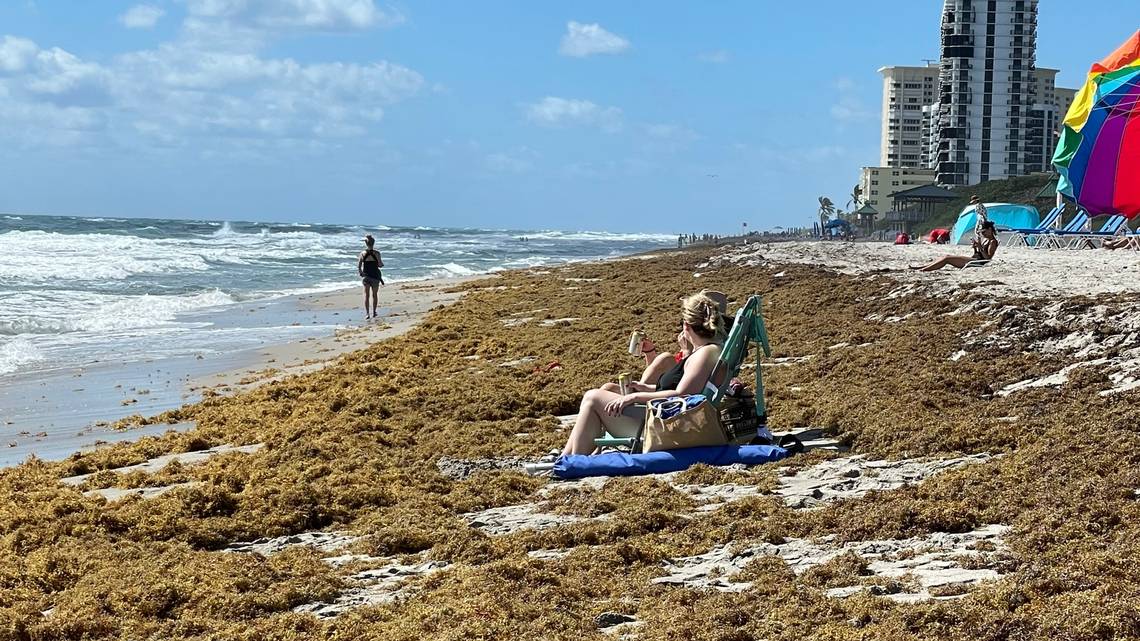
Governments and scientists deliberately fertilized sections of the ocean, cultivated massive quantities of seaweed and experimented with altering marine ecosystems in the years before an unprecedented Sargassum belt appeared across the Atlantic. There is no evidence that any of those projects caused the crisis—but history shows that manipulating the ocean can produce consequences nobody intended.
For generations, the floating brown seaweed known as Sargassum was associated primarily with the Sargasso Sea, an enormous region of the North Atlantic bounded not by land but by ocean currents.
Then something changed.
Beginning in 2011, enormous masses of Sargassum began appearing across the tropical Atlantic in quantities unlike anything recorded in the modern era. The phenomenon eventually became known as the Great Atlantic Sargassum Belt, a floating corridor of vegetation stretching thousands of miles from West Africa toward the Caribbean, Gulf of Mexico and the Americas.
By 2025, researchers estimated that the belt had exceeded 30 million metric tons, making it one of the most extraordinary biological transformations occurring anywhere in the world's oceans.
A floating belt of seaweed now stretches thousands of miles across the Atlantic, fouling beaches from West Africa to Mexico and Florida and imposing mounting costs on tourism, fisheries and coastal communities. Scientists have compelling natural explanations for its rise. But the history of deliberate ocean fertilization—and examples of human activity accidentally producing enormous algal blooms—raises a harder question: Have we been too quick to assume that human experimentation played no role at all?
Along Mexico’s Caribbean coast, the battle now begins before the seaweed reaches the beach.
Mexican authorities deploy collection vessels, barriers and heavy machinery. Hotels employ crews whose job is essentially to defend the shoreline. Bulldozers and tractors move through stretches of beach that tourists once associated almost exclusively with turquoise water and white sand. Offshore, containment systems attempt to intercept enormous brown mats before wind and current push them onto Cancún, Playa del Carmen, Tulum and the resorts of the Riviera Maya.
In 2026, Mexico was preparing for another record assault. Reuters reported in July that officials expected as much as 119,000 tons of Sargassum to reach the Caribbean coast of Quintana Roo during the year, eclipsing the approximately 96,000 tons collected the previous year. The state was estimated to be suffering roughly $2 billion a year in economic damage, while the Mexican Caribbean hotel industry reported spending approximately $150 million in 2024 alone fighting the seaweed.
The expense is not simply the cost of running a tractor down a beach every morning. Researchers studying Mexican resorts have estimated that hotels can spend roughly $300,000 to $1.1 million per kilometer of beachfront per yearremoving Sargassum and keeping beaches usable. The problem then continues after collection: the seaweed has to be transported somewhere and disposed of, often while mixed with sand, plastics and other debris.
And Mexico is only one piece of an enormous transatlantic problem.
What began appearing in unprecedented quantities in 2011 has developed into the Great Atlantic Sargassum Belt, a recurring floating ecosystem that can extend from the coast of West Africa across the tropical Atlantic, through the Caribbean and into the Gulf of Mexico. The Environmental Protection Agency says the belt has stretched more than 8,850 kilometers—about 5,500 miles.
By 2025, the numbers had become difficult to comprehend. University of South Florida satellite monitoring measured roughly 38 million metric tons of Sargassum across the Atlantic, Caribbean and Gulf in July 2025, smashing previous records. A 2026 study in Nature Communications concluded that the belt had surpassed 30 million tons during the year and noted that since 2018 it has routinely exceeded 20 million tons at its seasonal peak.
The record did not disappear the following year. NASA reported that 2026 became the second-largest Sargassum year in the satellite record, surpassed only by 2025. In June 2026 alone, researchers estimated approximately 9 million metric tons in the eastern Caribbean, 3.6 million tons in the western Caribbean and 5 million tons in the Gulf of Mexico, where the amount was nearly twice the previous record.
Those numbers describe vegetation floating offshore, not necessarily the amount that will ultimately land on a particular beach. Winds, currents and local geography determine where the worst strandings occur. But the scale explains why an ecological curiosity has become an international economic problem.
The World Bank says recurring Sargassum inundations now affect more than 20 countries, with cleanup expenses across the Caribbean alone exceeding an estimated $120 million annually.
The geography reads like a map of the Atlantic tourism and fishing economy.
Sargassum has reached the West African coastline from Senegal toward Nigeria, with especially serious inundations reported in places including Ghana and Sierra Leone. Across the Atlantic it has hit Trinidad and Tobago, Barbados, Grenada, Saint Lucia, Saint Vincent and the Grenadines, Jamaica, the Dominican Republic, Puerto Rico, the U.S. Virgin Islands, Martinique, Guadeloupe and the Lesser Antilles. It has reached Belize and Honduras, the Mexican Caribbean, the Florida Keys and Florida's southeast coast, with material also entering the Gulf and appearing along portions of Louisiana and Texas. NOAA says the post-2011 phenomenon has affected Florida, Puerto Rico, the Virgin Islands and most island and coastal areas of the Caribbean and western Africa.
For many of those places, the beach is not scenery. It is economic infrastructure.
Tourism contributes nearly half of GDP across parts of the Eastern Caribbean, according to the World Bank, while Caribbean tourism more broadly supports millions of jobs. Hotels, restaurants, charter-boat operators, dive shops, taxi drivers, beach vendors, marinas and fishing businesses ultimately depend on the same product: people wanting to be near the sea.
A shoreline buried beneath decomposing brown vegetation is a serious threat to that business model.
As Sargassum rots, bacteria consume it and produce hydrogen sulfide—the gas responsible for the familiar rotten-egg smell. Large accumulations can make beaches unpleasant or unusable and, at sufficient exposure levels, create health concerns. Offshore and nearshore mats can block sunlight, damage seagrass and coral ecosystems, reduce oxygen as they decompose and interfere with marine animals.
For hotels, the result can be cancellations and expensive cleanup. For fishermen, it can mean clogged nets, fouled propellers, inaccessible harbors and altered fish populations. For municipal governments, it means crews, trucks, excavators, disposal areas and an annual expense that barely existed 15 years ago.
The EPA says Miami-Dade County has estimated the cost of collecting, transporting and landfilling Sargassum at approximately $35 million per year. A NOAA-funded economic analysis published in 2025 found multimillion-dollar annual losses in Puerto Rico and the U.S. Virgin Islands and concluded that the economic effect along Florida's Atlantic coast could potentially reach billions of dollars when losses across tourism, recreation, fisheries and related sectors are considered.
Mexico offers perhaps the clearest indication that the damage extends beyond cleanup.
Researchers studying tourism-heavy areas of Quintana Roo found that the presence of Sargassum was associated with an estimated 11.6 percent reduction in local economic output in affected beach areas. Perhaps more troubling, the damage did not necessarily end when the beach was cleaned. The study detected effects extending as far as 12 months after Sargassum appeared, with estimated reductions in gross local product ranging from 5.9 to 9.9 percent, a possible consequence of lost visitors and reputational damage.
The fishing industry has its own warning signs. In Barbados, officials reported that the arrival of major Sargassum influxes coincided with flyingfish landings falling from 981 tons in 2014 to 278 tons in 2015—a 72 percent decline. That does not by itself prove Sargassum caused the entire drop, but for an island where flyingfish is both an important commercial species and practically a national symbol, the coincidence was alarming.
In West Africa, the consequences can be even more immediate. The United Nations Environment Programme has documented fishing communities where nets fill with Sargassum instead of fish and boat propellers become entangled. In Sierra Leone, officials warned years ago that reduced fishing catches were already rippling through households dependent on fish processing and sales.
This is what makes the central scientific mystery so consequential.
Where did all of this come from?
Before 2011, This Didn't Exist in Anything Like Its Present Form
Sargassum itself is not new.
Christopher Columbus wrote about floating vegetation in the Atlantic more than five centuries ago, and sailors have long encountered Sargassum in the Sargasso Sea. In the open ocean it is not inherently harmful. Far from it. Floating mats provide habitat and nursery grounds for fish, crabs, shrimp, sea turtles and other marine life.
What changed was the geography and the quantity.
Satellite records show the new tropical Atlantic belt emerging in 2011. Since then, enormous Sargassum accumulations have returned almost every year. The Great Atlantic Sargassum Belt became something different from the historic Sargasso Sea population: a vast seasonal system extending across the tropical Atlantic and feeding repeated strandings thousands of miles away.
Scientists now have increasingly persuasive explanations for how that happened, although important questions remain.
A major Nature Communications study published in April 2026 concluded that an unusually prolonged negative phase of the North Atlantic Oscillation around 2009 and 2010 altered winds and ocean circulation, helping shift Sargassum into tropical Atlantic waters. Once established there, the researchers found, the system increasingly became capable of recycling nutrients internally, helping the biomass sustain itself from year to year.
Another major paper, published in Nature Geoscience in late 2025, focused on nutrients. It found that phosphorus brought toward the surface by equatorial Atlantic upwelling can stimulate nitrogen-fixing organisms associated with Sargassum. Those organisms effectively provide the seaweed with additional usable nitrogen. The researchers concluded that the interaction between phosphorus supply and nitrogen fixation can explain a majority of Sargassum variability since 2011.
Then, in April 2026, researchers from the University of Miami and Florida State University published a study that complicated the origin story further.
Rather than tracing the first major tropical Atlantic bloom back exclusively toward the traditional Sargasso Sea population, their mathematical reconstruction pointed toward West Africa. Running ocean currents and winds backward, they identified coastal West African waters as the likely source region as much as two years before the first major bloom became obvious in satellite imagery.
When the model was taken back to early 2009, one of its strongest source probabilities appeared in the Gulf of Guinea near Cameroon and Nigeria. The finding was consistent with reports of unusual Sargassum strandings in Ghana in 2009.
The authors identified unusual natural conditions—including powerful upwelling associated with a Dakar Niña event and nutrient availability—as plausible reasons for that early growth.
That is currently evidence for a natural oceanographic mechanism, not for sabotage or an experiment.
But the West African finding raises an interesting historical question: What else was happening in the Atlantic in the years before this new ecosystem appeared?
The answer is that humans were already experimenting with deliberately altering ocean productivity.
We Were Fertilizing the Ocean
The term "ocean fertilization" sounds comparatively harmless. The reality is more radical.
Scientists learned that biological productivity in some enormous areas of the ocean is limited not because organisms lack sunlight or the major nutrients required for growth, but because they are missing tiny amounts of particular elements.
Iron is one of them.
Add iron to certain nutrient-rich but iron-poor ocean waters and phytoplankton can respond dramatically. The microscopic organisms multiply, photosynthesize and absorb carbon dioxide.
From that discovery emerged one of modern geoengineering's most seductive propositions: perhaps humans could deliberately fertilize the ocean, manufacture enormous phytoplankton blooms, allow part of that organic matter to sink into deep water and thereby remove carbon dioxide from the atmosphere.
The theory led to real experiments.
Scientists did not merely simulate fertilization in laboratories. Ships sailed into the open ocean and intentionally released nutrients into the sea.
More than a dozen major open-ocean iron-fertilization experiments have been carried out since the 1990s. Researchers demonstrated repeatedly that nutrient additions could substantially increase biological productivity, although the amount of carbon actually exported into deep water often fell far short of hopes.
Some of the experiments took place in the Atlantic.
In 2000, European researchers conducted EisenEx in the Atlantic sector of the Southern Ocean, adding iron to stimulate a phytoplankton bloom.
In 2004, another European project, EIFEX, deliberately fertilized Southern Ocean waters with iron and tracked the resulting biological response.
Then came an experiment that, viewed through the lens of today's Sargassum research, is particularly striking.
The Experiment West of the Canary Islands
In April and May 2004, Britain's Natural Environment Research Council funded the Phosphate and Iron Addition Experiment, known as FeeP.
Unlike the Antarctic experiments, FeeP took place in the subtropical North Atlantic, in international waters west of the Canary Islands.
Its purpose was straightforward: researchers wanted to know whether iron and phosphorus controlled biological productivity in this portion of the Atlantic.
They therefore added them to the ocean.
According to the British Oceanographic Data Centre, one experiment involved releasing 20 tonnes of anhydrous monosodium phosphate at a depth of approximately 10 meters across an area of about 25 square kilometers.
A second experiment was even more interesting. Researchers added approximately five tonnes of acidified iron sulfate, waited roughly a day, and then added another 20 tonnes of phosphate over the fertilized water.
The project monitored nitrogen fixation, phytoplankton growth, nutrient chemistry, grazing, bacterial production and numerous other biological changes.
There is no evidence that FeeP created the Great Atlantic Sargassum Belt. None.
It happened seven years before the 2011 bloom became visible on a basin-wide scale, it covered a minuscule area compared with the Atlantic Ocean, and the experiment was not designed to cultivate Sargassum.
Yet it is impossible to read the project's stated purpose today without noticing the parallel.
FeeP was explicitly designed to determine how the supply and interaction of iron and phosphorus control biological activity in the subtropical North Atlantic.
Two decades later, scientists investigating the largest floating macroalgal bloom on Earth concluded that phosphorus availability, in an Atlantic already receiving abundant iron from Saharan dust, helps drive nitrogen fixation associated with Sargassum.
That does not establish a connection between the two events.
It does establish something more basic and arguably more important: humans have intentionally experimented with precisely the nutrient controls now known to influence biological productivity in the Atlantic.
Six Tonnes of Iron in 2009
Another experiment came even closer to the critical 2009–2011 period.
In January 2009, 48 scientists aboard the German research vessel Polarstern departed Cape Town for the southwestern Atlantic sector of the Southern Ocean. Thirty of them were from India. Their Indo-German experiment was called LOHAFEX.
The researchers selected a roughly 300-square-kilometer patch of ocean and fertilized it with six tonnes of dissolved iron.
The purpose was to create a bloom.
As the Alfred Wegener Institute explained at the time, adding the iron was expected to produce rapid growth of phytoplankton and allow researchers to investigate whether such fertilization could ultimately increase the ocean's ability to remove carbon dioxide from the atmosphere.
The experiment worked biologically, but not quite as envisioned climatically. Phytoplankton increased, but grazing zooplankton consumed much of it. The hoped-for carbon export was limited.
LOHAFEX is an even less plausible direct source of tropical Atlantic Sargassum than FeeP because it occurred far to the south, in the Southern Ocean.
But it illustrates the larger point.
At precisely the moment when the Atlantic was approaching a biological transition scientists are still trying to reconstruct, governments and research institutions were conducting deliberate ecosystem-manipulation experiments at sea.
And regulators were becoming nervous about where the practice might lead.
Governments Became Worried Enough to Restrict It
By 2007, ocean fertilization was moving beyond academic research.
A private company called Planktos announced plans for a large iron-fertilization project near the Galápagos, generating enough controversy that the International Maritime Organization began addressing ocean fertilization formally.
The concern was not imaginary.
In October 2008, the parties to the London Convention and London Protocol adopted a resolution declaring that knowledge of ocean fertilization's effectiveness and environmental consequences was insufficient to justify activities other than legitimate scientific research. Governments agreed that other ocean-fertilization activities should not be allowed.
The international debate was already contemplating more than iron. Regulators specifically considered fertilization involving nitrogen or phosphorus compounds, along with techniques designed to bring nutrient-rich deep water artificially to the ocean surface.
Today, the IMO continues to identify ocean fertilization, artificial upwelling, macroalgae cultivation and other marine geoengineering methods as activities capable of causing potentially widespread, long-lasting or severe effects on the marine environment.
There is a reason for that caution.
It is very easy to describe an experiment by the amount of material poured off the side of a ship. It is much harder to describe the biological chain reaction that follows.
Five Thousand Tons Became More Than a Million
For perhaps the clearest demonstration, leave the Atlantic for a moment and go to China.
In 2008, a giant green mass appeared in the Yellow Sea shortly before the Olympic sailing competition in Qingdao. Cleanup crews ultimately removed roughly one million tonnes of algae from the coast.
The bloom was Ulva prolifera, not Sargassum.
But subsequent research produced an extraordinary explanation for how the event became so large.
Along the Jiangsu coast, farmers were operating more than 20,000 hectares of Porphyra seaweed aquaculture. Ulvagrew as a fouling organism on those aquaculture structures. During harvesting and cleaning, researchers estimated that about 5,000 tonnes of Ulva biomass could be released into coastal waters.
Currents carried it away.
The water contained abundant nutrients. Temperatures were favorable. The organism grew rapidly and reproduced efficiently.
According to peer-reviewed research on the bloom, those roughly 5,000 tonnes of starting biomass were capable of expanding to more than one million tonnes in approximately two months.
The following year, it happened again.
Researchers found no major oceanographic change sufficient to explain why such enormous blooms had suddenly appeared. Their conclusion implicated a combination of large-scale aquaculture, nutrient pollution, currents, favorable temperature and the biology of the algae itself.
The Chinese green tide has no demonstrated connection to Atlantic Sargassum. It involved another ocean, another species and another set of conditions.
But it destroys one comforting assumption: that a human disturbance must be enormous at the beginning in order to produce an enormous biological event at the end.
It doesn't.
Biology amplifies.
Five thousand tonnes became more than a million.
That is the principle that should matter whenever anyone proposes deliberately manipulating a marine ecosystem.
Fertilization Does Not Necessarily Grow What You Want
The risks extend beyond producing too much biomass.
When scientists add a nutrient to the ocean, they are not operating a factory in which only the desired organism responds. They are altering competition among thousands of organisms occupying the same ecosystem.
Sometimes the winners are unexpected.
A National Academies review concluded that extensive iron fertilization could alter marine food webs and fisheries, change nutrient availability in downstream regions and shift plankton communities in ways whose effects on fish, seabirds and marine mammals remain poorly understood.
One particularly disturbing example involves Pseudo-nitzschia, a genus of diatoms containing species capable of producing domoic acid, a potent neurotoxin associated with harmful algal blooms.
Researchers examining waters from previous iron-fertilization experiments detected substantial concentrations of domoic acid associated with Pseudo-nitzschia. In samples from one experiment, concentrations approached levels that have been associated with animal mortality in coastal waters.
Other potential consequences of ocean fertilization include oxygen depletion as additional organic matter decays, alteration of marine food webs, shifts in nutrient availability and increased production of greenhouse gases such as nitrous oxide.
That does not make scientific experimentation inherently irresponsible. Controlled experiments have taught researchers enormously important things about how the ocean works.
It does mean that nobody can credibly argue that dumping nutrients into the sea is biologically trivial.
The entire purpose is to change what grows there.
So Did an Experiment Cause the Sargassum Explosion?
There is no evidence at present that FeeP, LOHAFEX, EisenEx, EIFEX or another known ocean-fertilization experiment created the Great Atlantic Sargassum Belt.
There is also no credible evidence that China, Russia or another government intentionally engineered Sargassum as an economic weapon against the United States or Caribbean nations.
Those conclusions matter.
A serious investigation should not begin by selecting a culprit and then arranging facts around the accusation.
But the opposite mistake would be to declare human involvement impossible simply because no direct connection has yet been demonstrated.
Science is still reconstructing the origin of a biological event that began only 15 years ago and now produces tens of millions of tonnes of floating biomass annually.
The newest research itself demonstrates how much remains unsettled. One recent study emphasizes movement from the Sargasso Sea following unusual 2009–2010 atmospheric conditions. Another reconstructs the earliest bloom toward coastal West Africa and the Gulf of Guinea. Researchers continue debating the relative contributions of ocean circulation, upwelling, phosphorus, nitrogen fixation, nutrient recycling, river discharge and other processes.
That leaves a legitimate investigative gap.
What Happened Along West Africa Before 2011?
The new West African origin research makes the period between roughly 2007 and 2011 particularly important.
If the earliest population capable of generating the Great Atlantic Sargassum Belt developed near West Africa, then understanding everything that happened in those waters during the years immediately before the explosion should be a scientific priority.
That means cataloguing not merely known geoengineering experiments but aquaculture operations, marine research cruises, industrial discharges, coastal fertilizer runoff, sewage inputs, dredging, mining-related discharges, agricultural expansion and foreign-funded oceanographic projects.
It means examining activities from Senegal and Guinea south toward Ghana, Nigeria, Cameroon and the Gulf of Guinea.
It means asking whether any experimental algae cultivation occurred there; whether any nutrient-addition projects were conducted but poorly documented internationally; whether coastal development altered nitrogen or phosphorus inputs; and whether unusual marine operations coincided with the first reports of Sargassum in Ghana around 2009.
The answer may very well be no.
Natural upwelling and atmospheric conditions may turn out to explain the entire event.
But considering the economic damage now being inflicted from West Africa to Florida, looking carefully should not be controversial.
The Ocean Has No Laboratory Walls
That is ultimately the uncomfortable lesson buried inside the Sargassum story.
A laboratory experiment usually has boundaries. An ocean experiment does not.
Currents move water thousands of miles. Organisms reproduce. Nutrients are consumed, recycled and transported. One biological community feeds another. Dead organisms sink and alter deeper waters. Floating vegetation moves between countries that never consented to whatever happened upstream.
Scientists conducting FeeP did not dump millions of tonnes of material into the Atlantic. They added tens of tonnes of nutrients to carefully selected patches so they could study what happened next.
That distinction is important.
But the reason those experiments worked at all was that small chemical interventions can produce biological responses vastly larger than the quantity of material introduced.
China's Yellow Sea provided the dramatic real-world corollary: an aquaculture-associated release measured in thousands of tonnes contributed to a bloom that grew beyond a million tonnes in a matter of months.
The Atlantic now contains something larger still.
The Great Atlantic Sargassum Belt has grown into what researchers describe as the world's largest interconnected floating biome. It can stretch more than 5,000 miles. In 2025 its biomass approached 38 million metric tons. In 2026, the second-largest year on record, communities from the Lesser Antilles to Florida and Mexico were again digging themselves out.
The affected nations will spend hundreds of millions cleaning it up. Businesses will lose customers. Fishermen will lose days at sea. Hotels will protect beaches with barriers and excavators. Governments will search for places to dispose of mountains of decaying vegetation.
And scientists will continue trying to determine why an ecosystem that did not exist in its present form before 2011 suddenly became a permanent feature of the Atlantic.
There is no evidence that a foreign government intentionally caused that transformation.
There is no evidence that one of the known fertilization experiments caused it accidentally.
There is, however, abundant evidence that human beings know how to manipulate ocean productivity, that governments and organizations were doing exactly that before the Sargassum era began, that nutrient enrichment can create enormous and sometimes unexpected biological responses, and that human activity has already helped produce runaway macroalgal blooms elsewhere.
Those facts do not solve the mystery.
They make the mystery worth investigating.
As governments and private companies again contemplate ocean fertilization, giant seaweed farms, artificial upwelling and other forms of marine geoengineering as tools against climate change, the Atlantic should impose a basic burden of proof: before deliberately changing an ocean ecosystem, we ought to understand much more clearly how difficult it may be to change it back.
Because the most consequential environmental experiment may not be the one that fails.
It may be the one that succeeds beyond anyone's expectations.