


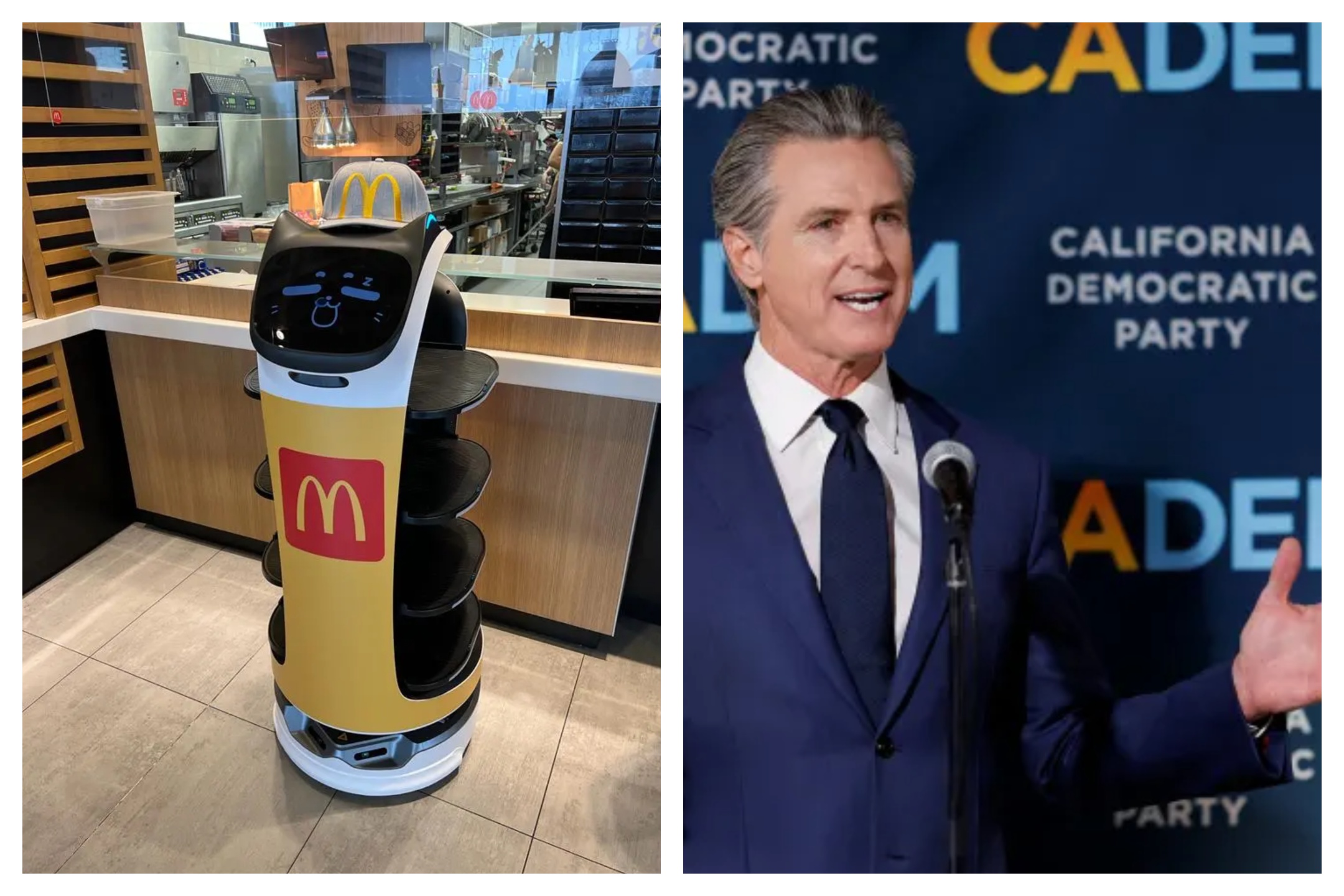
California’s minimum wage hike for fast food workers isn’t exactly having its intended results.
The law, which went into effect in early 2024, requires that fast-food companies pay their workers a minimum of $20.00 an hour. Two years later, a University of California, Santa Cruz study has shown that in response, fast-food employers have reduced employee hours and cut overtime. In addition, locally-owned restaurants experienced pressure to increase wages and raise costs to compensate.
Those results are not surprising, but one other impact is new: fast-food companies like McDonald’s have also responded by attempting to automate away the need for workers. According to the UC Santa Cruz analysis, “Automation, such as order kiosks, mobile apps, Artificial Intelligence drive-through ordering systems, as well as other innovative assembly technologies, are being tested and implemented with the goal to reduce labor requirements.”
Of course, as long as companies had the opportunity to replace workers with touchscreen ordering automation, they were going to do so. An increased minimum wage simply accelerated the move in this direction.
The results of the minimum wage hike, though, haven’t caused any reevaluation among California Democrats. Alameda County, for instance, is proposing a raise in their minimum wage to $30.00 an hour. Since the end of 2025, a coalition of unions and community organizations in Los Angeles began to collect signatures that would raise the city’s minimum wage to $30.00 an hour as well.
California, and the San Francisco Bay Area in particular, famously has some of the highest cost of living in the country. The question is whether the Democratic Party has any novel ideas besides minimum wage hikes, and performative handwringing about supposedly inevitable automation. The evidence appears to be no, although vehicle automation has split the Democratic candidates in the gubernatorial election, with Rep. Katie Porter backing a ban on most automated deliveries.
That split, if it results in anything beyond rhetoric, will prove more determinative of California Democrats’ future than a rehash of the minimum wage debate. To the extent that working-class and service-sector members of the Democratic coalition still have pull in the state’s politics, the specter of entire sectors being automated away will prove much more existential than how much those jobs should pay.
