In 2025, Steve Bannon repeatedly advocated for the full public release of the Jeffrey Epstein files, portraying it as a necessary step to expose “deep state” corruption and elite cover-ups. He called for a special prosecutor or independent review in interviews and public statements, framing the documents as a tool to unlock broader institutional accountability—while appearing, in hindsight, to function almost as a double agent: projecting unwavering public loyalty to Trump even as private texts later revealed a more complicated dynamic, including exchanges that mocked Trump.
The massive disclosures Steve Bannon promoted, backfired, spotlighting his own deep ties to Jeffrey Epstein. The U.S. Department of Justice's January 30, 2026 release—under the Epstein Files Transparency Act signed by President Trump on November 19, 2025—included nearly 3.5 million pages of records, with hundreds of 2018–2019 texts/emails between Bannon and Epstein on politics, travel, and media, plus a video interview Bannon conducted with him.
These revelations starkly contrast Bannon's public calls for transparency with his compromising relationship to one of history's most notorious convicted sex offenders. These ties go far beyond casual acquaintance—the documents portray a deep, ongoing partnership during Trump's first term, with Bannon providing advice on image rehabilitation and Epstein facilitating introductions and logistical support as Bannon advanced his nationalist agenda.
In one chilling exchange captured on video, Bannon questioned Epstein about his sex offender classification in a mock-serious tone: “What are you, class three sexual predator?” Epstein replied that he was “tier one,” clarifying that tier one was “the lowest” level (not the highest), to which Bannon accepted the correction and continued the conversation without strong condemnation. This moment underscored their casual familiarity and the lack of serious pushback from Bannon.
Private text exchanges from the Epstein files reveal a sharply critical view of Trump that contrasts with Bannon's public image as one of his most staunch defenders. In one exchange, Epstein joked that Donald Trump Jr. had called his father a "regifter," but suggested "re grifter" would be more accurate, prompting Bannon to reply "Brilliant."
Other messages show Bannon sarcastically referring to Trump as "out of gas" in reference to an Axios report on his schedule.
In a December 30, 2018 - January 1, 2019 text, Bannon agreed Trump was "beyond borderline" unfit for office and suggested invoking the 25th Amendment to remove him.
The files show he conducted over 15 hours of interviews with Epstein, aiming to rehabilitate the financier's image from convicted sex offender to philanthropist. In one text chain from April 5, 2019, Bannon writes: "We need to work around your 38—first we need to push back on the lies; then crush the pedo/trafficking narrative; then rebuild your image as a philanthropist." Epstein defends his actions by claiming girls lied about their ages, and Bannon engages without pushback, pushing for "face to face" meetings to advance their plans.
In his 2021 book Too Famous, journalist Michael Wolff—citing firsthand observations, transcripts, and materials—reports that Bannon provided Epstein with extensive media training and image advice in 2018–2019, including coaching him to appear "engaging," "friendly," "sympathetic," and not "creepy" in potential interviews. Bannon later described the project as an exposé, but the footage aligns with rehabilitation efforts.
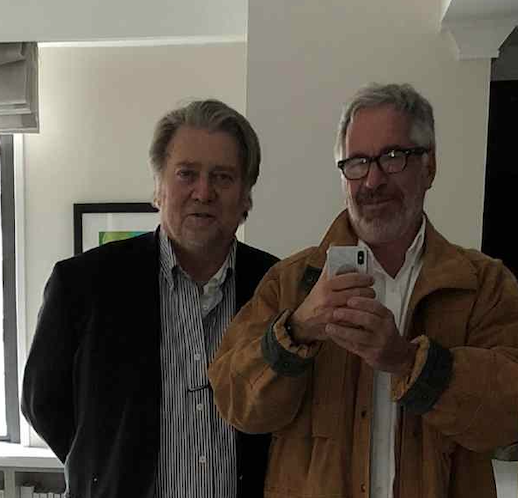
Photographic evidence in the files include images of Bannon and Epstein together, such as one in a luxurious office with Bannon gesturing animatedly across a desk, and a mirror selfie capturing their personal rapport—visuals that contradict claims of limited interaction.
Another selfie-style photo in a mirror depicts Bannon and Epstein standing side by side in a modern apartment, with Bannon holding a phone to capture the moment. Such visuals from the Epstein estate, released by the House Oversight Committee, contradict Bannon's claims of limited interaction and highlight his willingness to associate closely with someone whose scandals could taint Trump.
The files also detail logistical favors, such as Epstein offering his private plane and accommodations to Bannon, including stays in Paris and Palm Beach. In a March 29, 2019 text, Bannon asks if Epstein's plane can pick him up in Rome, with Epstein replying affirmatively and inviting him for dinner in France.
In late 2018 or early 2019, Jeffrey Epstein gifted Steve Bannon a luxury Hermès-branded Apple Watch, a premium high-end model with a 44 mm space gray stainless steel case and space black details, retailing for around $1,499 at the time (far exceeding standard Apple Watch prices).
A curious detail from the files: In a November 20, 2018 email, an Epstein associate asked, "Shall we purchase the Hermes Apple watch and Hermes bands for both Steve and Sean Bannon? (this would be the top of the line. The face of the watch says 'Hermes Paris') $1499 each," to which Epstein mysteriously replied "no."
Despite Epstein's "no" response to purchasing matching Hermès versions for both Steve and Sean in November 2018, he proceeded with the gift. Lesley Groff coordinated the FedEx delivery to Bannon in Washington, D.C., emailing tracking details and confirming the package was left at his door on January 10, 2019. Sean replied that while he was still on the West Coast, "my colleague got it!"—verifying Steve received the Apple Watch.
This expensive gesture fit Epstein's pattern of providing lavish items to those in his circle, further illustrating the intimate ties shown in hundreds of their 2018–2019 texts and emails. The revelation has amplified conversations about the true extent of their closeness, particularly in light of Bannon's subsequent push for transparency regarding the Epstein case.
Bannon has faced backlash from his fan base, with many expressing outrage over his hidden close ties to Epstein—including texts, a planned image-rehab documentary, after he pushed hard for file releases without disclosing his own deep involvement.
In February 2025, Steve Bannon plead guilty to felony fraud for scheming to defraud donors in the "We Build the Wall" campaign, a disgraced effort that coincided precisely with his documented close friendship with Jeffrey Epstein. The overlap highlights the irony for his supporters.
From 2018 through mid-2019, while Bannon chaired the privately funded border wall project, promoted it as a patriotic cause, and managed fundraising that resulted in fraud charges and his guilty plea (with a three-year conditional discharge and no prison time), he maintained thousands of friendly texts and emails with Epstein.
In one 2019 iMessage exchange, Bannon discusses keeping a secret meeting "in the closet" while on-site with Kris Kobach and Brian Kolfage for the project. They timed construction over Memorial Day weekend to build a private border wall section near El Paso quietly, and he noted he didn't want it to highlight Trump's "incompetence" on the border.
Ultimately, the Epstein file drop, signed into law by President Trump himself in November 2025, has inadvertently spotlighted Bannon's apparent disloyalty and self-interest. What was intended as a transparency triumph has instead become a profound political embarrassment.
As more details emerge and public spotlight intensifies, the episode raises enduring questions about trust, hidden alliances, and the true cost of weaponizing transparency in an era of elite entanglements. Whether driven by deliberate sabotage, opportunistic maneuvering, or simple hypocrisy, Bannon's role in this saga has left his credibility, and the movement he helped shape, irreparably damaged.