


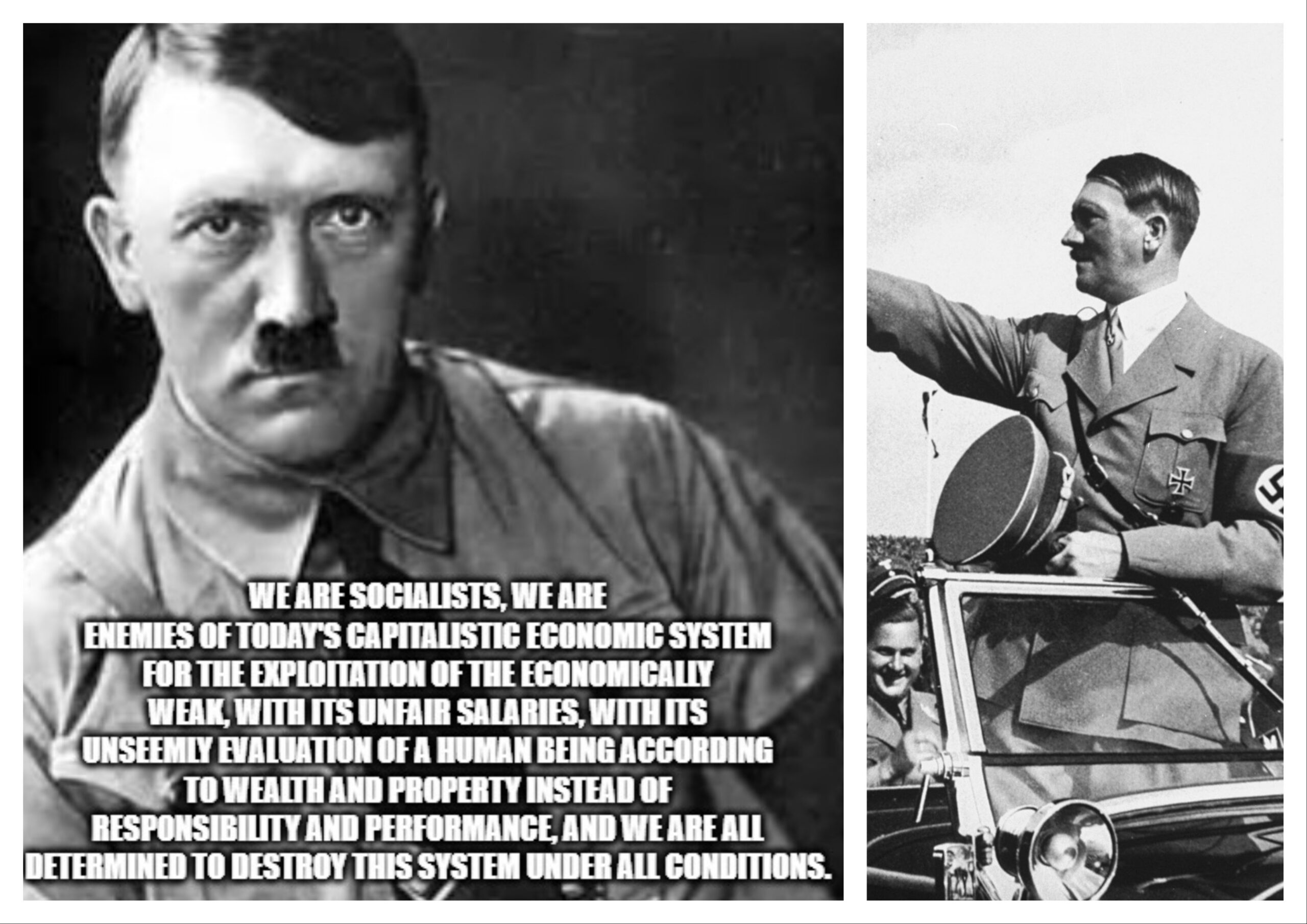
Recently, Twitter/X Owner Elon Musk caused much controversy when he called Hitler a Socialist.
What Is Socialism?
The term socialism always seems to change. Whenever a state embraces Socialism, and the inevitable death camps, mass starvation, and loss of freedom ensues, Socialists always attempt to redefine socialism so that they can claim “That wasn’t *real* socialism! But *my* version of socialism will actually work!”
It’s an argument we hear so consistently, the “No True Scotsman” fallacy might as well be the “Not True Socialism” fallacy.
In 2026, the term “socialism” is often conflated with Marxist Socialism, which is but one specific flavor of socialism. Socialism as a whole pre-dates Marxism: it originated in the late 18th century around the time of the French Revolution. The first socialists were Utopian socialists, who advocated for voluntary communes and moral improvement. There were many other flavors of socialism, ranging from Christian Socialism (Christian ethics with socialist ideas), Anarchist Socialism (rejection of the state entirely in favor of worker cooperatives), State Socialism (Top-down social reforms with a massive welfare state), and at least a half dozen others.
Marxist socialism is a specific type of socialism that emphasizes class struggle, historical materialism, inevitable revolution, and dictatorship of the proletariat.
The common themes through all forms of socialism are:
Anti-Capitalism – All forms of socialism are generally not friendly to private enterprise, ranging from heavy regulation to outright nationalization.
Anti-Economic Liberalism: Most forms of socialism oppose economic liberalism, which means free markets and free enterprise.
Restriction of Private Property – Socialism often heavily restricts or abolishes private property. Even when permitted, it is often viewed as a privilege rather than a right.
National Socialism
The term “Nazi” is short for National Socialism. Many left-wing academics use all kinds of mental and academic gymnastics to try to deny that National Socialism was a form of socialism, often calling it “corporatism” or “crony capitalism.”
First, we must establish that the National Socialists had extreme forms of state control of the economy. How the Nazis controlled the economy could be a 1,200-page book by itself, but to summarize, the Nazis did not directly take ownership of private businesses in the Third Reich. Rather, they exercised informal control through threats, coercion, and even the promise of massive profits to prevent business owners from exercising true control of their businesses.
Gunter Reimann, who was ironically a German Communist, goes into detail in his book “The Vampire Economy” about the numerous ways in which the Nazis controlled the economy. From price-fixing to controlling the supply of materials to the formation of a state-controlled labor union, the National Socialists exercised broad control over private enterprise, while allowing business owners the illusion that they still owned their businesses. These business owners were permitted to have profit, at times even massive profit, so long as they obeyed their Reichskommissars’ instructions.
The National Socialists also abolished the right of private property. In the Reichstag Fire Decree, Article 153 of the Weimar Constitution was abolished. Private property went from being an inalienable right to being a conditional privilege granted by the state that could be confiscated at any moment without due process. “Property” that can be confiscated arbitrarily is not actually “private property.”
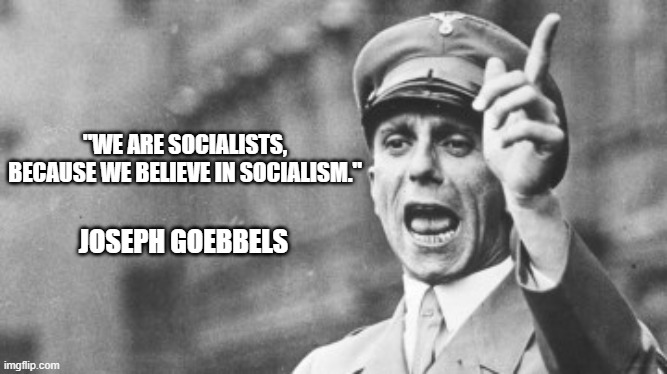
The Nazi leaders, both publicly and privately, espoused Socialism and anti-capitalism. Here is a list of many of the quotes. Examples include:
“Socialism is the ideology of the future.”
“England is a capitalist democracy. Germany is a socialist people’s state.”
“To be a socialist is to submit the I to the thou; socialism is sacrificing the individual to the whole. Socialism is in its deepest sense service.”
But what was really at the heart of German National-type Socialism? Certainly, they exercised state control of private enterprise and the economy. But, those were merely means to an end. What National Socialism sought to achieve was to *redistribute the means of production along racial lines, instead of class lines.*
Whereas Marxist Socialism sought to redistribute the “means of production” along *class* lines, National Socialism sought to redistribute the means of production along *racial* lines. If you were a “racially pure” ethnic German, then you were one of the “volk” or “people” who were supposed to benefit from this Socialist redistribution. It was “class socialism” vs “race socialism”, which is why the National Socialists sought to take support from the Class Socialists (Marxists). The end was still the same: the redistribution of the “means of production.”
The Denialist Arguments
Not surprisingly, the modern left has attempted to claim that the National Socialists were not socialists. The main argument from the left is that the Nazis used Socialist rhetoric as a “smoke screen” to cover for their capitalist beliefs. Further, they often cite a paper, “The Role of Private Property in the Nazi Economy: The Case of Industry,” by Christoph Buchheim and Jonas Scherner, as evidence that the Nazis were not socialists.
The Nazis’ control over private enterprise was not an illusion. This illustration from Reimann’s “The Vampire Economy” shows the process a German auto manufacturer had to follow to obtain rubber for tires.
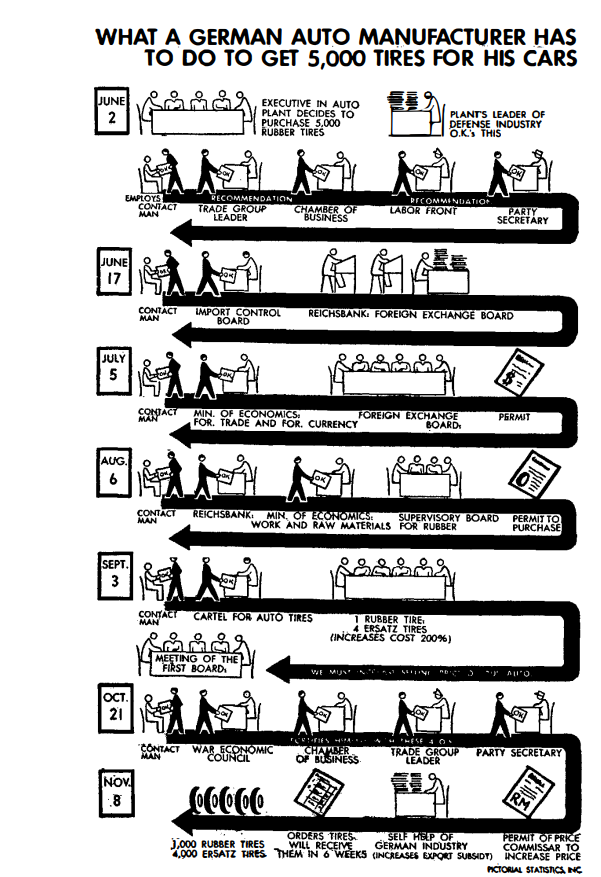
Second, leftists often cite the Buchheim/Scherner paper as evidence that the Nazis were not socialists. In the paper “The Role of Private Property in the Nazi Economy,” Buchheim and Scherner successfully show that, in some aspects, the National Socialists didn’t exert complete control over private enterprise the way the Soviet Union did. This is a fair argument, but nobody is arguing that National Socialism was the same as Marxist Socialism. It is fair to say that, in some ways, there was freedom of contract and private owners could devise their own production and investment profiles. Yet prices were strictly controlled, and they needed state permission to do a host of other things, including changing employee wages.
However, if we use the definition of being “not socialism” as “private enterprise still had some degree of freedom,” then we also have to rule out various other forms of socialism as being “socialism.” For example, “State Socialism” under German Chancellor Otto von Bismarck in the late 19th century is still called “socialism” even by left-wing academics. State Socialism emphasized massive welfare programs, but still had private enterprise.
Further, “Democratic Socialism” or “Social Democracy,” which many leftists themselves claim is “true” socialism, would not qualify as socialism under this standard. Social Democracy outright uses capitalism to fund social programs to reduce the perceived harm of capitalism. Various forms of “Democratic” socialism have differing positions on private property, ranging from mildly tolerant to the outright nationalization of every industry.
For example, Tony Blair famously fought to redefine the British Labour Party in the 1990s by removing its traditional commitment to the state nationalization of industry (the famous Clause IV), choosing instead to combine ‘the enterprise of the market’ with social programs. If the modern Left accepts Tony Blair’s heavily market-reliant ‘Third Way’ as a valid evolution of democratic socialism, they cannot logically disqualify National Socialism on the grounds that it tolerated private enterprise.
“The Labour Party is a democratic socialist party. It believes that by the strength of our common endeavour we achieve more than we achieve alone… to create for each of us the means to realise our true potential and for all of us a community in which power, wealth and opportunity are in the hands of the many, not the few…”
The “True” Socialism Debate
Denying that National Socialism was a form of socialism is really just another form of the “Not True Socialism” arguments that Socialists always bring out whenever one particular form of socialism fails and leads to authoritarian/totalitarian dystopia. Leftists routinely argue that National Socialism wasn’t socialism because Germany had private businesses (under heavy state control) that still had at least some limited forms of autonomy, while ignoring the fact that the Nazis exercised more state control of private enterprise than other academically accepted forms of socialism, including State Socialism, Social Democracy, and some forms of “Democratic” Socialism.
There have been many forms of socialism throughout history, dating back to the 18th century. Every single one of these forms of Socialism had its own definition of “Socialism” and insisted on its own definition of what “true” socialism was. National Socialism was no different, and attempts to distance National Socialism from being a form of Socialism are merely a different flavor of the “Not True Socialism” excuses we always hear when yet another socialist state fails.
