A 69-year-old Army veteran who proudly flew American flags and supported former President Donald Trump has died after a brutal, daylight beating outside his own home—an attack that is fueling outrage and raising serious questions about political hostility in America.
PKerry Sheron succumbed to his injuries Sunday after days in critical condition. What began as an alleged assault case is now rapidly escalating into a potential murder prosecution.
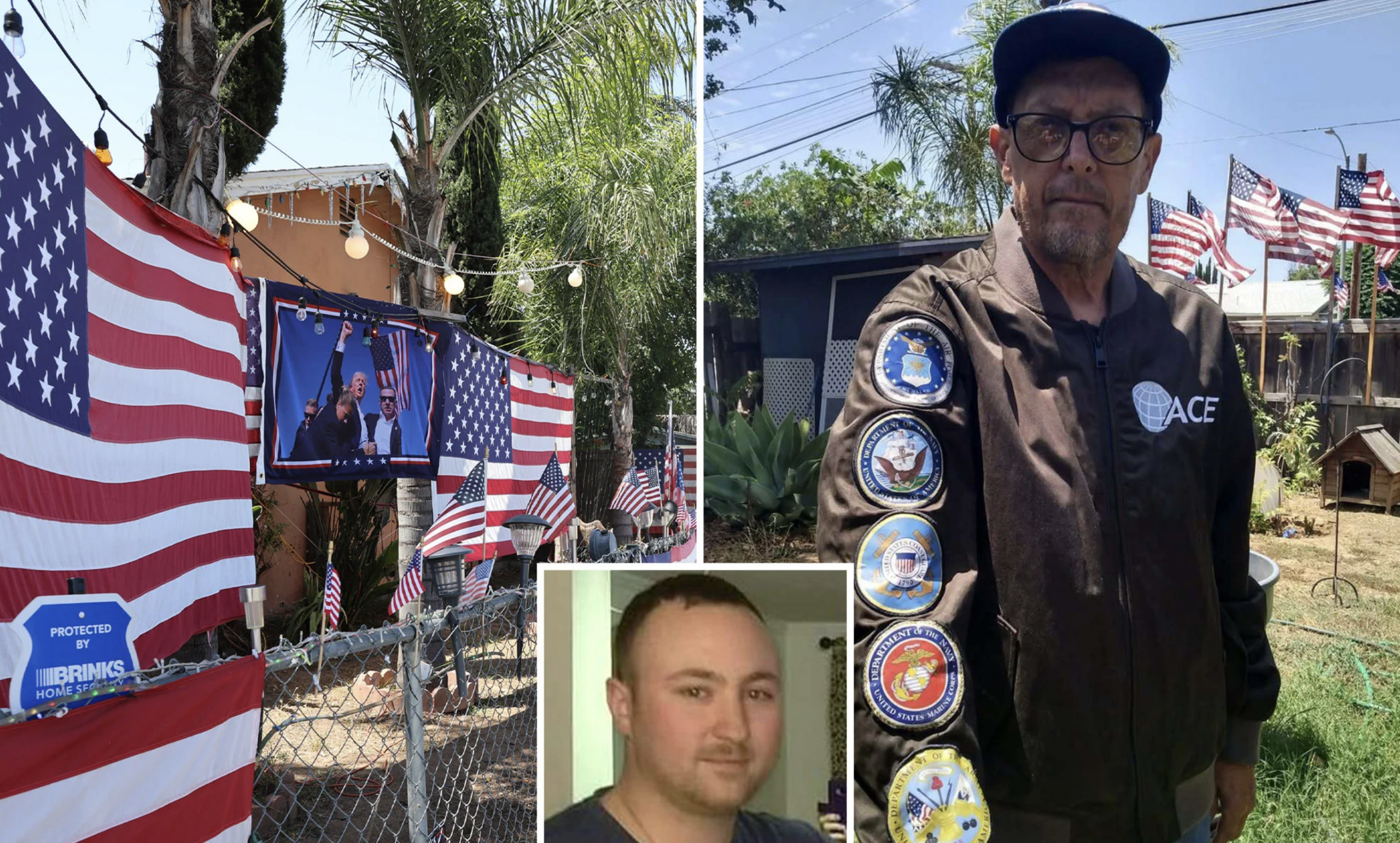
Sheron’s home—widely known as the “Trump House”—had become a symbol of unapologetic patriotism in his Escondido neighborhood. Covered in American flags and pro-Trump banners, it stood out—and not always in a good way.
For years, the property had been targeted. Sheron had previously documented vandalism, including torn flags and damaged displays, pointing to a pattern of hostility tied to his political expression.
The attack itself was swift and devastating. Police say Sheron was confronted outside his home in broad daylight, in what prosecutors described as an unprovoked act of violence.
Deputy District Attorney Ross Garcia laid out the sequence in court. Sheron was struck in the jaw with a single punch, knocked to the ground, and then beaten further while defenseless.
“It was a single punch to the jaw,” Garcia said, adding that multiple blows to the head followed as Sheron lay on the pavement. The injuries, prosecutors said, were catastrophic from the start.
When officers arrived, they found Sheron gravely wounded. A bystander who attempted to intervene was also injured, underscoring the intensity of the attack.
Authorities identified the suspect as 32-year-old Thomas Caleb Butler, a Navy veteran. He was arrested nearby shortly after the incident without resistance.
Butler has been charged with attempted murder and other serious offenses. Following Sheron’s death, prosecutors are now moving to upgrade those charges—potentially to murder.
Officials have not confirmed a motive. They say it remains unclear whether the suspect and victim knew each other.
But for many, the broader context is impossible to ignore. Sheron’s home had long been a lightning rod, drawing attention precisely because of its overt political messaging.
His wife, Maria Garcia, has been blunt in her assessment. “He tried to kill my husband,” she said, describing the attack as driven by hate.
“They don’t like the flags,” she added. “I don’t know why. I support America. My husband is a veteran.”
In the days after the attack, Sheron’s condition deteriorated rapidly. Doctors warned there was little chance of survival due to severe brain trauma.
Garcia told reporters there was “no hope.” The family began preparing for the worst as Sheron remained on life support.
Images from the hospital showed the extent of the damage—Sheron bruised, bandaged, and connected to machines. The photos quickly spread, amplifying public reaction.
Meanwhile, details about the suspect have raised additional questions. A friend told local media that Butler had been struggling with severe PTSD and worsening paranoia.
“He thinks everyone is coming to get him,” the friend reportedly said, describing a man who had become increasingly unstable.
Despite treatment, his condition had reportedly deteriorated in recent months. Authorities have not confirmed whether mental health played a direct role in the attack.
The killing has shaken the local community. Neighbors described the incident as shocking and deeply unsettling for an otherwise quiet residential area.
In the aftermath, supporters gathered outside Sheron’s home. They left flowers, flags, and handwritten messages, turning the site into a powerful symbol of grief and defiance.
For many, Sheron’s death is more than a local tragedy. It has become a flashpoint in a broader national debate about safety, political expression, and rising tensions.
The idea that a veteran could be beaten to death outside his own home has struck a nerve. It has intensified concerns about whether Americans can openly express their beliefs without fear of violence.
As prosecutors prepare to pursue upgraded charges, the legal case will move forward. But the deeper questions raised by this killing—about division, hostility, and the limits of tolerance—are unlikely to fade.