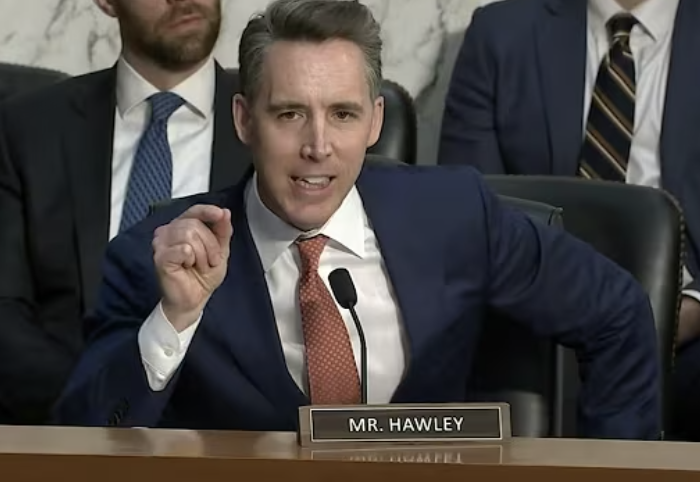
Sen. Josh Hawley (R-MO) is demanding that Republicans turn away campaign contributions from artificial intelligence companies. The senator argues that these firms are purchasing influence over legislators who ought to be defending the interests of working Americans.
Speaking with the Financial Times, Hawley urged his colleagues to reject donations from political action committees bankrolled by the founders of OpenAI, Palantir, and Meta.
"These people want something in exchange for [their financial support], and it's not just access," Hawley declared. "They want you to toe the line on their agenda. They want to spin to get influence. And I think that we need to be in the business, we Republicans . . . of putting people first."
Multiple Super PACs have emerged in recent months to back candidates who oppose strict oversight of artificial intelligence. Leading The Future, the largest among them, has collected $50 million from Andreessen Horowitz and an additional $25 million from OpenAI president Greg Brockman and his wife. The organization claims total commitments of $140 million. Another PAC supported by Anthropic says it expects to raise $75 million for candidates who favor tighter rules.
These massive fundraising totals have already spooked some Democrats. The Financial Times reported that senior party consultants have advised candidates against provoking the AI lobby ahead of the November midterms.
Sen. Bernie Sanders (I-VT) condemned that silence as "unacceptable." Writing on X, Sanders stated, "Democrats must get Super Pacs out of their primaries. We must have the courage to take on the AI oligarchs." Rep. Alexandria Ocasio Cortez (D-NY) has likewise urged candidates to refuse all AI money.
Hawley, a loyal Trump ally, warned that inaction on AI would come at the "cost of children who are introduced to self-harm" along with economic strain from surging electricity prices. "When there's a human cost, there will be a political cost," he cautioned.
The senator split with the Trump administration last year by opposing a proposed federal ban on state AI regulations. Industry groups and presidential AI adviser David Sacks had pushed aggressively for that ban. After reports of children harming themselves or dying by suicide following prolonged interactions with AI chatbots, Hawley introduced legislation in October to bar companies from providing chatbots to minors.
The White House called on Congress in March to enact basic child safety and content standards but has simultaneously pressured Republican lawmakers in Utah and Missouri to abandon state level bills. The administration has even threatened to withhold federal funding from states that proceed.
"This is something I've talked to the president about directly on more than one occasion," Hawley said regarding state initiatives. "It is vital that we allow that important work to go forward. To say that . . . we're not going to do anything federally, but we want to stop the states from doing anything at all . . . is a mistake, and I've consistently opposed that."
Hawley attributed congressional paralysis to the technology lobby's reach. "I'm worried that the Senate's behaving more like there's a sign on the door that says 'Property of Big Tech' . . . it is time to change that."
Without legislation, Hawley expressed doubt about the future. "I don't have any confidence that this technology will just magically evolve in a way that is pro-worker and pro-family," he said. "I think it will evolve in a way that benefits the billionaires who control it, and will be severely detrimental potentially to just about everybody else."
Hawley has identified a genuine threat. Artificial intelligence development cannot proceed according to the preferences of Silicon Valley billionaires whose priorities differ fundamentally from those of American families and workers. Neither prohibition nor unrestrained deregulation offers a path forward. The answer lies in thoughtful oversight that channels this technology toward the national interest and away from corporate exploitation. Achieving that requires elected officials who will decline tech industry donations and place their constituents above their campaign accounts.