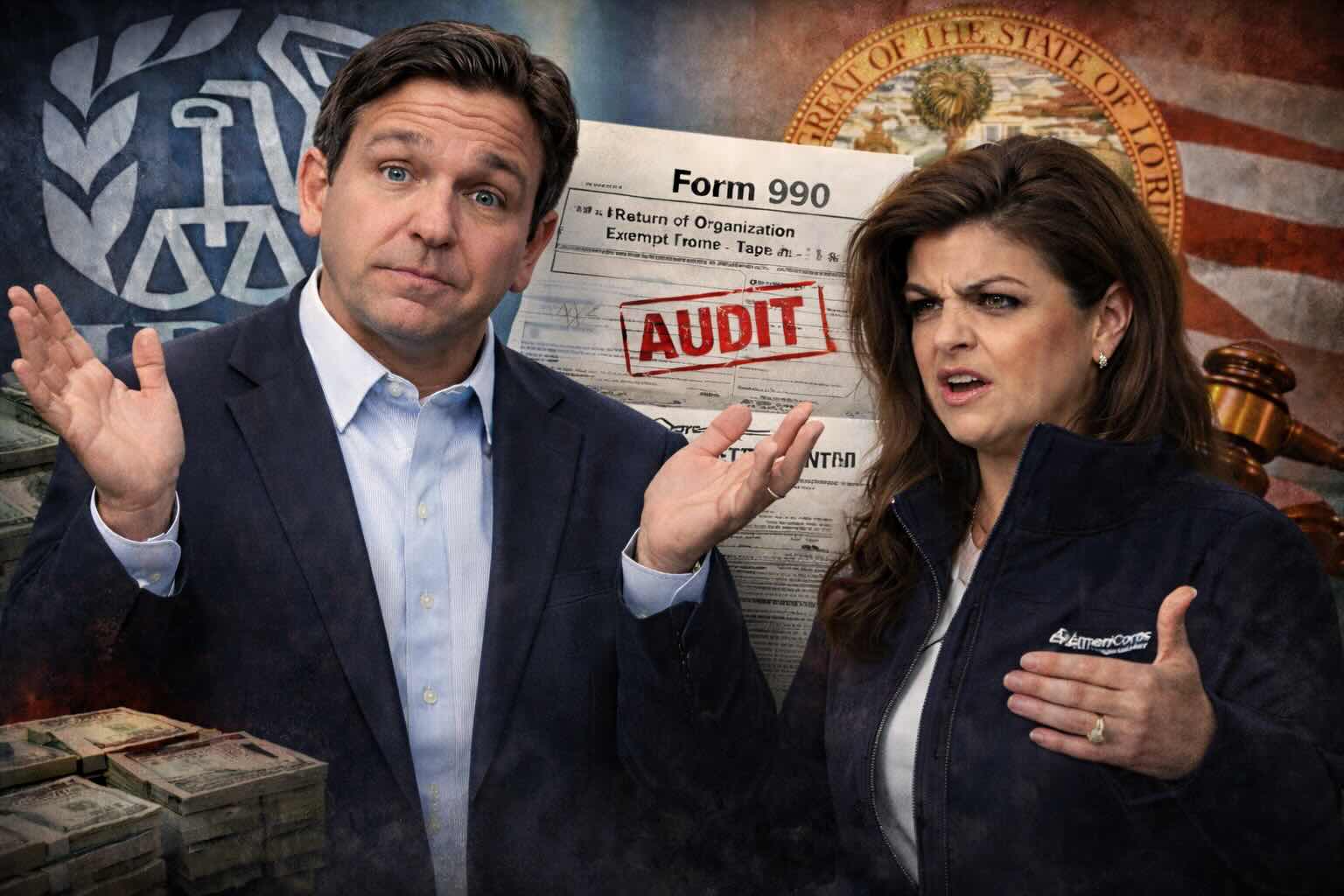
Governor Ron DeSantis and his wife, First Lady Casey DeSantis, still remain entangled in a protracted state-level grand jury investigation into allegations of corruption, money laundering, and misuse of public funds. While the US Department of Justice has cleared the Governor and his wife and his former Chief of Staff who is now the appointed Florida State Attorney General James Uthmeier, state inquiry continues.
Florida state prosecutors continue to examine the diversion of $10 million out of a $67 million 2024 Medicaid settlement between Florida and contractor Centene, even as the separate federal inquiry was quietly dismissed without charges earlier this year. That amount was diverted to the Hope Florida Foundation, a nonprofit closely tied to First Lady Casey DeSantis. The Medicare funds were earmarked for the poor, the elderly, and the handicapped.
According to a major December 2025 Miami Herald/Tampa Bay Times investigation, this $10 million was only part of a much larger scheme: the DeSantis administration diverted at least $36.2 million in taxpayer resources originally earmarked for healthcare, child welfare, opioid recovery, and aid to vulnerable Floridians—including children—to fund advertising campaigns against various statewide 2024 ballot measures the Governor opposed.
Critics, including Republican State Rep. Alex Andrade of Pensacola, have alleged corruption, money laundering, and misuse of public funds. They claim the funds were improperly routed through the foundation to political committees opposing the 2024 Florida Amendment 3 (marijuana legalization initiative).
DeSantis supporters defend this as a form of public patronage—the DeSantis team called the $10 million transfer a “cherry on top” to a good cause (the Hope Florida charity), but really it was taxpayer money being secretly used to help political goals—like fighting against the marijuana legalization ballot measure (Amendment 3). Many say it treats everyday Floridians like they’re too gullible or naive to notice the real purpose behind the charity cover.
Instead of returning the money to state revenues or Medicaid programs, nearly all of the $10 million was funneled to a political committee controlled by James Uthmeier—then DeSantis’s chief of staff and now Florida’s Attorney General. The state eventually reimbursed the federal government for the full amount in an “abundance of caution,” after acknowledging it had been treated as Medicaid funds that may be how the Governor and his wife and their top political operative avoided a Federal criminal indictment.
In October 2025, Leon County State Attorney Jack Campbell—a Democrat in a heavily Republican area—convened a grand jury in Tallahassee to investigate the alleged diversion of $10 million from the 2024 Centene Medicaid settlement through the Hope Florida Foundation. Campbell made a referral to the FBI in October 2025.
The grand jury heard testimony over multiple days from key witnesses, including former Hope Florida Foundation president Joshua Hay and longtime DeSantis staffer Kate Strickland. The grand jury, instead of returning indictments or “true bills” that would have led to criminal charges, opted for a presentment around February 25, 2026.
A presentment is a record that is supposed to be public but remains sealed and effectively confidential. It allows grand jurors to criticize misconduct, highlight problems, or recommend reforms when the evidence falls short of criminal charges. This path avoids formal prosecution while still producing an official—though currently hidden—record of their concerns.
On March 25, 2026, Leon County Circuit Judge J. Lee Marsh granted limited intervention to transparency watchdogs, including the Florida Trident and its parent organization, the Florida Center for Government Accountability, giving them the right to argue for public disclosure and challenge the secrecy surrounding the presentment.
Further reporting from March 26–28, primarily by the Tampa Bay Times and the Florida Trident, confirms the presentment remains unreleased amid ongoing stonewalling by State Attorney Jack Campbell’s office.
The judge’s pointed observation that Campbell’s repeated use of exemptions “appears to tacitly acknowledge” the presentment’s existence has only intensified public scrutiny, with editorials and transparency advocates ramping up calls for the report to be released ahead of the 2026 election.
Under Florida Statute 905.28 (an exemption to the Sunshine Law), when a grand jury issues a presentment without criminal indictments, the entire report is automatically confidential. Anyone named or criticized in it can file a motion within 15 days to redact their names or damaging portions.
Filing that motion automatically pauses any public release during hearings, rulings, and appeals—effectively buying months of time and conveniently shielding the findings past the November 2026 Attorney General election.
Casey DeSantis, the founder and public face of Hope Florida’s welfare-to-work mission, has been associated with the foundation by virtue of her central leadership position. The program, once praised for its innovative approach to reducing government dependency, now faces accusations that it served as a pipeline for political slush funds.
Reports indicate that the foundation distributed the money to anti-drug nonprofits, which in turn funneled it to political action committees aligned with DeSantis’ agenda, blurring the lines between charity and campaigning.
Governor Ron DeSantis has vehemently denied any misconduct, dismissing the probe as a “hoax” and a politically motivated attack by the media and opponents. When the Governor was first publicly confronted about the diversion of funds he initially blamed it all on his wife saying that the Hope Foundation was “her project, not mine.
The real spotlight, however, will fall on the Hope Florida Foundation’s upcoming Form 990 tax filing, due May 15. According to the Miami Herald, nonprofit tax experts warn this is where serious IRS scrutiny could begin. As a 501(c)(3) charity, Hope Florida is strictly prohibited from political campaign activity and limited in lobbying.
Here is how the $10 million moved, according to public records and reporting:
In September 2024, as part of a $67 million Medicaid settlement with Centene Corporation, the DeSantis administration directed $10 million to the Hope Florida Foundation. Shortly afterward, the foundation wired $5 million to Securing Florida’s Future, a nonprofit run by executives at the Florida Chamber of Commerce. It wired another $5 million to Save Our Society From Drugs, a St. Petersburg-based anti-drug organization.
Within days, the two nonprofits together forwarded $8.5 million to Keep Florida Clean, the political committee chaired at the time by then-Governor DeSantis’ chief of staff, James Uthmeier. That committee used the funds as part of the successful campaign to defeat the 2024 recreational marijuana ballot measure (Amendment 3).
If the IRS determines that routing the settlement money this way violated the rules against political campaign intervention, the foundation could lose its tax-exempt status — triggering taxes on donations, lost deductions for donors, and potentially hefty back taxes that would undermine its mission.
Yet the story’s slow unfolding stems from more than tax questions. It is also tied up in Florida’s Sunshine Laws and a grand jury presentment that remains under wraps. Attorney General James Uthmeier has repeatedly declined to disclose whether he or others named in the report have petitioned a judge to keep the presentment secret or heavily redacted.
Critics argue this creates a clear conflict of interest, as the Attorney General — appointed by DeSantis and whose office oversees law enforcement — is now a central figure in the very matter under scrutiny.
Uthmeier has pushed back, declaring he has “not been involved in any criminal activity” and “Nobody did anything wrong here.” He added that grand jury confidentiality is required by Florida law: “That’s not my choice. That is Florida law.”
This episode reveals the practical limits of Florida’s vaunted Sunshine Laws when high-level officials, a grand jury presentment, and glaring conflicts of interest collide. The situation is made more striking by the central role of Attorney General James Uthmeier.
While serving as Governor DeSantis’ chief of staff, he chaired the political committee that ultimately received the bulk of the $10 million — effectively benefiting from funds that originated in a state Medicaid settlement.
According to text messages released by state Rep. Alex Andrade to the Tampa Bay Times and Miami Herald, on October 11, 2024 — just three days before the Hope Florida Foundation board accepted the $10 million in a non-public meeting — then-Governor DeSantis’ Chief of Staff James Uthmeier texted Amy Ronshausen, executive director of Save Our Society From Drugs, asking to speak with her.
Andrade publicly stated that Ronshausen told him Uthmeier encouraged her nonprofit to apply for the $5 million grant from Hope Florida; however, Ronshausen later testified and stated publicly that Uthmeier never directed how the funds should be used and that she had not been instructed to transfer any portion of the grant to the Keep Florida Clean political committee.
Critics argue he appears to be double-dipping: wielding significant influence over law enforcement and grand jury secrecy as the state’s top legal officer, while having been centrally involved in directing the money flow. Uthmeier has publicly pushed back on the issue, emphasizing he was simply following Florida law on confidentiality and that no criminal activity occurred.
With the Hope Florida Foundation now filing its tax returns and more records finally emerging, Floridians have every right to demand full transparency — no more excuses, no more delays. The people need straight answers: Were taxpayer dollars spent strictly as intended to help those in need, or did statutory exemptions, extended delays in public records requests, and conflicting overlapping roles allow vital details of this story to remain hidden far longer than the public should ever tolerate?