


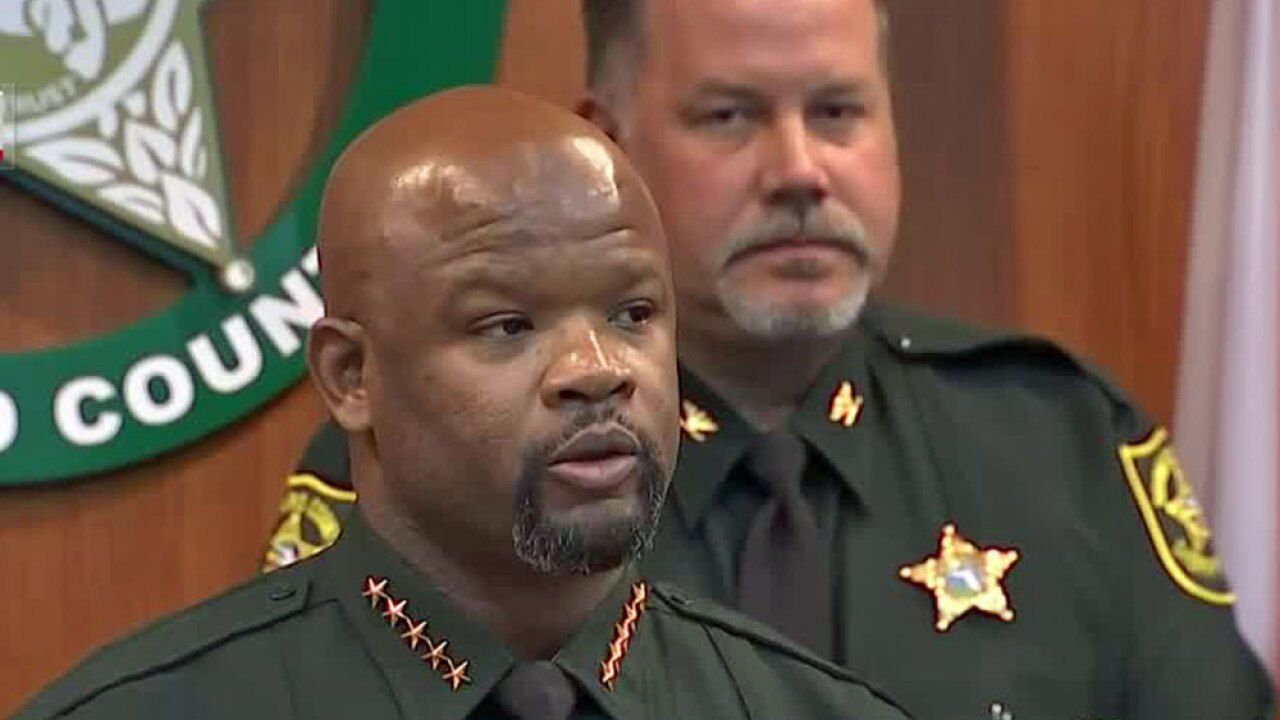
Illusion, Secrecy and Intimidation at the Broward Sheriff’s Office
In Tallahassee, silence is rarely unintentional.
When Broward County Sheriff Gregory Tony brought his budget appeal to the Florida Administration Commission in late February, silence was exactly what he received.
His request was $73.7 million. Sheriff Tony had asked for a 9 percent budget increase from the Broward County Commission, but the County approved only 3 percent. His gambit: if the county wouldn’t give him the full amount, he would force his demand through the state capital.
Chaired by Governor Ron DeSantis, the commission holds the full authority of Florida’s executive branch. The other three members, Attorney General James Uthmeier, Chief Financial Officer Blaise Ingoglia, and Agricultural Commissioner Wilton Simpson, each have votes equal to the governor’s. If there was any executive body that could approve or reject Tony’s request with no further appeal, this was it.
However, the meeting was canceled and removed from the agenda without explanation. Weeks later, the hearing still has not been rescheduled.
Why?
The answer begins with the budget Sheriff Tony was disputing. He detailed his claims in a 75-page letter. Among the chief complaints: his employees earned 19 percent less than those at comparable agencies; the airport and seaport were dangerously understaffed; 911 services needed further investment; and the county had abandoned the Broward Sheriff’s Office (BSO) helicopter unit until a tragedy forced action.
In the sheriff’s view, the county’s decision to approve only 3 of the 9 percent request was “arbitrary and capricious,” indicating that public safety was not a priority for the commissioners. The appeal to the state was meant to protect residents, and in a Sun Sentinel op-ed, Sheriff Tony called the move a “last resort.”
But, if the issue is so urgent, why have the governor and the Florida Administration Commission chosen to quietly move the item off the agenda? After all, Governor DeSantis made fiscal responsibility a top priority, even naming his 2025-2026 state budget the “Focus on Fiscal Responsibility.” Throughout 2025, he dispatched auditors with the Florida Department of Government Efficiency (DOGE) to Broward County to expose what he called wasteful, unconscionable spending.
Yet the largest line item in Broward County’s budget, the Broward Sheriff’s Office, which utilizes more than half of county funds, was never touched. Florida Administration Commission member and CFO Blaise Ingoglia acknowledged this omission when announcing the audit findings.
“What I can tell you is that we have received numerous inquiries about the sheriff’s budget here,” said Ingoglia. “All I can say with that is that we should be protecting people, but we should also balance the taxpayer with making sure we keep people safe at the same time.”
That’s it. No promise to audit the sheriff’s office. No explanation for why BSO was not examined. If Ingoglia did decide to sift through BSO’s finances, the state’s top fiscal watchdog might have been surprised at what he found.
In fact, the unusual silence in the state capital begins to make sense once you look at the numbers Sheriff Tony was disputing. Ten days after Tony’s 75-page petition was issued, the county published their 71-page response. The document challenged Tony’s central claims, which founder under scrutiny.
Sheriff Tony is correct. Many of his employees are underpaid. But not those closest to him. A Sun Sentinel editorial board review of BSO payroll records found at least 195 employees earning more than $150,000 annually. Sheriff Tony’s chief of staff earns $184,000 a year. His personal driver, a captain, earns $180,000. His executive assistant draws $155,000. If those outside his immediate orbit are undervalued, it was the sheriff’s own budget decisions that contributed to it. The county’s reply documents additional funds for BSO salary increases, but the sheriff’s office did not use them in the employees’ interest.
“BSO budgets aggressively for personnel and operating expenses, underspends those lines and then diverts the savings into one-time capital projects,” the county responded. “For the last several years, BSO has had money to further increase salaries: it just has not used the money that was made available for that purpose.”
The BSO training center, which opened in 2024, was one of the projects to which county funds, including salaries, were allocated. The facility was originally budgeted at $34 million, but it ballooned to $73.7 million. Overall, the building overran county funding by $18.2 million. One reason for the inflated budget was the sheriff’s excessive personal branding, which included his name on the Defensive Training Room floor, light fixtures, gym walls, ice bath and shower curtains, as well as an oversized logo affixed to the outside of the building.
Sheriff Tony’s claim that the airport and seaport were dangerously understaffed, compromising public safety, is also contradicted by his own agency’s documentation. Revenue collected by BSO at Port Everglades declined steadily under Sheriff Tony, even as the port expanded, dropping from $16.5 million to $12.4 million, despite the port processing record cargo volumes. A 2024 audit of the airport found insufficient documentation of how budgeted funds were spent. County Auditor Bob Melton said it was “very difficult, or in some cases not possible,” to get data to account for how BSO’s money was spent.
Subsequently, in February 2026, the county started a process to determine whether to strip BSO of responsibility for both the airport and seaport.
911 services faltered under BSO. By 2022, Broward’s 911 system was in crisis. A Sun Sentinel investigation documented dropped calls, long wait times, and staffing shortfalls severe enough that a baby and a woman died in separate incidents following delayed emergency response.
“We found out about the problem from the Sun Sentinel,” said Broward commissioner Mark Bogen. “He (Tony) never came and said, ‘My people are underpaid, I got a mess here, I need help.’ We need to lead. Because there is no leadership in 911.”
Later that year, Tony allowed BSO’s contract to operate Broward County’s 911 system to expire, rejecting a renewal and demanding technology upgrades as a condition of continuing service. The gamble left the emergency communications system in limbo. A new contract was signed in 2023, and BSO continues to staff the call centers today.
Sheriff Tony and BSO had also contracted with SaferWatch, a private company with technology that allowed residents to send perceived threats via phone to the agency’s Real-Time Crime Center. The sheriff used BSO resources and his sheriff’s uniform to film a two-minute promotional video for the company, urging Broward residents to download its app. SaferWatch CEO Geno Roefaro was a significant financial contributor to Sheriff Tony’s Broward First political action committee, cutting a $10,000 check as recently as August 2024. Roefaro also contributed heavily to Tony ally James Reyes in his failed bid for Miami-Dade sheriff. In February 2026, Roefaro was federally indicted on bribery charges for allegedly paying tens of thousands of dollars in cash and gifts to a New York Police Department official to secure city contracts.
Tony’s petition accused the county of neglecting BSO’s aging helicopter fleet until two people died, a BSO Fire Rescue Captain and a civilian woman, in an August 2023 crash. Tony had verbally raised concerns about the helicopters at a county budget meeting two months earlier, but he never made a formal request. Additionally, his submitted 2024 budget did not include helicopter replacement. After the crash, the county budgeted for a single helicopter replacement, which BSO used as a down payment on three aircraft. The county assumed the balance.
In an editorial response to the sheriff’s petition, Broward Commissioner Beam Furr expressed that the county has been more than fiscally fair to BSO, granting them a budget raise higher than any other county agency. He noted that Sheriff Tony did not make his case for a larger raise in public hearings and told Commissioner Furr personally that the increase was “sufficient and a positive step forward.” He praised the transparency of the budget process, all while DOGE was auditing county finances. DOGE “examined every nook and cranny of our budget process,” wrote Commissioner Furr, “with the notable exception of the sheriff’s budget.” According to the commissioner, the county also has no way to see how BSO spends its money.
There are exceptions.
Sheriff Tony’s personal branding is one of the only ways BSO spends public money transparently. When the sheriff received his doctorate in June 2024, he demanded that all digital and printed materials be rebranded to reflect his new title: “Sheriff Gregory Tony, Ph.D.” This resulted in thousands of dollars spent on new or updated promotional items to replace the old ones.
As the last election season approached, Tony kicked into full campaign mode. Broward was flooded with glossy mailers touting “Sheriff Doctor” Tony’s accomplishments. BSO mailboxes span all precincts, yet observers noted that the mailer appeared to be distributed disproportionately to frequent Democratic voters. This very group effectively determines the outcome of Broward primaries.
The sheriff’s office also employs a social media team, whose duties include helping to manage Sheriff Tony’s social media page. His online presence consists of sheriff-centric workout videos with motivational messages, sheriff’s office happenings, and, more recently, a continued focus on the county budget fight.
The agency that plasters the sheriff’s name on gym walls and dispatches social media teams to defend his budget decisions is the same one that county officials say won’t open its books. Therein lies a bigger problem for Florida’s largest public safety agency and another reason the Florida Administration Commission has chosen to delay its evaluation of Sheriff Tony’s claim.
According to one local law enforcement official with direct knowledge of BSO’s operating budget, the petition to the state should be the last worry on the sheriff’s mind.
“When you look at the sheriff’s office budget, you arrive at more questions than answers,” the insider said. “The numbers don’t add up.”
A recent investigation by the Florida Bulldog found tens of millions of dollars in budgetary discrepancies. One glaring issue in the BSO budget is Special Details, a unit that contracts for public and private security. The official agency budget reported that the unit reported nearly double its operating cost, a $4.3 million surplus, with no explanation in their 2022-2023 budget. That number grew to $4.8 million the following year.
The year-over-year Special Details fiscal error is not isolated. Across fiscal years 2022-2023 and 2023-2024, BSO’s adopted budgets show a $54.6 million gap between what the agency reported collecting from contract cities and entities and what its backup documentation shows it spent to provide those services.
Yet, when all the pluses and minuses are reconciled, the budget nearly breaks even. So, if all budgeted money is accounted for, doesn’t BSO pass the financial check?
Not exactly.
When BSO is hired to provide services, revenue should equal expenses. Under Florida law, contracted services must be provided at actual cost. BSO should be collecting from cities only what it costs to serve them. A mistake in accounting can be an isolated incident, but tens of millions of dollars and units with continual widening fiscal gaps is more than oversight. The money moves. But there is no public explanation of where it goes.
So, the sheriff’s office budget resembles a shell game. In several cases, money is collected in one unit, spent in another, reported one way in one document and another way in the next, with no public accountability for where the dollars land.
When County Auditor Bob Melton reviewed the figures, he said that the county’s understanding was “that contracted services should be provided at actual cost.” Former Broward Sheriff Al Lamberti called the discrepancies “troubling,” a feeling compounded by BSO’s request to the state for more money.
The budget is not a suggestion for how money should be spent; it’s meant as a record, an honest accounting and allocation of taxpayer money. The natural response to numbers that don’t reconcile is to ask questions. But in Broward County, asking questions about BSO’s budget comes with a cost.
When Deerfield Beach’s contract came under scrutiny, Sheriff Tony addressed his deputies at a recorded roll call. He asked whether he should “go absolutely nuclear” and destroy City Manager Rodney Brimlow, who filed a formal complaint with the Florida Department of Law Enforcement. Fearing his safety, Brimlow would subsequently work from home. Sheriff Tony’s social media team was then deployed against the city. The targeted campaign included calling the city’s feasibility study into question and urging Broward residents to vote out the city’s elected officials.
The sheriff’s response to Deerfield Beach was not an isolated incident. It was an established pattern.
Pembroke Park’s mayor said that Sheriff Tony threatened him personally. A Tamarac commissioner, after a city meeting, wrote publicly that the sheriff had tried to “bully his way through” questions about BSO’s finances. “Now we know why his deputies are so angry,” the commissioner wrote. “It flows from the head.”
Cooper City Commissioner Lisa Mallozzi, whose husband is a career law enforcement officer, praised her local BSO, but summarized what other city officials across Broward County had concluded.
“What I don’t support is Sheriff Tony,” Mallozzi said at a scheduled televised meeting. “I don’t like bullies.”
Cooper City had called for an “itemized forensic audit” of BSO to justify every new dollar her city was being asked to pay, but she was stonewalled. The city manager, Alex Rey, told commissioners negotiations with BSO were non-existent.
“They’re not willing to negotiate,” Rey said. “It is a one-way direction where they say, ‘This is it, period.’ I don’t know if, over the long term, that’s going to be productive and beneficial for Cooper City residents.”
Weston City Manager Don Decker requested a meeting with the contract cities and the sheriff to reach a general accord. The sheriff did not respond.
The pattern is consistent: vagary on the numbers, aggression toward anyone who presses. Deerfield Beach Mayor Todd Drosky put it simply: “The sheriff is asking for more money, and when we ask to justify where those dollars are going, we have not received a response.”
This strategy of secrecy and intimidation has started a movement away from BSO. And it’s spreading.
Pembroke Park has left. Deerfield Beach is in the process of separation. Pompano Beach has formally commissioned a feasibility study and is actively evaluating departure. Cooper City and Weston have not signed new contracts. Two cities gone, three in various states of departure, not because of politics, because the math doesn’t work, and the sheriff won’t let anyone check it. When anyone does want to check it, they are attacked.
Florida’s DOGE kicked off with an audit of Broward County spending in 2025. Governor DeSantis singled out Broward as a good place to start because, while the tax burden has increased, the population has stayed the same. He added that there were “a couple sheriff’s departments across the state that people find concerns about.” Broward County Commissioner Steve Geller opined that his county was chosen first as a purely political move, a big blue county in a sea of red.
In September 2025, Blaise Ingoglia held a press conference in Pembroke Pines, where he announced $190 million in alleged Broward waste and excoriated the stewards of public money. Among his examples of bad bureaucracy were DEI training and virtual Metaverse art on gender equity.
“That math just does not math,” he said. “If you’re a business and you operated like that, you would be bankrupt.”
Yet, BSO’s budget is not inspected, and there is no good reason why.
Perhaps the long refusal to comment from Governor DeSantis or his administration has more to do with the governor’s relationship with Sheriff Tony. He appointed Tony as sheriff after removing Scott Israel due to Israel’s role in the Parkland School shooting, after Tony was recommended by Andrew Pollack, whose daughter was tragically murdered at Parkland.
In the last election, two Republican allies of DeSantis, Shane Strum and George LeMieux, hosted a campaign fundraiser for Tony’s political action committee, “Broward First.” Strum was DeSantis’s first chief of staff and a co-chair for the transition between his first and second terms, and LeMieux was a co-chair of DeSantis’s first transition team. The fundraiser was held at the Las Olas home of Wael Barsoum, who was appointed to the state Board of Medicine by DeSantis in 2021.
In late 2023, during a CNN Town Hall in Iowa, Governor DeSantis was asked to name his favorite Democratic official in Florida. His first answer was Sheriff Gregory Tony. The governor’s more recent commentary about the wayward sheriff has been tepid at best.
“Sheriff Tony has become a liability,” the local law enforcement official said. “Both the county and the cities he contracts with no longer trust him. That doesn’t make the governor’s job any easier.”
Regardless of their personal relationship or financial ties, if the governor’s sole determination is to remove waste and abuse of government, it would be in his interest to review the BSO budget.
And Sheriff Tony has sent the budget up to the state capital and laid it at the governor’s doorstep. Yet the governor still refuses to look, and his administration will not comment.
In Tallahassee, silence is rarely unintentional.
