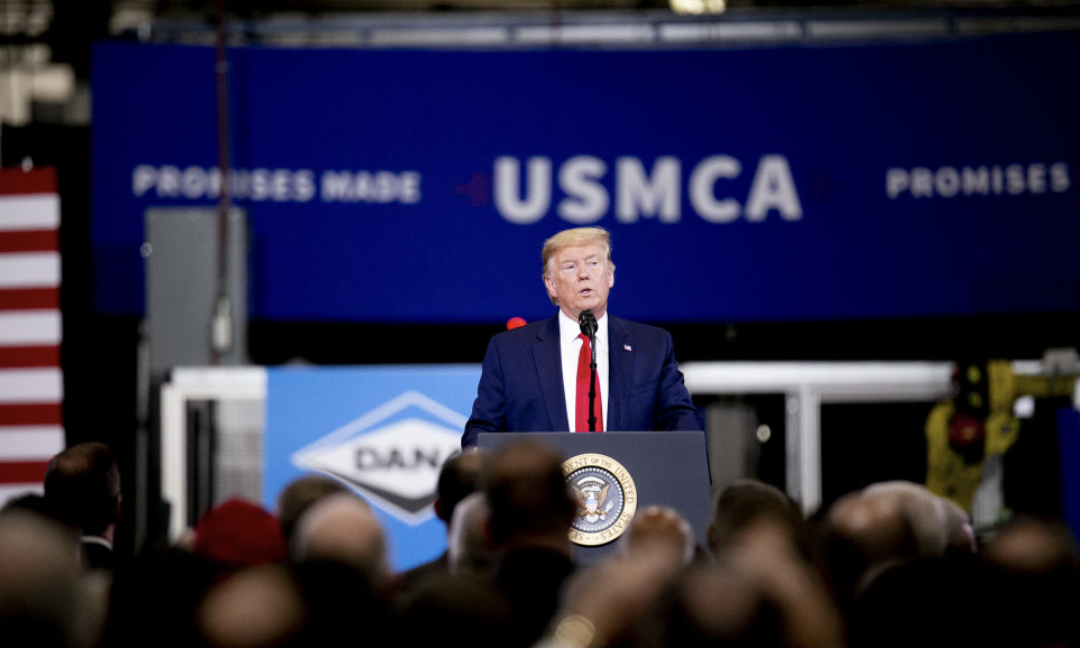
President Donald Trump warned Wednesday that the United States may refuse to renew the USMCA, sending a clear message to Canada, Mexico and the globalist trade class: access to America’s market is not a birthright.
Speaking from the Oval Office, Trump ripped into America’s trade deficits with both neighbors and made clear he is not interested in rubber-stamping another deal that leaves the United States carrying the burden. His position was blunt, direct and unmistakably America First.
“I’m not looking to renew it,” Trump said. “We don’t need anything that Canada has. We don’t need anything that Mexico has, but they need everything that we have.”
“They have to treat us better,” he added. That line cut through decades of diplomatic fog and exposed the basic reality of North American trade — Canada and Mexico depend on the United States far more than Washington depends on them.
The United States-Mexico-Canada Agreement replaced NAFTA during Trump’s first term after years of American workers being told to accept factory closures, wage pressure and offshoring in the name of “free trade.” USMCA was supposed to be a correction, not a blank check.
Now Trump is signaling that even his own renegotiated agreement must be judged by results. If the deal no longer serves American workers, farmers, manufacturers and taxpayers first, then it should not be renewed automatically.
The three countries face a July 1 deadline to approve renewal or signal their intention to exit the pact. If they fail to extend it, the agreement would move into annual reviews until 2036.
That gives Trump exactly what he wants — leverage. Instead of locking America into another long-term arrangement favored by corporate lobbyists and trade bureaucrats, he can force Canada and Mexico back to the table again and again.
The numbers show why he is applying pressure. In 2025, the United States ran a $46 billion goods trade deficit with Canada and a massive $197 billion deficit with Mexico.
To the old free-trade establishment, those deficits are brushed aside as technical details. To Trump’s America First movement, they are proof that Washington still lets foreign governments and multinational corporations profit while American communities absorb the cost.
Mexico has been America’s top trading partner since 2023. Roughly 80 percent of Mexican exports go to the United States, making its economy heavily dependent on American consumers.
Canada is in the same position. Nearly 70 percent of Canadian exports flow south into the U.S. market.
That is the leverage previous American leaders were too weak or too ideologically captured to use. Trump is saying openly what Washington elites avoided for decades: America is the customer everyone needs, and the customer has every right to demand better terms.
Together, Canada and Mexico buy nearly one-third of exported U.S. goods. That matters — but it does not change the larger point.
America should trade with its neighbors, but it should not subsidize them, indulge them or tolerate lopsided arrangements out of fear of offending polite diplomatic opinion. Trade is not charity.
Trump’s approach is not anti-trade. It is anti-surrender.
The old Washington consensus treated open markets as a religion and American sacrifice as the cost of global leadership. Trump treats the U.S. market as a national asset that should be defended like any other strategic resource.
The U.S. Trade Representative’s Office has said Washington and Mexico will hold another round of negotiations on June 16 and 17. Those talks are expected to focus on agriculture and a “level playing field.”
A third round is scheduled for the week of July 20 in Mexico City. Mexico has moved more aggressively to engage the Trump administration — likely because it understands how much it stands to lose if America stops playing by the old rules.
Canada, by contrast, has moved more slowly and has faced criticism from business groups for dragging its feet on the review process. Ottawa now appears to be trying to preserve the pact before Trump turns warning shots into action.
Dominic LeBlanc, Canada’s minister for U.S. trade, urged Washington and Mexico to renew the agreement for another 16 years. “The Agreement is highly beneficial to each of our countries and to the integrated North American economy,” he wrote.
That is precisely the kind of language Trump is challenging. “Integrated North American economy” may sound impressive in Davos-style speeches, but the real question is whether the deal strengthens the American nation.
For decades, U.S. leaders hid behind words like integration, competitiveness and partnership while American industry was hollowed out and border pressure intensified. Trump’s return has revived the question the globalists hate most: who benefits?
The USMCA and NAFTA before it helped create nearly $1.6 trillion in annual trilateral trade. Free-trade defenders point to that number as proof of success.
But trade volume alone does not prove victory. A gigantic trading system can still weaken the country at its center if it rewards dependency, offshoring, cheap labor and permanent deficits.
Trump has never accepted the idea that corporate profit is the same thing as national success. His test is whether America becomes stronger, richer, more sovereign and less vulnerable.
That is why tariffs remain central to his thinking. For Trump, tariffs are not a dirty word — they are a weapon.
Canada learned that lesson late last year when Trump suspended talks after Ontario aired an advertisement featuring Ronald Reagan warning that tariffs lead to trade wars. The ad was meant to shame Trump, but it only confirmed that foreign governments still think they can lecture America while depending on its market.
Ottawa has since said it had a positive meeting with U.S. officials about the USMCA review. But no formal negotiation date between Washington and Canada has been set.
That leaves Canada exposed. Mexico is already engaged in scheduled talks, while Canada is still trying to navigate a president who does not worship the old trade consensus.
The coming negotiations could touch agriculture, autos, manufacturing rules, energy, tariffs, labor standards and market access. For multinational corporations, that uncertainty is uncomfortable.
For the America First base, it is necessary. Deals affecting American workers should not be renewed on autopilot by bureaucrats, lobbyists and foreign ministries.
The broader fight is not just about trade balances. For many MAGA voters, trade policy, border security, fentanyl trafficking, illegal migration, industrial decline and national sovereignty are all part of the same failed globalist order.
Mexico’s dependence on the U.S. market gives Trump leverage over more than commerce. It gives him leverage over border cooperation, cartel pressure, migration flows and the security crisis that Washington politicians ignored for years.
Canada’s dependence gives him leverage over trade barriers, energy, agriculture and political games from Ottawa. If America is expected to keep its market open, then its neighbors should expect hard demands in return.
Critics will warn that threatening USMCA could disrupt supply chains or raise costs. Trump’s answer has always been that a country afraid to use its own power has already surrendered.
A superpower that refuses to defend its workers, borders and industrial base is not generous. It is foolish.
Trump’s warning puts Canada and Mexico on notice that the era of automatic renewal is over. The United States will not be treated as a consumer colony, a dumping ground or a permanent subsidy machine.
Whether Trump walks away from USMCA or uses the threat to extract major concessions, the message is clear. North American trade will be judged by one standard only: does it put America first?
For the globalist class, that is the nightmare. For Trump voters, it is exactly the mandate they gave him.