In the lead-up to America’s 250th anniversary celebrations, the newly renovated Lincoln Memorial Reflecting Pool was meant to gleam as a symbol of national renewal under President Donald Trump. Trump had personally championed the $14.2 million project, ordering the basin painted a striking “American Flag Blue” to restore its dignity after years of neglect.

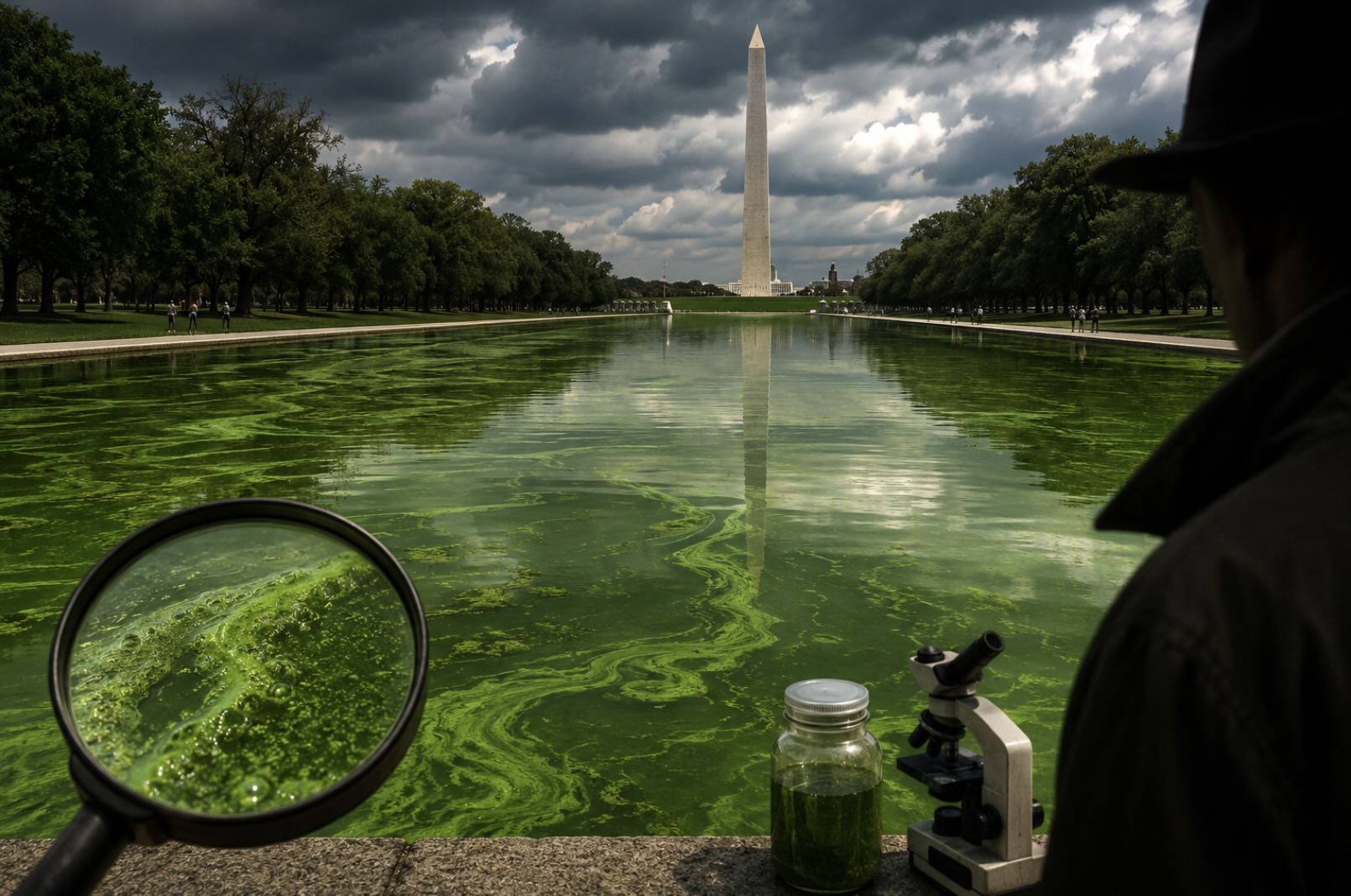
Yet, just days after refilling in early June 2026, the iconic 2,000-foot-long pool turned a vivid, unnatural bright green, overtaken by aggressive algae blooms. While official explanations point to “residual” algae from dormant supply lines, a closer examination reveals how improbable such a rapid, widespread infestation truly is—and raises serious questions about deliberate sabotage aimed at embarrassing the Trump administration during a moment of patriotic triumph.

Algae growth in shallow, sun-exposed bodies of water like the Reflecting Pool is a known challenge, but the speed and intensity of this bloom defy standard biological timelines. The pool draws from the Tidal Basin and relies on circulation and filtration systems. Even in warm Washington, D.C. summer conditions, natural algae proliferation typically requires sustained nutrient buildup, stable temperatures, and time—often weeks for visible mats to form and dominate. Here, the transformation happened almost overnight after refilling following an eight-week construction pause. Crews had already begun vacuuming and netting dying algae, yet the green hue persisted aggressively. Experts note that prior renovations, such as the 2012 overhaul, also faced regrowth, but nothing matched this immediate, uniform takeover right as the pool was showcased for the 250th anniversary. This was no ordinary ecological hiccup; it appeared engineered for maximum visual impact and embarrassment.
The Unlikelihood of Natural Aggression
Biologists and water management specialists emphasize that aggressive algal blooms, especially in a managed urban reflecting pool with upgraded ozone nanobubbler filtration intended to prevent exactly this, rarely manifest with such ferocity in a freshly flushed system. Residual algae from pipes might seed minor growth, but turning millions of gallons a bright, opaque green within days suggests either extreme nutrient loading or an external accelerant. The pool’s history of problems under previous administrations does not absolve the suspicious timing: precisely when Trump was touting the renovation as a success, with the White House highlighting its “reflecting” beauty ahead of the July 4th festivities.
Skeptics of the official “residual” narrative point to environmental factors that do not align. Nutrient runoff from the Tidal Basin would build gradually, not spike instantly. Sunlight and warmth play roles, but the bloom’s uniformity across sections near the Lincoln Memorial and World War II Memorial hints at something introduced systemically, perhaps via the supply lines themselves during the dormant period. Natural processes do not produce such a photogenic disaster—perfect for viral images and headlines mocking the “blue” pool turned green. This rapid aggression mirrors cases where human intervention, intentional or otherwise, introduces excess phosphates, nitrates, or live cultures to kickstart exponential growth.
Sabotage Scenarios: Technology and Chemicals for Instant Green
The most troubling aspect is how feasible deliberate contamination would be for bad-actors seeking to disrupt the anniversary and discredit Trump. Foreign governments or domestic adversaries with basic aquatic expertise could exploit the pool’s vulnerabilities during renovation downtime. For instance, introducing concentrated algal inoculants—cultures of fast-growing species like Chlorella or cyanobacteria—directly into supply lines or the basin via discreet access points. These can be cultured in labs and dispersed in small volumes, blooming explosively under sunlight and warmth within 24-72 hours.
Chemicals offer even quicker results. Phosphorus-rich compounds or fertilizers, readily available and concealable, act as rocket fuel for algae. A targeted dump or injection could trigger hyper-eutrophication almost immediately, turning clear water murky green. More advanced methods might involve drone or nighttime delivery of encapsulated nutrients timed to dissolve post-refilling. Foreign intelligence services, such as those from nations opposed to U.S. resurgence under Trump, possess the technical means: submersible dispensers, pH-altering agents to favor algal dominance, or even genetically selected strains engineered for rapid proliferation in freshwater systems. Disrupting a high-profile national symbol during the 250th anniversary preparations would be a low-cost, high-reward psychological operation—generating mockery worldwide while forcing the administration into defensive cleanup mode with hydrogen peroxide treatments and manual labor.
Security around the National Mall, while present, is not impenetrable during extended construction. Workers, contractors, or infiltrators could easily access pipes or the drained basin.
Broader Implications for the 250th Anniversary
This incident is more than an eyesore; it represents an attempt to tarnish America’s milestone. Trump’s vision for a revitalized D.C.—fixing what he called Biden-era disrepair—faced immediate sabotage optics. Cleanup efforts continue, with nanobubblers and peroxide showing promise, but the damage to perception lingers.
If investigators ultimately determine that the Reflecting Pool’s discoloration resulted from intentional misconduct rather than natural causes, the incident will represent yet another example of how individuals or hostile actors may attempt to create division, embarrassment, or disruption during moments of national significance.
Attempts to sow controversy, create negative headlines, or diminish national pride cannot erase the achievements, traditions, and shared values that millions of Americans continue to celebrate. Those who wish to see America weakened often underestimate the resilience of its people.
No act intended to disrupt a national celebration can diminish the determination of citizens who remain committed to the country’s future and to the goal of making America stronger, safer, and more prosperous. Regardless of the cause of this incident, the nation’s 250th anniversary celebration reflects a much larger story—one of perseverance, renewal, and an enduring belief in the American experiment.