
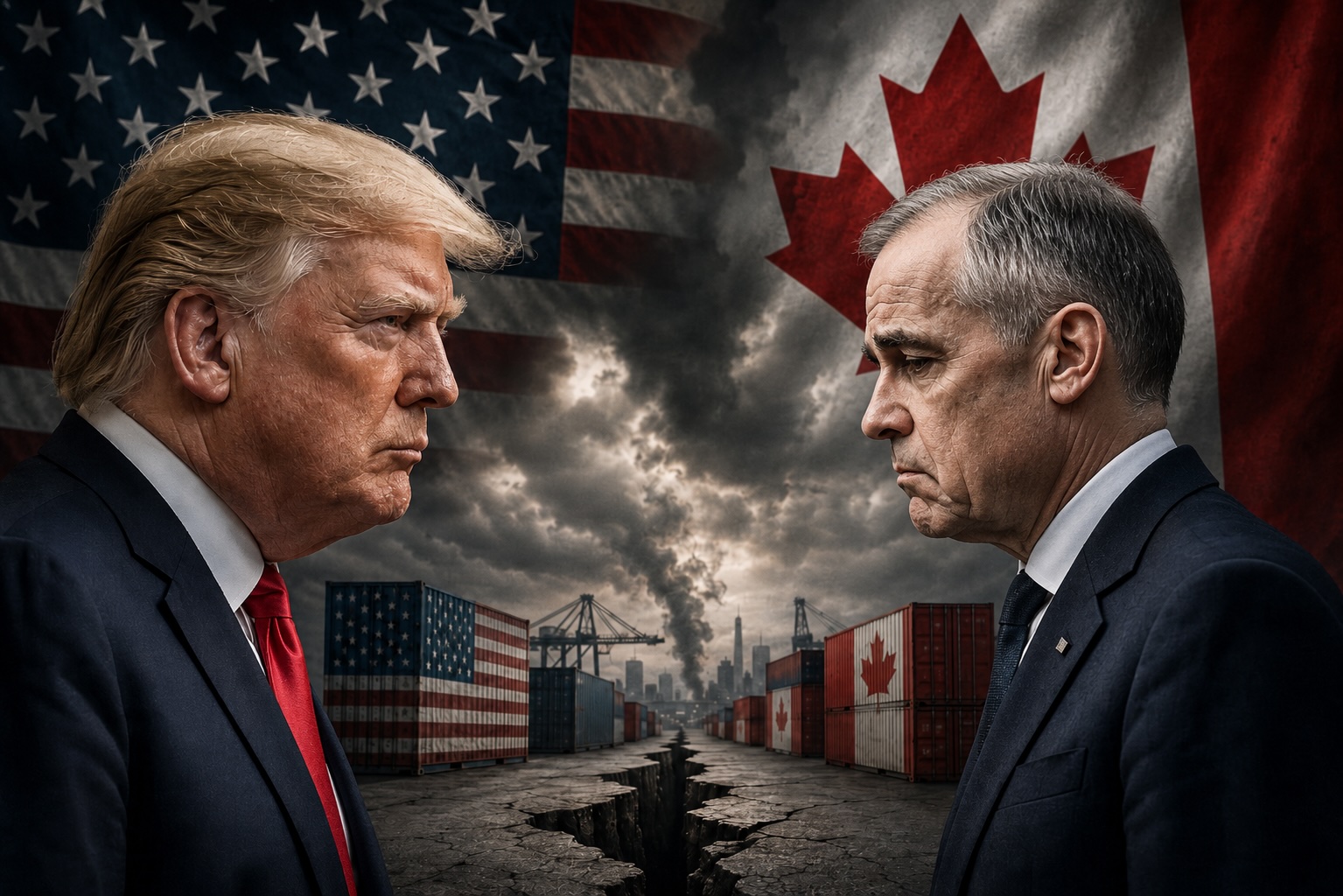
For generations, the economic relationship between the United States and Canada was so deeply embedded that politicians on either side of the border could quarrel without seriously questioning the underlying partnership.
Mark Carney may be testing how permanent that assumption really is. His recent reckless moves against the United States risks permanently altering the relationship between the two neighbors.
Canada’s prime minister has increasingly positioned himself not simply as a negotiator dealing with President Donald Trump, but as one of the most prominent international political counterweights to Trump's economic nationalism. What began as another tariff dispute has evolved into something much larger: a confrontation over sovereignty, trade, globalization and the future architecture of the Western economy.
And Canada has considerably more to lose.
Following the collapse of the latest U.S.-Canada negotiations, Washington imposed 50 percent tariffs on roughly $20 billion worth of Canadian goods. Carney responded by suspending negotiations and announcing dollar-for-dollar retaliation against American products. Trump subsequently threatened 50 percent tariffs on Canadian automobiles and parts beginning January 1.
The rhetoric has become nearly as combustible as the tariffs.
Trump declared this week that it was time to teach Canada that it “can't do this anymore.” Carney, meanwhile, has increasingly described America's economic policies as coercive and argued that Canada must reduce its reliance on the United States.
The rupture is becoming difficult to dismiss as another temporary Washington-Ottawa spat.
It is becoming a strategy.
Carney Is Betting Canada Can Afford a Fight It Cannot Win Easily
There is an obvious problem with Carney's confrontation.
Geography.
Canada can sign agreements in Europe, negotiate with Asian governments, court Middle Eastern capital and reopen commercial relations with China. What it cannot do is move the United States away from its southern border.
The two countries built their modern economies around one another.
In 2024, 75.9 percent of the value of Canada's domestic merchandise exports went to the United States, and nearly two-thirds of Canadian exporting enterprises sold goods only to the United States.
Those numbers reveal the fundamental asymmetry of the Trump-Carney confrontation.
Canada is of little importance to America.
America is indispensable to Canada.
The distinction matters.
Canada has already experienced what happens when that commercial artery between America and Canada begins narrowing. Canadian exports to the United States fell sharply during the first phase of the trade confrontation in 2025. Canada's merchandise trade surplus with America declined from C$101.3 billion in 2024 to C$80.9 billion in 2025, while Canada's overall merchandise trade deficit widened dramatically, from C$7.2 billion to C$32 billion.
Exports contracted 7.5 percent during the second quarter of 2025, the largest quarterly decline outside the pandemic since 2009, while real GDP contracted 0.4 percent.
That should make the current escalation especially concerning.
Reuters reported this week that economists estimate the latest tariff confrontation could ultimately cost Canada roughly 90,000 jobs, while a full American withdrawal from the USMCA could potentially push Canada into recession.
Carney's answer is diversification.
But diversification is not the same thing as substitution.
A factory in Ontario shipping auto parts a few hundred miles into Michigan cannot simply redirect its production to Singapore, Germany or China at comparable cost. North American automobile manufacturing has spent decades developing supply chains that cross the border repeatedly during production.
Steel, aluminum, oil, gas, agriculture, machinery and manufacturing operate under similar geographic realities.
Markets can diversify.
Continents cannot.
From Davos to Washington: Carney Makes the Fight Ideological
Carney revealed the larger philosophy behind his strategy at the World Economic Forum in Davos in January.
Without making Trump the sole subject of his address, the Canadian prime minister declared that the previous international system had suffered a “rupture” and argued that middle powers needed to cooperate against major countries using tariffs, financial systems and supply chains as instruments of leverage.
It was difficult to miss the target.
Trump responded the next day.
The disagreement therefore extends far beyond lumber duties or dairy quotas. Carney is challenging one of the central ideas behind Trump's foreign policy: that access to the gigantic American consumer market gives Washington leverage that previous American administrations were too reluctant to exercise.
Trump sees that leverage as a negotiating asset.
Carney sees its use as a reason for other countries to loosen their dependence on America.
Those positions are fundamentally incompatible.
Carney has consequently attempted something considerably more ambitious than negotiating another trade agreement. He is trying to organize Canada's economic future around a world in which American commercial markets - and Canadian dependence upon them - is substantially reduced.
That strategy included a January trip to Beijing and a limited tariff arrangement under which Canada and China agreed to lower certain trade barriers involving products including Chinese electric vehicles and Canadian canola.
From Carney's perspective, this is economic insurance.
From Trump's perspective, it risks looking like America's closest neighbor responding to Washington by moving toward its principal strategic competitor.
That is how commercial disagreements become geopolitical ones.
The Relationship May Be Harder to Repair Than Carney Imagines
Tariffs can be repealed with a signature.
Trust is harder to restore.
Canadian politics has changed dramatically. Cross-border tourism has suffered. Political rhetoric that once would have sounded unthinkable between Washington and Ottawa has become routine.
AP described the current conflict as a rupture in what had historically been one of the world's closest and most durable alliances. Carney himself has publicly argued that “America has changed” and that Canada must respond accordingly.
That language has consequences.
If Canadian executives begin building factories with the expectation that American market access can disappear overnight, investment patterns change.
If American companies begin viewing Canadian suppliers as politically vulnerable, procurement decisions change.
If governments begin deliberately creating separate supply chains in the name of national resilience, the economic integration constructed over three decades of NAFTA and USMCA begins gradually unwinding.
Once billions of dollars in investment move elsewhere, restoring tariff-free trade does not automatically bring the factories back.
Carney may therefore be presiding over something much more consequential than a tariff battle.
He may be accelerating the structural separation of two economies that spent decades becoming intertwined.
The Curious Résumé of the Man Leading the Resistance
Understanding Carney's confrontation with Trump requires understanding Carney himself.
He is unlike almost any recent Canadian prime minister.
Before entering electoral politics, Carney spent 13 years at Goldman Sachs, working in London, Tokyo, New York and Toronto before eventually becoming a managing director.
He then moved through Canada's Finance Department and the Bank of Canada before becoming governor of the Bank of Canada during the global financial crisis.
Then came an extraordinary appointment.
Carney became governor of the Bank of England, making him the first non-Briton in modern times to run Britain's central bank and eventually the first person to have governed central banks in two G7 economies.
He also chaired the Financial Stability Board, the international organization coordinating financial regulation among major economies.
After central banking came global climate finance and Brookfield Asset Management, one of the world's largest alternative-investment firms.
This was not the career path of an ordinary Canadian politician.
It was the résumé of someone who had spent most of his professional life inside the highest circles of international finance and economic policymaking.
And then there are the organizations that have made Carney particularly fascinating to critics of global governance.
Bilderberg, Davos and the Group of Thirty
Claims about Carney's connections to “secret societies” is rampant. The documented network is extraordinary.
Carney was a member of the Foundation Board of the World Economic Forum, according to both the Bank of England and the WEF's own records.
He belonged to the Group of Thirty, an influential organization of central bankers, financiers and economists, and served as its chairman from 2023 until January 2025—immediately before his plunge into Canadian electoral politics.
Then there is Bilderberg.
Official Bilderberg records identify Carney as a participant in its gatherings, including the 2019 conference while he was governor of the Bank of England. More significantly, Bilderberg's own website lists Mark Carney among its former Steering Committee members.
Bilderberg is described as a “secret society.” It is a private, invitation-only international conference whose meetings historically attracted political leaders, intelligence officials, central bankers, corporate executives, academics and media figures to discuss, and maybe manipulate, world political and economic matters.
Carney did not merely wander through these circles occasionally. He belonged to several of the most influential transnational financial-policy networks in the Western world.
Goldman Sachs.
The G7 central-banking establishment.
The Financial Stability Board.
The World Economic Forum.
The Group of Thirty.
Bilderberg.
The United Nations climate-finance apparatus.
Brookfield.
It would be difficult to design a résumé more perfectly suited to representing the worldview Trump has spent a decade campaigning against.
Canada Cannot Replace America Overnight
Carney's central economic promise is that Canada can transform vulnerability into independence by diversifying its commercial relationships.
The theory is attractive.
But the arithmetic does not add-up to a prosperous Canada.
When roughly three quarters of a country's merchandise exports flow into one neighboring economy, diversification measured in years cannot solve a crisis measured in months.
China cannot replace the United States.
Europe cannot replace the United States.
The Middle East cannot replace the United States.
They can supplement the American market. They can reduce Canada's dependence gradually. But none offers the combination of geography, scale, infrastructure, purchasing power and existing supply-chain integration that the United States provides.
That is why Trump's leverage over Canada is so enormous.
The American economy is vastly larger.
Canada cannot tariff its way into parity.
It can only attempt to make American retaliation sufficiently painful that Washington decides compromise is worthwhile.
That is a negotiating strategy.
It is not an economic growth strategy.
The Dangerous Endgame
If Carney continues to bait the Trump administration into a trade and tariff war, Canada's collapse would be inevitable. Both countries still have strong economic incentives to find a mutually beneficial solution - but the danger facing Canada is real, and Marc Carney is taking a huge risk in alienating the United States, which could have a devastating impact on the Canadian economy.
The man whose supporters considered him uniquely qualified to manage Donald Trump could become the prime minister who presided over the greatest deterioration in American-Canadian economic relations in modern history.
Carney's pedigree is unquestionably global.
His networks are unquestionably powerful.
His establishment credentials are unquestionable.
What remains very much in question is whether any of them can overcome Canada's most basic economic reality:
The United States is not merely another Canadian trading partner.
It is the market around which much of modern Canada was built.
Carney has decided that Canada must prove it can live with dramatically less dependence on America. President Trump now appears equally determined to make him prove it. And if Carney's gamble fails, the cost will not be paid at Davos, Bilderberg, Brookfield or the Group of Thirty. It will be paid in Canadian factories, Canadian paychecks and Canadian communities.
A Nation at the Precipice: Why Carney's Strategy Dooms Canada's Future
Mark Carney is playing a high-stakes game of chicken with a partner that Canada simply cannot afford to alienate.
His reliance on globalist legitimacy and confrontational optics may play well in a Davos keynote, but it is failing the test of real-world governance. As the rift between Ottawa and Washington widens, Canada finds itself drifting toward an isolationist trajectory that threatens to undermine its long-term prosperity. By choosing to prioritize an ideological showdown with the American President over the stabilization of the North American market, Carney is steering the nation into a self-inflicted economic winter. Unless there is a pivot away from this performative hostility, the architect of this strategy may find that he has not just built a barrier against American influence, but a cage that contains only a declining Canadian future.