
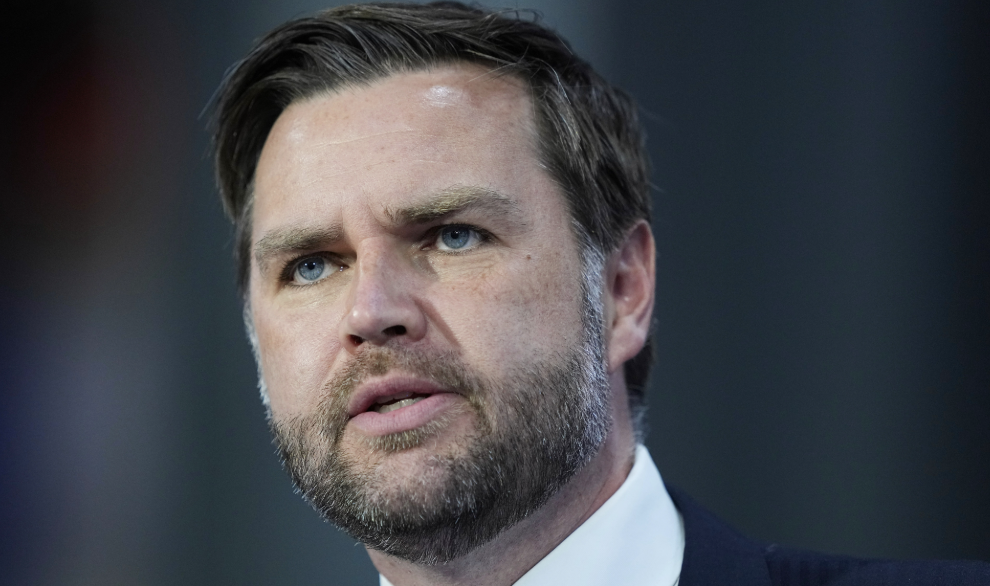
Vice President JD Vance has accused Britain’s ruling class of letting civilizational decay reach the point where 18-year-old Henry Nowak was handcuffed by police as he lay dying from stab wounds — a case that has become a horrifying symbol of mass migration, elite cowardice, and two-tier justice.
Nowak, a white student, was murdered in Southampton last December by 23-year-old Vickrum Digwa, who was sentenced this week to life in prison. The killing has sparked fury across Britain and the United States after video showed officers restraining the bleeding teenager while he repeatedly told them he had been stabbed and could not breathe.
Digwa falsely claimed he was the victim. He also alleged that Nowak had racially insulted him — a lie that has become central to the political scandal surrounding the police response.
For critics, the question is now unavoidable: did officers give more weight to a false racism accusation than to a dying young man pleading for help?
Vance, one of the Trump administration’s most aggressive voices on Western decline, immigration, censorship, and elite failure, said Nowak’s death revealed something rotten at the heart of modern Britain. In a blistering post on X, he described the case as more than a murder.
“Henry Nowak died the same way a civilization dies: abandoned, handcuffed by authorities who neither trusted nor cared for him, and accused of hate crimes he did not commit,” Vance wrote. “His murder is as tragic as it is enraging.”
The vice president said the appropriate response was not another managed statement from political elites, not another bureaucratic review, and not another lecture about tolerance. It was, he said, “righteous anger.”
Vance argued that Nowak “should still be alive today.” He said the teenager would still be alive “if the last few generations of European elites had stood their ground against the politics of self-hatred and the mass invasion of migrants, many of whom despise the West and the people who love it.”
The statement detonated in London. A sitting American vice president was no longer merely criticizing British policing — he was accusing Britain’s establishment of allowing ideology to endanger its own people.
“Henry was far from the first to so needlessly lose his life, and I fear he won’t be the last,” Vance added.
The case has become a nightmare image for conservatives: a young man bleeding out in the street while the system appeared primed to treat him as the suspect after his killer made a false accusation of racism.
To the populist right, it is the perfect snapshot of ideological policing. A dying British teenager said he had been stabbed, yet the institutions that should have protected him appeared more conditioned to fear a racism narrative than to believe the victim in front of them.
The U.S. State Department had already weighed in before Vance spoke publicly. On Thursday, it condemned what it called “ideological conditioning and two-tiered policing” in the handling of the case.
That intervention infuriated Prime Minister Keir Starmer’s government, which responded by accusing outside figures of stoking unrest. A spokesperson for Starmer said Britain had seen people “trying to interfere in our democracy and seeking to stir up division on our streets.”
The spokesperson also invoked the Nowak family’s request that Henry’s killing not be used to fuel further hatred, division, or tension. “We should respect their wishes,” the spokesperson said. “Even in the most terrible circumstances, our politics should bring people together. That is who we are as a country.”
But for many on the right, those words sounded like the familiar language of an establishment desperate to move on before the public asks too many questions. They argue that “unity” has become the ruling class’s favorite word whenever ordinary people demand accountability.
Starmer has admitted police have serious questions to answer. He has said investigators must examine how the false allegation of racism shaped police thinking at the scene.
At the same time, the prime minister has focused heavily on condemning public anger over the case. He called a violent and disorderly protest Tuesday night “unforgivable” after Nigel Farage urged people to respond with “pure cold rage.”
Farage has been among the most prominent British voices saying Nowak’s death exposed a broken system. His argument is blunt: Britain’s institutions have created a hierarchy of concern in which some claims are treated as sacred while ordinary citizens are left exposed.
Elon Musk has also repeatedly posted about the case on X, saying it showed police bias against white people in Britain. His intervention further internationalized the scandal and forced Starmer into another public clash with the American right.
Starmer accused Musk of “trying to whip up division” in Britain. His office also rejected the claim that Britain operates a two-tier criminal justice system.
Deputy Prime Minister David Lammy said he welcomed American condolences to the Nowak family. But he told Sky News that he did not recognize “this caricature of Britain having a two-tier criminal justice system.”
Local police have also rejected accusations of bias. Still, senior police figures have said they will review guidance introduced after past concerns about racism in policing, including guidance on how officers handle ethnicity-related incidents.
For critics, that review is not reassurance. It is evidence that police culture has been shaped by ideological training and institutional fear — a culture in which officers may hesitate to challenge certain narratives even when a victim is dying in front of them.
The case has now become part of a wider rupture between London and Washington. Britain and the United States remain formal allies, but under the Trump administration the alliance has become increasingly strained over immigration, free speech, policing, and the direction of Western civilization.
Vance has repeatedly warned that European leaders are censoring dissent, losing control of borders, and showing more hostility toward their own citizens than toward the forces destabilizing their societies. His comments on Nowak’s killing were a direct extension of that worldview.
For the MAGA movement, the lesson is brutal but simple. Western governments imported disorder, punished dissent, trained police and institutions to fear politically incorrect conclusions, and now act shocked when public trust collapses.
Starmer’s office insisted Friday that Britain’s relationship with the United States remains “incredibly strong.” But its rejection of the State Department’s criticism showed just how deep the ideological divide has become.
The Trump-Vance right sees mass migration and two-tier policing as existential threats to Western nations. Britain’s governing class, by contrast, often treats those concerns as dangerous agitation to be managed, censured, or dismissed.
Nowak’s family has asked that his death not be used to fuel hatred. That plea deserves respect.
But the political questions surrounding the case cannot be wished away. Why was a dying teenager handcuffed after saying he had been stabbed? Why did a false racism claim appear to carry such force? Why do so many British citizens now believe the system is quicker to suspect them than to protect them?
For Vance and the America First right, the answer is civilizational. A country that loses confidence in its own people, refuses to control its borders, and trains its institutions to distrust ordinary citizens will eventually fail at the most basic duty of government: protecting the innocent.
The Nowak case is no longer just a murder case. It is a referendum on the Britain built by mass migration, institutional guilt, elite cowardice, and managed decline.
The message from Vance was unmistakable. Henry Nowak’s death was not only a tragedy — it was a warning about what happens when a civilization forgets who it is supposed to defend.