
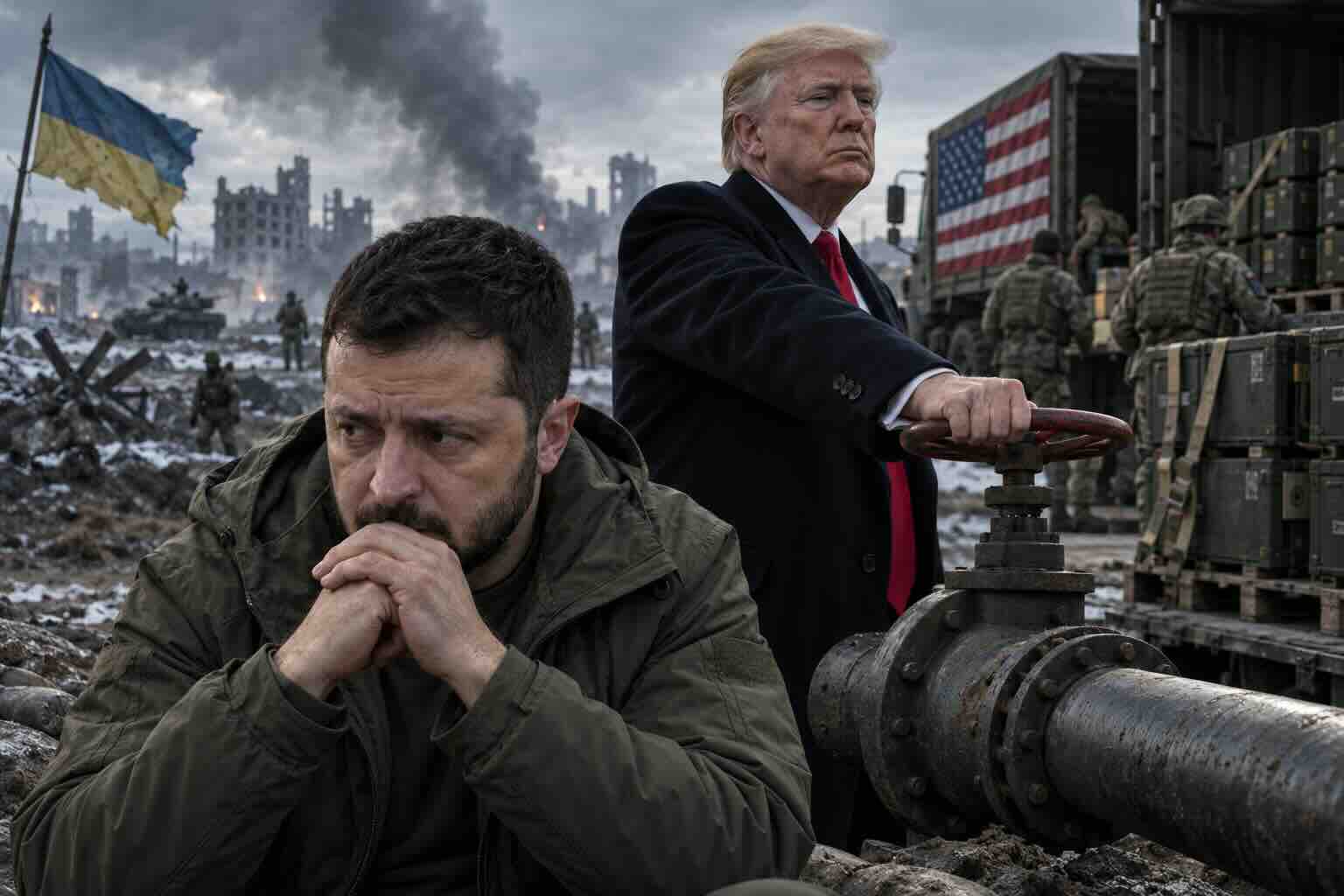
President Donald Trump’s growing pressure on Ukraine has created a new test for Volodymyr Zelensky as the war enters another uncertain phase. Washington has slowed some military assistance and raised the prospect of further restrictions, while Kyiv has signaled that it could freeze fighting along the current front in pursuit of a ceasefire. Yet Russia and Ukraine remain far apart on territory, security guarantees, and the conditions for a lasting settlement.
The latest reporting does not establish that the United States has eliminated every form of assistance. European countries can still finance purchases of American weapons through NATO’s Prioritised Ukraine Requirements List, known as PURL. But the Trump administration’s dispute with Zelensky has placed even those channels under pressure.
Reuters reported that the United States threatened to suspend intelligence sharing and PURL procurement if Ukraine continued attacks on Russian energy targets. That report described a warning rather than proof that Washington had executed a comprehensive cutoff. Trump could still decide to further restrict weapons, intelligence, or other support as his relationship with Zelensky deteriorates.
Intelligence support has become an especially contested issue. Zelensky said on October 18 that a brief interruption occurred before service resumed. Secretary of State Marco Rubio denied the next day that a pause had taken place, while Trump also said intelligence sharing continued. The competing accounts leave the public record unclear about the scope and duration of any disruption.
Satellite access has added another point of uncertainty. Trump said October 22 that Elon Musk restored Starlink access for Ukraine, although Ukrainian officials said service improvements might not amount to a full restoration. Rubio said SpaceX and Musk made the access decisions.
Against that backdrop, Zelensky offered his clearest recent endorsement of freezing the battlefield where forces stand. He said Kyiv supports a halt to the fighting followed by diplomacy and security guarantees from Washington and European partners. “It’s important to negotiate trilaterally” with Trump and Russian President Vladimir Putin, Zelensky said, while adding that European countries should also participate.
His proposal does not mean Ukraine accepts Russia’s territorial demands though. Kyiv continues to oppose giving Moscow land that Russia does not control, especially Ukrainian held areas of Donbas. Moscow, meanwhile, seeks a final settlement and a wider European security framework instead of a temporary pause in combat.
Russian and Ukrainian officials have both indicated support for renewed United States mediated technical talks, potentially beginning in Abu Dhabi in November. Still, diplomatic willingness does not erase the core disagreement over territory and Ukraine’s future security alignment.
From an America First perspective, Washington should end military assistance, reject an open-ended commitment to Ukraine, and press the parties toward a durable settlement. The US and its NATO satrapies have spent billions sending military aid and intelligence to Ukraine in a needless conflict that resulted in the deaths of hundreds of thousands of people. The United States should also leave NATO and stop placing American resources and lives at risk in a war that does not serve a vital national interest.