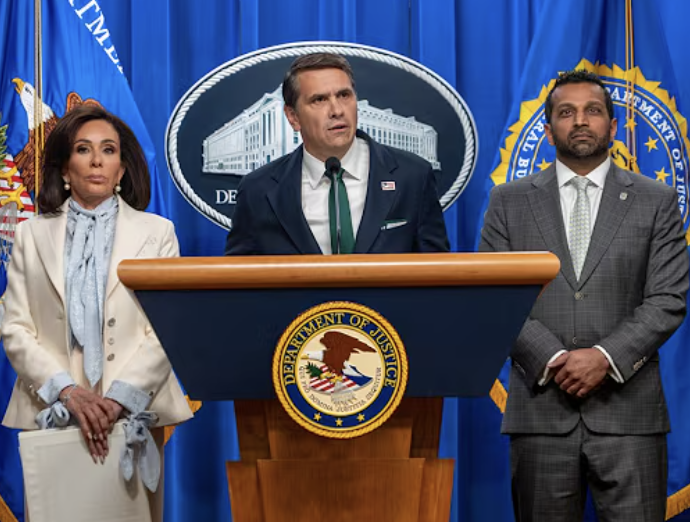
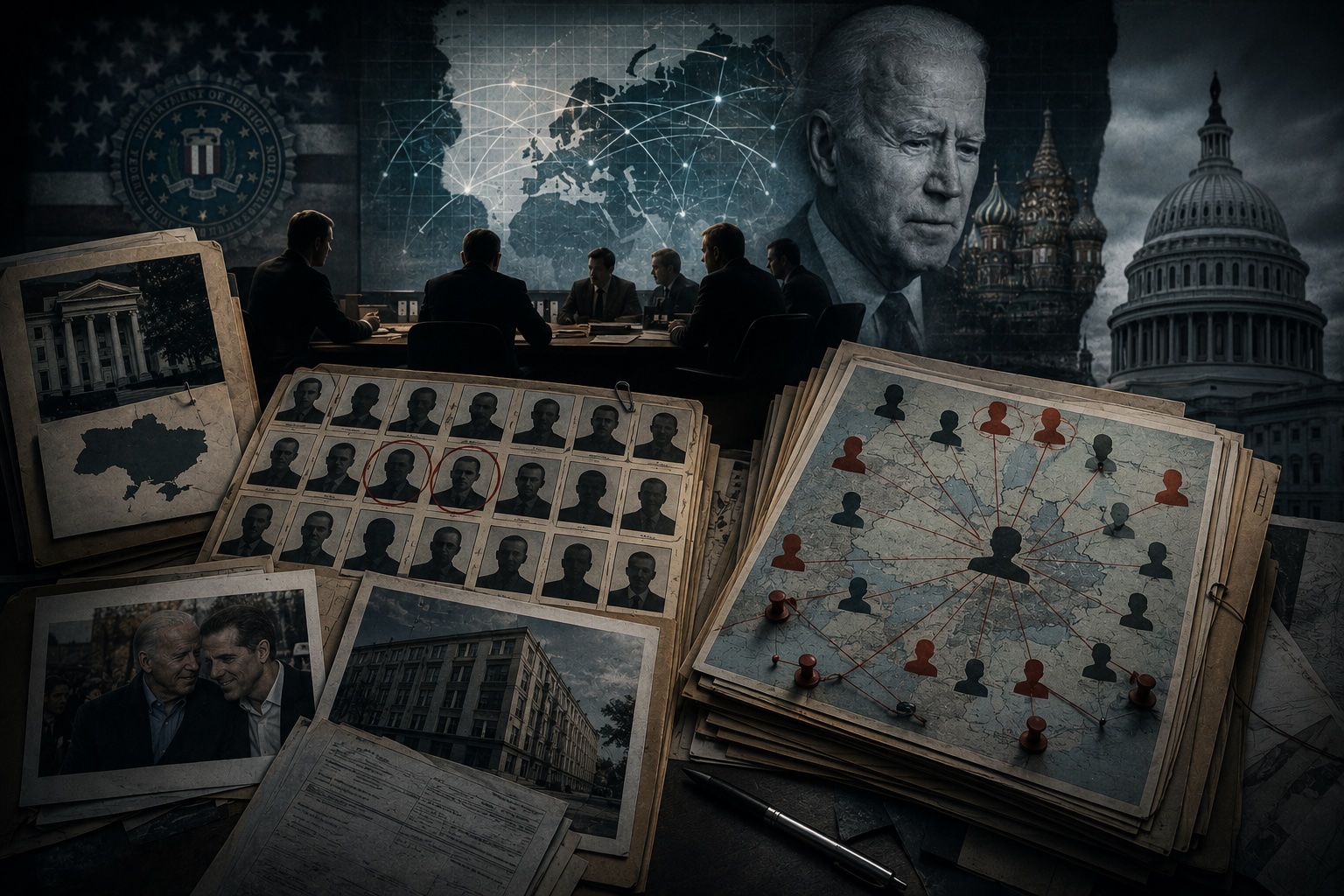
Newly released intelligence records describe an FBI effort that categorized senior government officials, members of Congress and journalists as potential conduits of Russian disinformation while the bureau possessed a much larger body of reporting about the Biden family than was publicly known.
In the final year of the 2020 presidential campaign, as American intelligence agencies were warning urgently about Russian efforts to interfere in another election, a small group of analysts inside the Federal Bureau of Investigation began assembling a different kind of map.
It included cabinet secretaries, senators, members of Congress, journalists, political operatives and media organizations. Some were classified as possible targets of Russian influence. Others were identified as potential “conduits” through which Russian disinformation might travel into American political life.
Among those placed in the latter category, according to newly declassified records, were Attorney General William P. Barr, Secretary of State Mike Pompeo and Republican lawmakers including Senators Charles E. Grassley, Ron Johnson and Lindsey Graham, as well as Representatives Devin Nunes and Jim Jordan.
The records also included journalists and news organizations.
The analytical effort was part of a previously little-known FBI counterintelligence operation known as Round River, according to documents released by the White House Government Transparency Task Force and reporting by Just the News.
But the most consequential revelation may concern what the FBI already had inside its own files.
According to FBI Director Kash Patel and an intelligence review released with the documents, federal agencies had received derogatory reporting concerning Joe Biden, Hunter Biden and their activities connected to Ukraine from at least 14 confidential human sources.
Some of that reporting dated back years.
The existence of informant reports does not mean the allegations they contained were true. Confidential human-source reporting is raw intelligence, not a finding of fact, and the history of the Biden investigations provides a particularly vivid warning against conflating the two: Alexander Smirnov, a longtime FBI source who made explosive allegations that Joe and Hunter Biden had each received a $5 million bribe from the Ukrainian energy company Burisma, later admitted that he had fabricated the story.
Still, the newly released documents raise a different and potentially more difficult question for the bureau.
They suggest that while the FBI possessed a substantial collection of allegations about the Bidens from multiple sources, a counterintelligence team was simultaneously examining the people trying to investigate or publicize those allegations as possible vectors of Russian influence.
That distinction goes to the heart of a controversy that has followed the FBI for nearly a decade: not simply whether individual allegations were ultimately proved, but how the nation’s premier law-enforcement agency decided which politically sensitive information deserved aggressive investigation and which deserved skepticism.
A Secret Program Takes Shape
According to a 2025 intelligence-community review cited in the newly released documents, Round River traces its origins to approximately December 2019.
The timing was extraordinary.
President Donald J. Trump was facing impeachment over his effort to pressure Ukraine to investigate the Bidens. Hunter Biden’s lucrative position on the board of Burisma had become a central Republican talking point. American intelligence officials were simultaneously preparing for another expected wave of Russian election interference.
Against that backdrop, analysts attached to the FBI’s Foreign Influence Task Force began searching government databases for previous confidential-source reporting involving Biden, Burisma, Hunter Biden, Ukrainian businessman Mykola Zlochevsky and allegations of Ukrainian involvement in the 2016 election.
The purpose, according to the intelligence review, was to identify reporting that might represent Russian disinformation.
That is not, by itself, an unusual counterintelligence function. Russia had interfered extensively in the 2016 election and had demonstrated a sophisticated ability to inject authentic, altered and fabricated material into Western political disputes.
What makes Round River unusual is the breadth of the Americans apparently drawn into its analytical orbit.
A newly released defensive-briefing spreadsheet divided prominent figures into categories including potential “targets” and “conduits” of foreign influence.
Democratic figures including Biden, Barack Obama, Hillary Clinton and John Kerry appeared among those characterized as targets. A number of Republicans and conservative media figures appeared among the potential conduits.
Barr and Pompeo were among them.
So were Grassley and Johnson, who were conducting a congressional investigation into Hunter Biden’s foreign business relationships.
The FBI’s Foreign Influence Task Force registered “no objection” to the assessments contained in the spreadsheet, according to the documents.
The significance of those labels remains unclear. Being identified as a possible conduit did not necessarily mean the FBI believed an individual was knowingly working for Russia. Foreign intelligence services routinely exploit people who have no idea they are being used.
But labeling senior American officials and journalists in such a system could carry substantial consequences inside the intelligence bureaucracy, particularly if the classification affected how investigators evaluated information coming from them.
The Informants
The other side of the Round River story was largely invisible to the public in 2020.
The FBI had confidential sources.
A lot of them.
Patel has told the White House task force that the bureau has identified at least 14 confidential human sources who supplied derogatory information concerning the Bidens, according to the newly released material.
Three received particular scrutiny in the intelligence review.
One source had worked with the government since roughly 2012 and began reporting concerns about Burisma and Zlochevsky as early as 2015, according to the review.
Another source provided reporting from 2017 through 2022 about alleged corruption involving Burisma.
A third had worked intermittently with the government since 2008 and reported information involving Hunter Biden in 2019.
The allegations were sometimes extraordinary, involving purported influence operations, secret payments and attempts by Ukrainian interests to cultivate politically connected Americans.
Changing the Files
The most serious allegation contained in the newly released intelligence review concerns what happened to some of those confidential-source records after Round River began.
According to the review, analysts with administrative access to FBI reporting systems created intelligence products that were subsequently added to the files of three confidential sources, indicating that their reporting had been assessed as Russian disinformation.
The review further says Round River analysts had not corroborated the underlying allegations.
That creates an unusual analytical problem.
Failure to corroborate an allegation is not the same as proving it is disinformation.
Disinformation generally implies something more: intentionally false or manipulated information, typically circulated to deceive.
Whether Round River analysts had sufficient intelligence to make that judgment is now one of the questions being examined internally by the FBI.
Patel has said the Foreign Influence Task Force has been terminated and that the bureau is reviewing whether Round River information was used in ways that interfered with other investigations.
The Pittsburgh Problem
One episode illustrates why the newly released records could receive sustained congressional attention.
In early 2020, Attorney General Barr directed the U.S. attorney’s office in Pittsburgh to evaluate information concerning Ukraine and the Bidens that was arriving at the Justice Department, including material associated with Trump’s personal lawyer, Rudolph W. Giuliani.
At roughly the same time, Round River was operating from FBI headquarters.
According to the newly released material, the operation directed activity involving several FBI field offices, including Pittsburgh.
That means two processes were unfolding inside the federal government at once.
One was tasked with evaluating Biden-related allegations.
Another was examining whether Biden-related allegations and the people spreading them might be part of a Russian influence operation.
Those missions were not necessarily incompatible. Indeed, responsible counterintelligence work could require both.
But they create an obvious institutional danger if information from the second process influenced the first without investigators understanding how the intelligence judgments had been reached.
Patel said the FBI is now investigating whether that happened.
A Warning to Congress
Round River also intersects with a long-running dispute involving Grassley and Johnson.
The senators have said that an FBI defensive briefing they received in 2020 appeared designed less to protect them from foreign manipulation than to undermine their investigation of Hunter Biden.
Defensive briefings are a standard counterintelligence tool. Intelligence agencies may warn lawmakers or campaigns when officials believe a foreign government is attempting to manipulate them.
But the newly released documents indicate that Round River contemplated defensive briefings for members of Congress who received information connected to what analysts called the “Ukraine narrative.”
If those briefings were based on intelligence assessments that themselves had not been adequately corroborated, their purpose and effect could become an important focus of congressional investigators.
Grassley has spent years seeking additional FBI and Justice Department records involving Crossfire Hurricane and other politically sensitive investigations. As recently as this year, the Senate Judiciary Committee was still pressing the Justice Department inspector general for roughly 170 interview transcripts connected to the earlier Russia investigation.
The fight over Round River is therefore emerging against a much larger backdrop of unfinished disputes over FBI conduct.
The Ghost of Crossfire Hurricane
The parallels to the bureau’s handling of the Trump-Russia investigation are difficult to avoid.
Crossfire Hurricane, opened in July 2016, examined whether members of Trump’s campaign were coordinating with Russia.
Justice Department Inspector General Michael Horowitz identified serious failures in the FBI’s applications for surveillance of former Trump campaign adviser Carter Page.
Those applications contained significant errors and omissions.
Special Counsel John Durham later went further, arguing that the FBI had relied too readily on poorly corroborated information and had failed to apply appropriate analytical rigor when investigating Trump.
Durham’s investigation described an institution that, in his view, had repeatedly failed to challenge assumptions when dealing with politically explosive intelligence.
Then Came the Laptop
Nothing better illustrates that ambiguity than Hunter Biden’s laptop.
In October 2020, weeks before the election, the New York Post published emails and other material said to have originated from a laptop Hunter Biden had left at a Delaware repair shop.
The provenance of the material was initially difficult for other news organizations to establish. Giuliani, who helped bring the material to the Post, had himself been the subject of warnings about Russian influence efforts involving Ukraine.
More than 50 former intelligence officials subsequently signed a public letter saying the laptop story had the “classic earmarks” of a Russian information operation, while explicitly acknowledging that they did not have evidence proving Russian involvement.
That distinction largely disappeared in the political debate.
Social-media companies restricted circulation of the New York Post reporting. Much of the national press refused to truthfully report on the story.
What Was Real
There is now a considerable amount of information about Hunter Biden’s foreign business dealings.
Hunter Biden did serve on Burisma’s board while his father was vice president.
He received substantial income from foreign business relationships.
Federal prosecutors later established that he failed to pay at least $1.4 million in federal taxes during a period that included income from overseas ventures.
In September 2024, Hunter Biden pleaded guilty to nine federal tax offenses, including three felonies. He had separately been convicted on federal gun charges.
President Biden subsequently issued his son an extraordinarily broad pardon covering federal offenses Hunter Biden “committed or may have committed” between Jan. 1, 2014, and Dec. 1, 2024.
The starting date was notable.
2014 was the year Hunter Biden joined Burisma’s board.
Years of congressional investigation produced evidence that Joe Biden interacted with some of Hunter Biden’s business associates, contradicting his earlier assertions that he had never discussed his son’s business.
The Question That Remains
Patel has said the FBI’s internal review of Round River is continuing.
It is not yet publicly known who authorized every stage of the operation, which officials approved the assessments, how many Americans actually received defensive briefings, what intelligence supported each “conduit” designation or how information generated by Round River materially altered or influenced investigations.
Some of the underlying concerns surrounding Hunter Biden — including his foreign income, unpaid taxes and the authenticity of significant portions of his laptop material — proved real.
The question confronting investigators now is what the FBI knew at the time, how it distinguished one from the other, and whether politics influenced their decisions on who to target, and who to exonerate.