


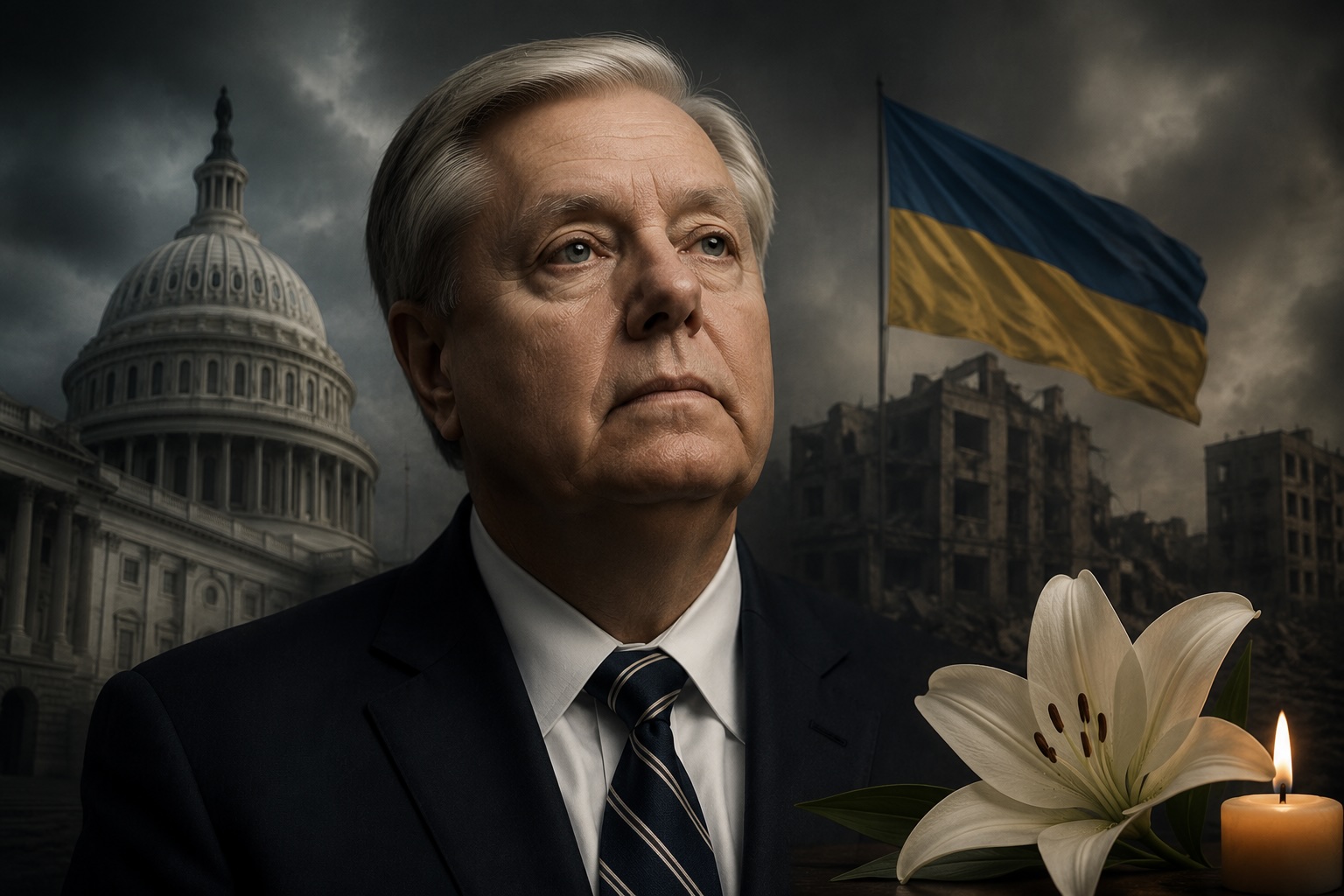
Senator Lindsey Graham, who once suggested that some January 6 Capitol rioters “should be shot in the head” and who told White House counsel that President Trump should be removed under the 25th Amendment after the riot, has died at age 71.
Graham had a reputation as one of Washington’s most consistent foreign policy hawks and warmongers. Throughout his time in government, he pushed for deeper U.S. military involvement and prolonged engagements abroad while repeatedly visiting American troops in combat zones in Iraq and Afghanistan.
Most notably, however, was his love for Ukraine.
For more than a decade, beginning around late 2013, Graham — often alongside Sen. John McCain — publicly offered weapons, military aid, and direct support to Ukraine through Senate speeches, media appearances, and on-the-ground visits. (See, e.g., their December 2013 Kyiv visit and the December 2016 Donbas front-line trip documented here.)
Senators John McCain and Lindsey Graham visited Ukrainian forces on the front lines in the Donbas region in late December 2016. Graham told troops: “Your fight is our fight. … 2017 will be the year of offense…”
Graham often framed U.S. support for Ukraine as both a strategic investment in American security and a moral imperative.
Many Americans, however, dismissed his approach as political theater — a spectacle of animated speeches from Kyiv’s streets, relentless calls to arm Ukraine, sweeping sanctions on Russia, and deeper NATO involvement, all well before the 2022 full-scale invasion.
These high-profile efforts contributed to America’s sustained, open-ended commitment and the flow of billions in taxpayer dollars to the fight.
America’s role as Ukraine’s major funding source was no accident. Trace the key policy decisions, and the trail consistently leads back to Graham.
Since late 2013, Sen. Lindsey Graham (R-SC) emerged as one of Congress’s loudest and most persistent advocates for deeper U.S. entanglement in Ukraine across political, military, and economic fronts.
Graham worked to sustain Republican support for military aid and sanctions amid growing skepticism about endless commitments and proxy conflicts, often citing the benefits to U.S. defense and the need to pay now or pay later.
Questions still remain about how organically the 2013–2014 escalation unfolded.
Protests erupted almost immediately after November 21, 2013, when President Viktor Yanukovych suspended a landmark Association Agreement with the European Union under heavy Russian economic pressure.
According to Ted Galen Carpenter of the Cato Institute, “The extent of the Obama administration’s meddling in Ukraine’s politics was breathtaking.”
The Euromaidan demonstrations escalated rapidly, with tactics, masks, imagery, and coordination that struck many observers as echoing classic U.S.style “color revolution” patterns, which have invited legitimate skepticism about the degree of spontaneity.
The leaked Nuland-Pyatt telephone call, secretly recorded in late January 2014 and publicly released days later, added fuel to those doubts. It revealed direct U.S. involvement in opposition strategy and post-Yanukovych political transition planning, including senior U.S. officials openly discussing preferred opposition leaders — famously declaring “Yats is the guy.” The U.S. government neither confirmed nor denied the call.
Graham and McCain served as vocal public cheerleaders on the ground in Kyiv, casting the upheaval as a pure struggle for freedom and European values.
A 2014 Guardian analysis by Seumas Milne pointed to the Western double standard: armed protesters seizing buildings in Maidan were celebrated, while similar actions in eastern Ukraine were condemned. Milne argued that Western efforts to pull Ukraine into its orbit by ousting an elected leader made conflict nearly inevitable, a view shared by many Ukrainians, especially in the east and south. Many who lived through the chaos still consider it an effective coup, despite official Western narratives.
These protests followed a familiar pattern: large crowds gathered in central squares to voice genuine grievances over corruption and the abrupt pivot away from the EU, but the rapid emergence of masked, militarized self-defense units struck many observers as out of step with traditional civilian protest culture.
While legitimate grievances existed, many still continue to question the movement’s authenticity.
By December 2013, Senators McCain and Graham were in Kyiv addressing crowds on Maidan Square, framing the events as a historic stand for European values. Graham declared: “Your fight is our fight. … 2017 will be the year of offense. All of us will go back to Washington, and we will push the case against Russia. Enough of Russian aggression. It is time for them to pay a heavier price.”
Violent clashes led to a contested transition: Yanukovych fled to Russia, and parliament removed him from power. The new leadership was widely viewed as pro-American.
The pattern repeated with Volodymyr Zelensky. Elected in 2019 on promises of peace, reform, and ending the Donbas conflict, he ultimately aligned closely with Washington’s priorities, backed by sustained U.S. advocacy, including from Senator Lindsey Graham, for arms and aid.
Many Ukrainians, exhausted by casualties, economic ruin, and broken promises, are aware of the fact that official narratives have been obscuring the reality. They recognize their country’s rich deposits of lithium, titanium, rare earths, graphite, and other strategic resources in contested regions as a major unspoken driver of Western interest, turning what was sold as a pure democratic revolution into a great-power contest fought on Ukrainian soil.
Throughout his career, Sen. Lindsey Graham was one of the leading proponents of U.S. interventionism in foreign policy and a particularly strong advocate for Ukraine. Critics, however, saw a consistent, familiar pattern of reflexive calls for greater military involvement and a consistent rejection of restraint or diplomacy.
He advocated for arming Ukraine following Russia’s 2014 actions in Crimea and remained one of Kyiv’s most vocal champions in Congress during the full-scale war. In a May 2023 meeting in Kyiv with President Zelenskyy, Graham described U.S. military aid as “the best money we’ve ever spent,” while separately remarking in the same conversation that “the Russians are dying.”
