


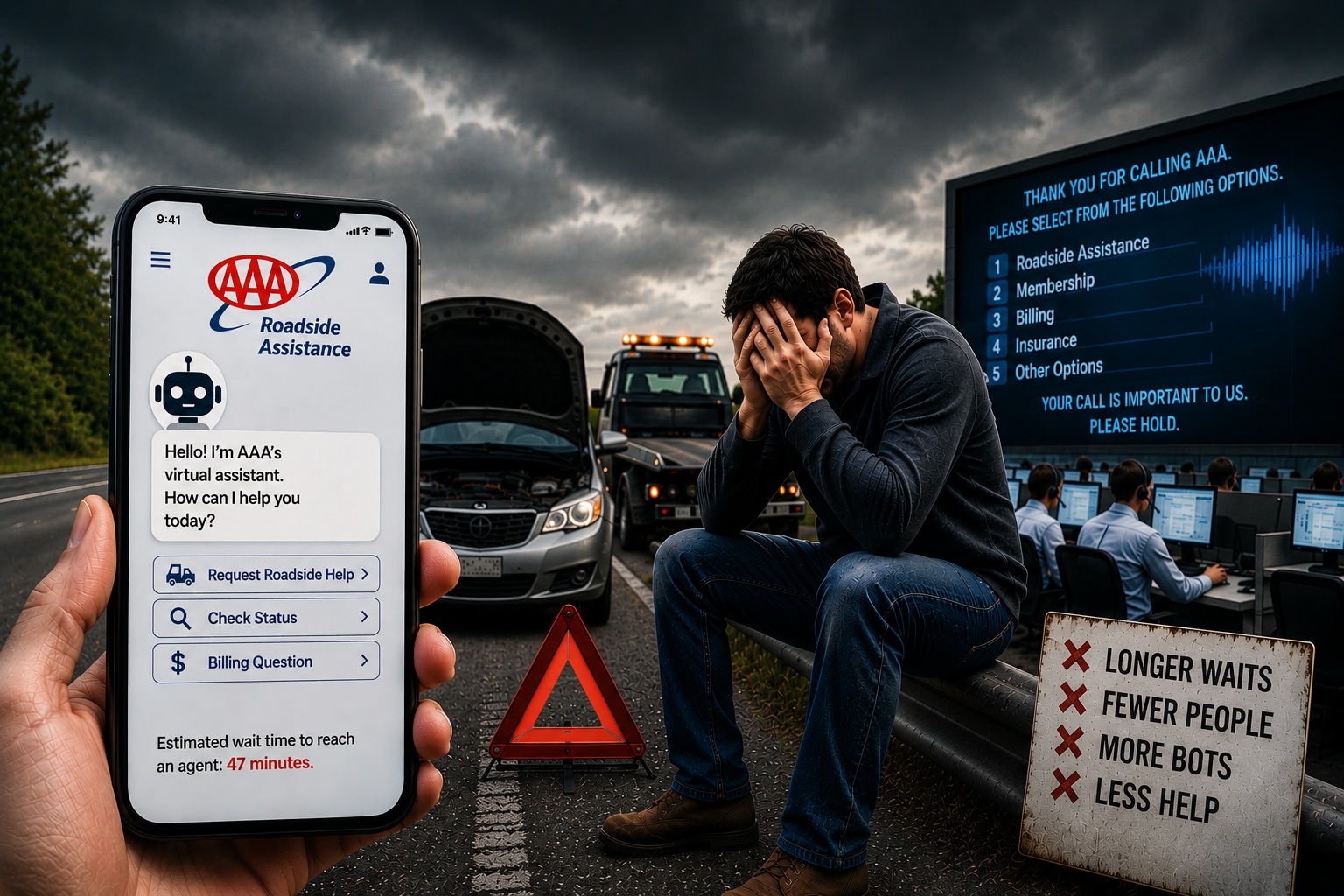
For much of the last decade, corporate America has embraced artificial intelligence, automated phone systems, chatbots and digital self-service platforms with the promise of making customer service faster and more efficient. Companies have argued that technology would reduce wait times, improve consistency and make it easier for customers to obtain help at any hour of the day. Increasingly, however, consumers describe a different experience—one in which automation has become another obstacle separating companies from the people they are supposed to serve.
The problem is not artificial intelligence itself. Used well, AI can speed routine tasks, organize information and help employees respond more quickly. The concern arises when businesses treat automation as a substitute for trained customer-service representatives rather than as a tool that supports them. In industries where customers are under stress, frightened or facing an emergency, the absence of human judgment can transform an inconvenience into an ordeal.
Few businesses illustrate that tension more clearly than roadside assistance. The value of a roadside assistance membership has never depended solely on dispatch software or mobile applications. It has always rested on a simple promise: when a vehicle breaks down, someone will answer the call, understand the situation and coordinate help as quickly as possible. Customers purchase that peace of mind long before they ever need a tow truck.
AAA remains one of the most recognizable roadside assistance organizations in North America and continues to serve millions of members every year. At the same time, some customers have criticized what they view as an increasingly automated customer experience. Online reviews and consumer forums frequently describe frustration with navigating automated systems, difficulty reaching live representatives during stressful situations, repeated requests to confirm information already provided and uncertainty about arrival times. Individual experiences vary, but the broader criticism reflects a growing concern shared across many industries: technology can leave customers feeling that no one is personally responsible for solving their problem.
That perception matters because roadside assistance is unlike most subscription services. People rarely think about it until something goes wrong. A dead battery on a busy interstate, a flat tire during a thunderstorm or a disabled vehicle late at night is not merely an inconvenience; it can be a safety issue. In those moments, reassurance often comes from speaking with an experienced person capable of making decisions rather than following a scripted workflow.
The economic incentives behind automation are easy to understand. Labor is expensive, and AI systems can process thousands of routine requests simultaneously. For executives, reducing staffing costs while expanding digital capabilities can improve operating margins. The challenge is that the same efficiencies that benefit a company’s balance sheet may diminish the quality of the customer experience if human support becomes difficult to access.
That creates an opening for competitors. Insurance companies, automobile manufacturers and independent roadside assistance providers continue expanding their own programs. Those organizations may find that the most effective way to win market share is not by introducing more automation but by investing in responsive dispatchers, knowledgeable representatives and customer-service teams empowered to solve problems instead of directing customers through another digital workflow.
Artificial intelligence will almost certainly remain a permanent part of customer service. The question is whether businesses deploy it to strengthen relationships with customers or to replace them. Companies that strike the right balance can benefit from both technology and human expertise. Those that rely too heavily on automation risk discovering that the greatest competitive advantage in the AI era is not another chatbot, but a real person who answers the phone when customers need help most.
