


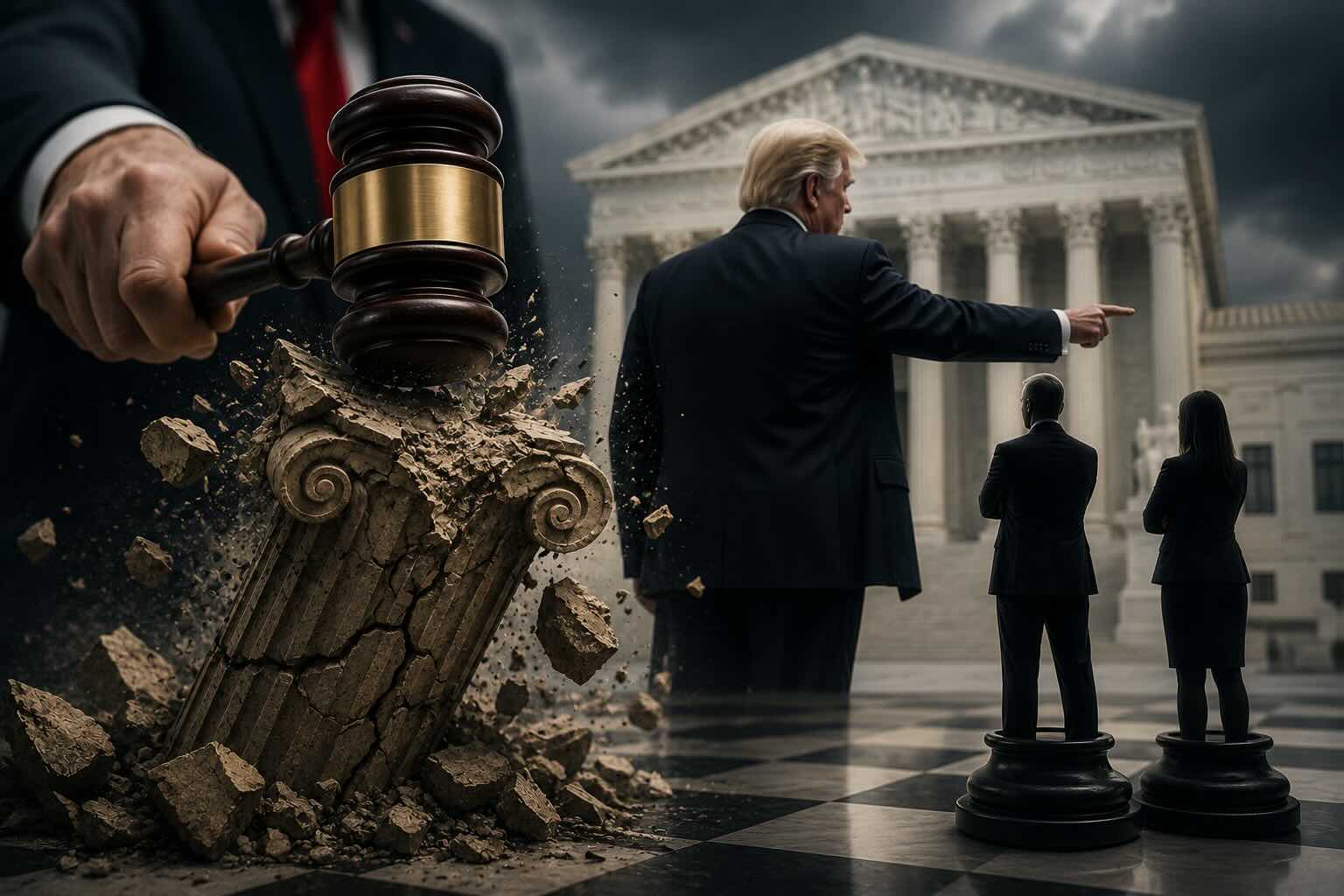
President Donald J. Trump is now legally able to fire officials from the Federal Trade Commission.
The Supreme Court issued a 6-3 decision on June 29, 2026, in Trump v. Slaughter, holding that the Federal Trade Commission’s statutory for-cause removal protections for its commissioners are unconstitutional, siding with President Trump.
This ruling directly overturns the 90-year-old precedent in Humphrey’s Executor v. United States (1935), which had permitted Congress to shield FTC commissioners from at-will removal except for “inefficiency, neglect of duty, or malfeasance in office.”
Chief Justice John Roberts, writing for the majority, delivered a clear rebuke to congressional overreach. He declared that if anything remains of Humphrey’s Executor, “we overrule it.”
The dispute originated early in President Trump’s second term when he removed Democratic FTC Commissioner Rebecca Kelly Slaughter, a former aide to Senate Minority Leader Chuck Schumer, and another Democratic commissioner.
The President cited policy misalignment rather than the narrow statutory “cause.”
Lower courts initially reinstated Slaughter based on the outdated Humphrey’s precedent. The Supreme Court stayed that order in September 2025 and heard arguments in December 2025.
The majority held that the FTC’s structure and powers have evolved dramatically since the 1935 ruling.
Today’s commissioners exercise substantial executive authority in enforcement, rulemaking, and antitrust actions, powers that fall squarely within the President’s constitutional duty to “take Care that the Laws be faithfully executed.” For-cause removal restrictions undermine this accountability and violate the separation of powers.
The Court rightly described Humphrey’s Executor as an “outdated outlier” whose original rationale is now obsolete in light of today’s expansive administrative state.
This ruling builds directly on recent precedents reinforcing executive authority, including Seila Law LLC v. Consumer Financial Protection Bureau (2020) and Free Enterprise Fund v. Public Company Accounting Oversight Board (2010).
President Trump acted lawfully when he fired Slaughter and her colleague without cause. The decision confirms his authority to reshape the FTC, accelerating much-needed deregulatory efforts in antitrust, technology, and consumer protection. With partisan balance protections now weakened, the President can ensure the commission serves voter priorities rather than entrenched Washington interests.
Republicans hail this as a long-overdue vindication of the unitary executive theory. By making agencies directly accountable to the elected President, the ruling strengthens democratic accountability, reining in the unaccountable bureaucratic power that has expanded unchecked for decades.
The Commander in Chief now has confirmed authority to reshape the FTC, accelerating much-needed deregulatory efforts in antitrust, technology, and consumer protection. With partisan balance protections now weakened, the President can ensure the commission serves voter priorities rather than entrenched Washington interests.
The effects could extend beyond the FTC to roughly two dozen other multi-member independent agencies, such as the SEC, NLRB, FCC, and CPSC) that rely on similar protections.
This decision delivers a monumental victory for the Trump administration’s drive to restore constitutional order. It aligns seamlessly with the Supreme Court’s unwavering skepticism toward unchecked agency power, building directly on landmark rulings that curtailed Chevron deference and invoked the major questions doctrine. Ultimately, it marks a transformative rebalancing of the government, shifting power away from unaccountable bureaucratic insiders and firmly back to the American people.
