


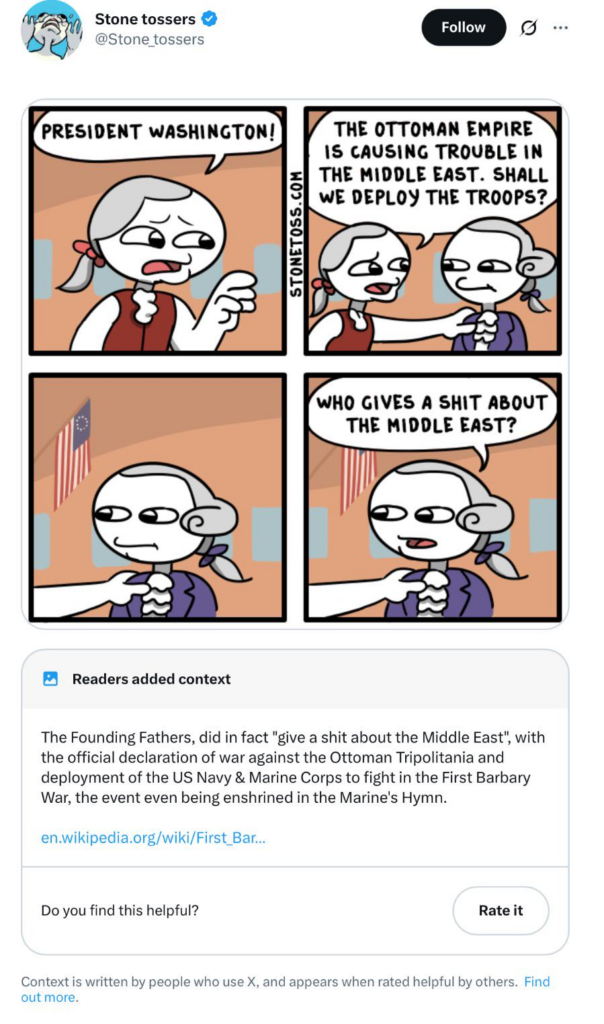
A popular Twitter/X account, Stonetoss Comics, published a comic a while ago that has resurfaced in the light of President Trump’s attempts to end the Iran War, which Iran started in 1979 when they kidnapped our embassy staff. Without going into a great deal of explanation of the comic, I will simply post it verbatim.
The Barbary Pirates and North African Slavery
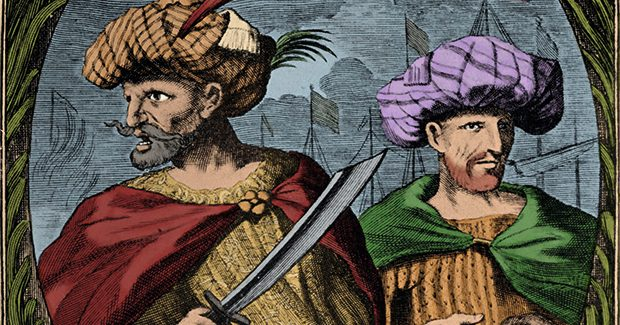
The North African Coast of the early 19th century was a hotbed of piracy and slavery. Various Ottoman vassal city states were notorious for their piracy and slave trading. Of particular interest to the North African pirate slave states was vulnerable American shipping.
After the Americans won the Revolutionary War, American merchantmen lost the protection of the mighty British Navy. Mediterranean shipping accounted for anywhere from 11%-20% of all overseas US trade. US merchant ships were routinely attacked, and their crews enslaved, showing that piracy is not some sexy endeavor starring Johnny Depp.
This was not solely for economic benefit. The Barbary Pirate States, who were Muslim, believed they had a sacred duty to make war upon Christians and enslave them. When Thomas Jefferson and John Adams were in London in 1786, the Tripolitan ambassador told the two Founding Fathers that it was a Muslim’s right and duty to make war upon any non-Muslims. Jefferson and Adams recounted the exchange in a letter to John Jay:
We took the liberty to make some inquiries concerning the grounds of their [Barbary’s] pretentions to make war upon nations who had done them no injury, and observed that we considered all mankind as our friends who had done us no wrong, nor had given us any provocation. The ambassador answered us that it was founded on the laws of their Prophet, that it was written in their Koran, that all nations who should not have acknowledged their authority were sinners, that it was their right and duty to make war upon them wherever they could be found, and to make slaves of all they could take as prisoners, and that every Musselman who should be slain in battle was sure to go to Paradise.
American Merchant Captain James Riley of the Commerce was captured by North African slave traders in 1815, and his book Sufferings in Africa was instrumental in developing Abraham Lincoln’s views on slavery.
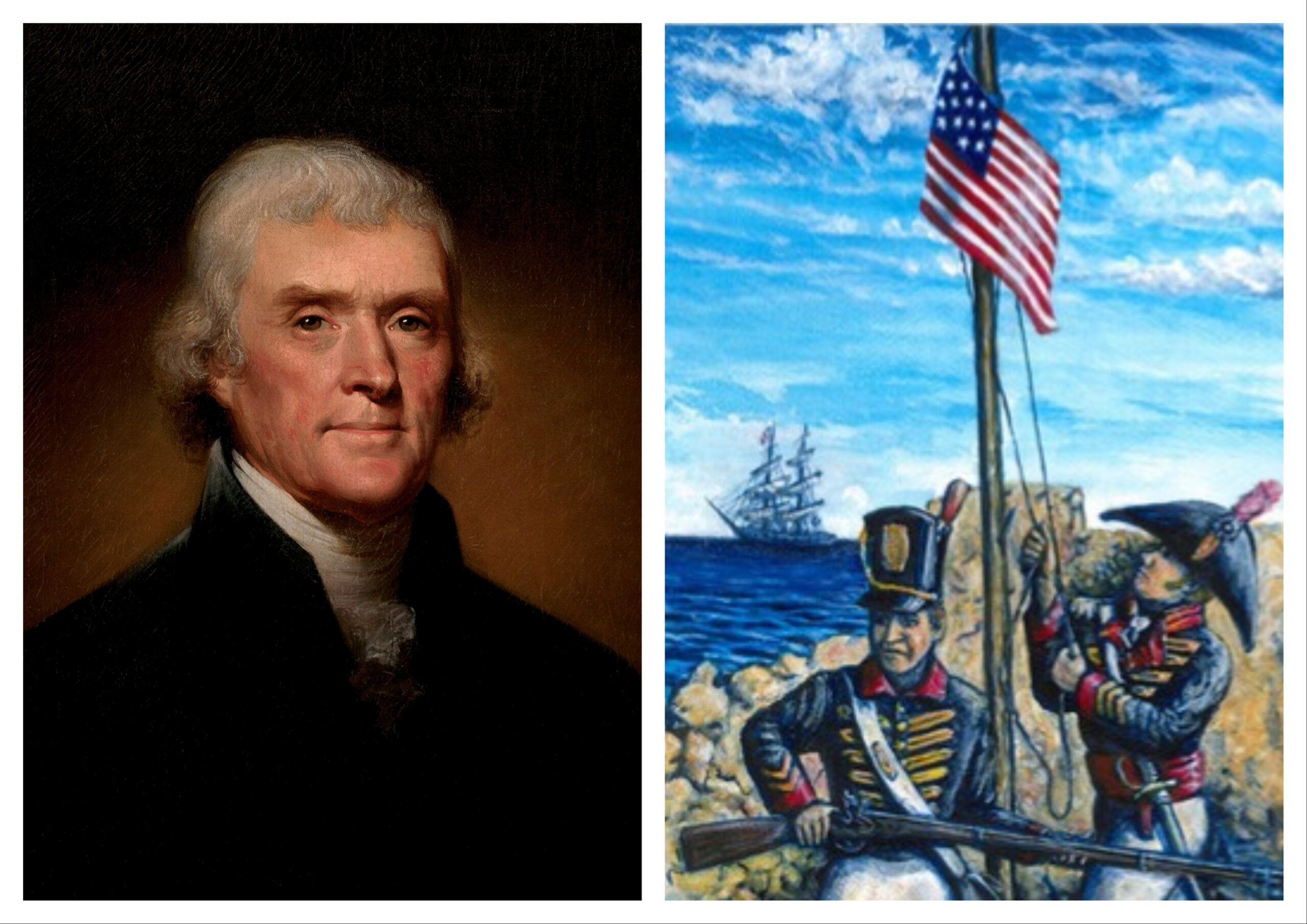
Jefferson Goes To War
After the American Revolution, the United States had a tiny navy, one that was barely able to defend the US coast, much less project power across the Atlantic. The US Navy was fundamentally incapable of protecting US Mediterranean merchantmen and the US citizens that crewed them. The United States was forced to pay tribute and ransom captured American citizens. These payments to the various Barbary Pirate states amounted to 20% of the US Federal budget in the late 1790s.
Thomas Jefferson was not a man known for his support of US overseas military adventures. But when he was inagurated in March of 1801, the Pasha of Tripoli asked for an additional $225,000 (out of an annual Federal budget of about $12 million), in additional to all the previous tributes that had taken up as much as 20% of the Federal budget.
Jefferson refused, and Tripoli decalred war on the United States. Jefferson had already sent three frigates and a schooner under Commodore Richard Dale in a last-ditch attempt to maintain the peace. As often happened in the Age of Sail, Jefferson did not know of the declaration of war until after Dale had sailed. But Dale had orders to protect American shipping in the event of war.
And thus, Founding Father Thomas Jefferson launched America’s first war against a Middle Eastern power (Tripoli was nominally a Turkish tributary). Like other American wars in the Middle East, there was no formal declaration of war, but an Authorization by Congress to use military force against the Pasha of Tripoli.
To The Shores of Tripoli
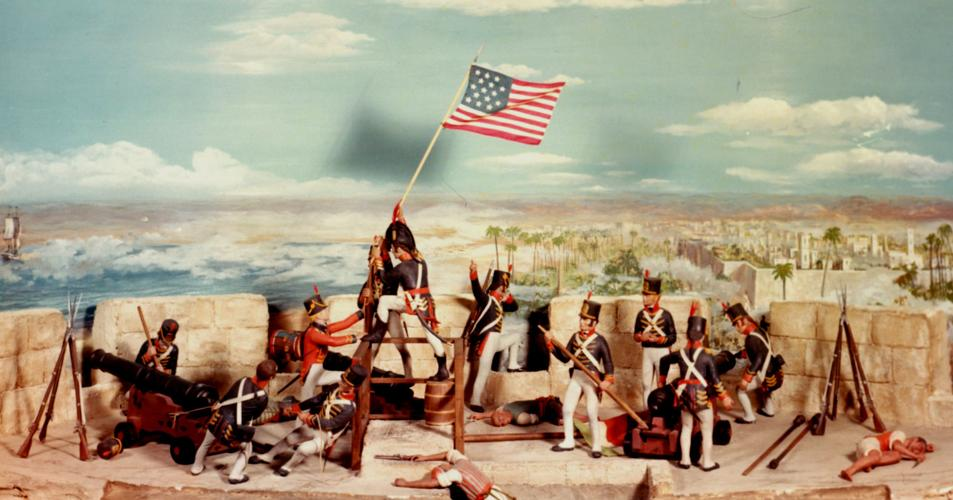
In 1804, former American Consul to Tunis William Eaton landed in North Africa along with Lieutenant Presley O’Bannon and seven United States Marines. O’Bannon and Eaton hired a force of about 300-400 Greek and Arab mercenaries. Their objective was the city of Derna, the capital of the Ottoman province of Cyrenaica. Traveling with them was Yusef Karamanli’s brother Hamet, who was the rightful ruler of Tripoli, as Yusef had murdered his older brother in front of his mother while Hamet was out of the country. Eaton had agreed to put Hamet on the throne in exchange for support against Yusef.
The first American overseas military expedition reached Derna on April 26th. O’Bannon and Eaton found the city defended by 800 men, while nearby was a Tripolitan army. After a brief parley, where the goveronor of Derna refused surrender, the US Marines and their allies attacked.
Under withering musket fire, General Eaton and Lieutenant O’Bannon charged the fortifications. Eaton was shot in the wrist, but the US Marines and Greeks led by O’Bannon took the main battery, and planted the American flag on the wall. It was the first time in history the American flag was planted on foreign soil. The attack on Derna was the inspiration for the lyrics in the Marine Anthem “to the shores of Tripoli.”
A Peace Squandered
Despite the capture of Derna, Yusef signed a treaty with Tobias Lear, ending the war. In spite of Eaton’s promises to Hamet, Lear squandered the victory at Derna and agreed to pay the Pasha $60,000 in ransom for the release of all Americans held. With Derna in their hands, the US probably could have secured the release of all American prisoners for no ransom.
The problem with the Muslim Pirate states enslaving Americans would not end until 1815. Commodore Stephen Decatur, a hero of the First Barbary War, would decisively end the threat of Muslim piracy to American shipping in the Second Barbary War.
But, What About Today?
The parallels to the Barbary Pirate Wars should be obvious, but for our purposes we can explore them. Just as in the early 19th Century, shipping vital to American interest is being threatened by an Islamic state that feels it has a moral and religious right to butcher any non-Muslim.
Both wars started with the issue of Americans being captured: in 1979, the Iranians took 66 Americans hostage who were working at the US Embassy. Both wars involve a Muslim nation threatening international shipping. In both cases, for years the US appeased said Muslim nation: The US paid tribute equal to about 20% of the Federal budget to the Barbary pirate states, and President Obama attempted to bribe the Iranians into giving up nuclear weapons by releasing frozen assets. And in both cases, the war is being waged by a President who is fundamentally against unnecessary overseas US military adventures.
It is a common cry among a certain group of the right that the Founding Fathers would never countenance overseas military operations. Nothing could be further from the truth. Presidents Adams (the Quasi-War with France), Jefferson (First Barbary War) and Madison (Second Barbary War) all waged overseas wars. In the latter two cases, they were against Middle East-aligned Islamic powers. The writer of the Declaration of Independence (Jefferson) and the Father of the Constitution (Madison) both waged overseas wars (without formal declarations of wars by Congress) to secure US interest against Muslim powers that didn’t threaten the US mainland directly, but vital economic overseas trade interest.
