


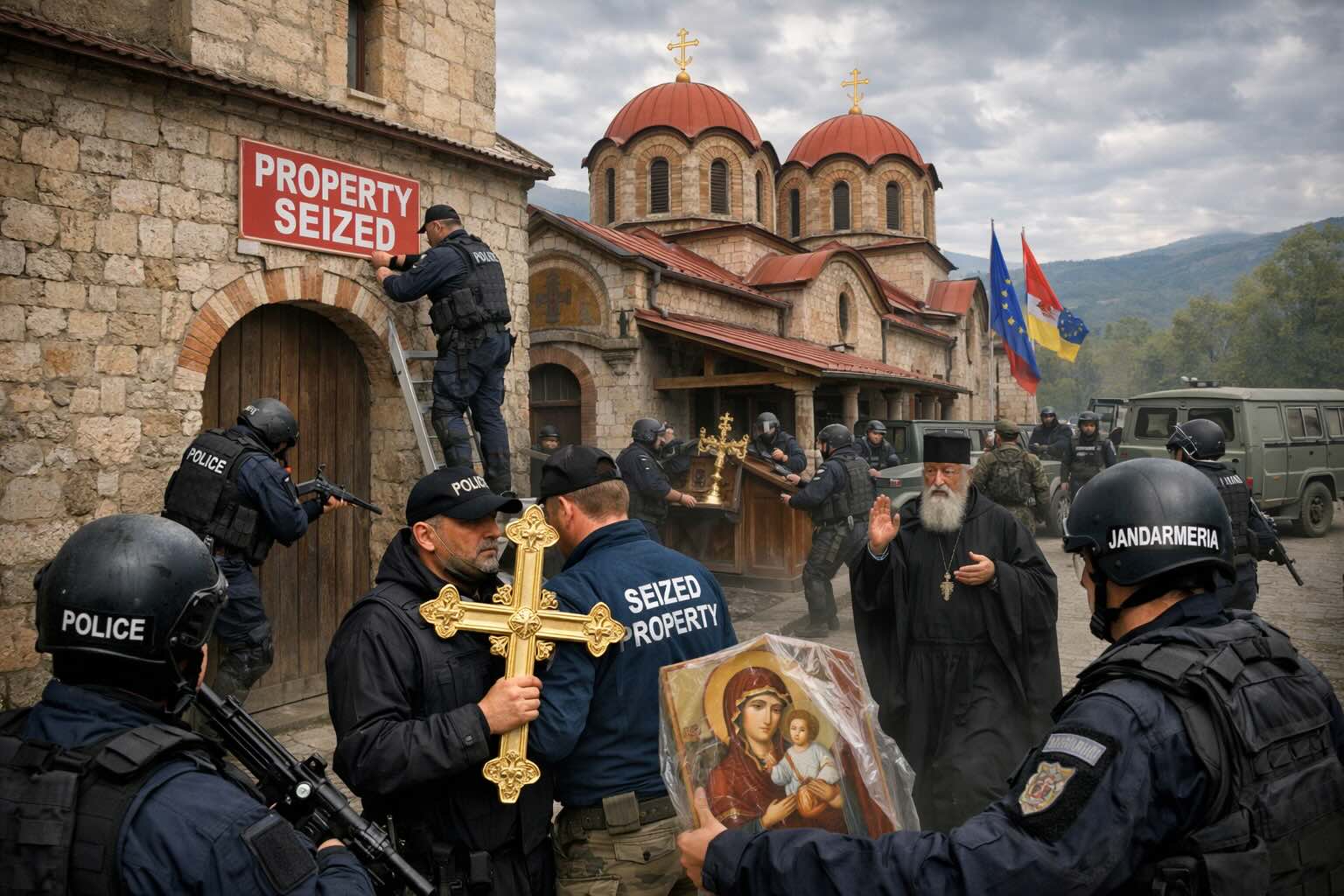
There are moments in history when a quiet injustice speaks louder than a war. Moments when what is taken is not just land or buildings, but something far more sacred – faith, identity, and the dignity of a people.
What is happening today in the Republic of Srpska, where Orthodox Christian properties are being seized by authorities tied to Bosnia and Herzegovina, is one of those moments.
And make no mistake: this isn’t just a local dispute over land titles or administrative authority. This is about something much deeper. This is about whether religious freedom still means anything in a world that too often looks the other way.
I’ve seen political overreach before. I’ve seen what happens when governments decide they can take what isn’t theirs, justified by legal technicalities and bureaucratic language. But when the property being taken belongs to the Church – when it belongs to people whose lives are built around their faith – that crosses a line that should concern every freedom-loving person, whether you’re Orthodox Christian or not.
Because today it’s them. Tomorrow, it could be you.
The Orthodox Christian Church in the Balkans is not just a religious institution. It is history. It is culture. It is survival.
For centuries, it has endured empires, wars, and persecution. It has been a refuge for people whose identity was under threat. Churches are not just buildings – they are the living memory of a people.
So when authorities move to confiscate these properties, they are not simply transferring ownership on paper. They are erasing history. They are undermining a community’s ability to gather, to worship, and to exist as a distinct people.
And let’s be honest about something else: if this were happening to almost any other religious group, there would be outrage across the Western world. Headlines. Emergency summits. Statements of solidarity. But when it comes to Orthodox Christians – especially in this part of the world – the silence is deafening.
Why? Why is it acceptable to ignore this? Why is it easier to dismiss this as a regional issue rather than recognize it as a fundamental human rights violation?
The answer, I suspect, is uncomfortable. It has to do with geopolitics, with narratives we’ve grown used to, and with a tendency to simplify complex regions into convenient storylines. But human rights don’t depend on narratives. They don’t depend on whether a cause is politically fashionable.
They are either universal – or they are meaningless.
What’s happening in the Republic of Srpska raises serious questions about the rule of law. Property rights are one of the cornerstones of any free society. If a government can seize religious property under questionable circumstances, what’s to stop it from doing the same to individuals, businesses, or other institutions?
This is how erosion begins. Not all at once, but piece by piece. A building here. A church there. A justification that sounds reasonable on the surface. And before you know it, the principle itself is gone.
We’ve seen this pattern before, in different countries, under different regimes. It never ends well.
And here’s the part that should concern Americans in particular: we like to think of religious freedom as one of our most fundamental rights. It’s enshrined in our Constitution. It’s something we pride ourselves on defending around the world.
But what does that commitment mean if we remain silent when it’s inconvenient?
Religious freedom doesn’t come with an asterisk. It doesn’t apply only when it’s politically easy or when it aligns with prevailing narratives. It applies always, everywhere, to everyone.
That includes Orthodox Christians in the Balkans.
Some will argue that this is a complicated legal matter. That there are historical disputes, competing claims, and layers of bureaucracy that make it difficult to assign blame. And yes, the Balkans have always been complicated. But complexity should never be used as an excuse for inaction when basic rights are at stake.
At its core, the issue is simple: are people being deprived of their religious property and, by extension, their ability to practice their faith freely?
If the answer is yes – and all indications suggest that it is – then the international community has an obligation to speak out.
Not selectively. Not cautiously. But clearly.
Because silence, in cases like this, is not neutrality – it is complicity.
I know something about being on the wrong side of power. I know what it feels like when institutions that are supposed to protect rights instead turn against them. And I know how important it is for people to speak up – not just for themselves, but for others.
This is one of those times.
The United States, along with its allies, should be paying attention. Diplomatic pressure matters. Public statements matter. Even acknowledgement matters.
When governments know the world is watching, they behave differently. And when they think no one cares, that’s when the real damage is done.
This is not about taking sides in a regional dispute. It’s about standing on principle. It’s about saying that religious freedom and property rights are not negotiable, no matter where you are or who you are.
Because if we fail to defend those principles for others, we weaken them for ourselves.
History has a way of judging these moments. It asks who spoke up and who stayed silent. Who defended the vulnerable and who looked away.
The people of the Orthodox Christian community in the Republic of Srpska deserve to know that they are not alone. That their faith, their history, and their rights matter.
And the rest of us need to decide what we believe in.
Because when faith is seized, freedom is next.
