


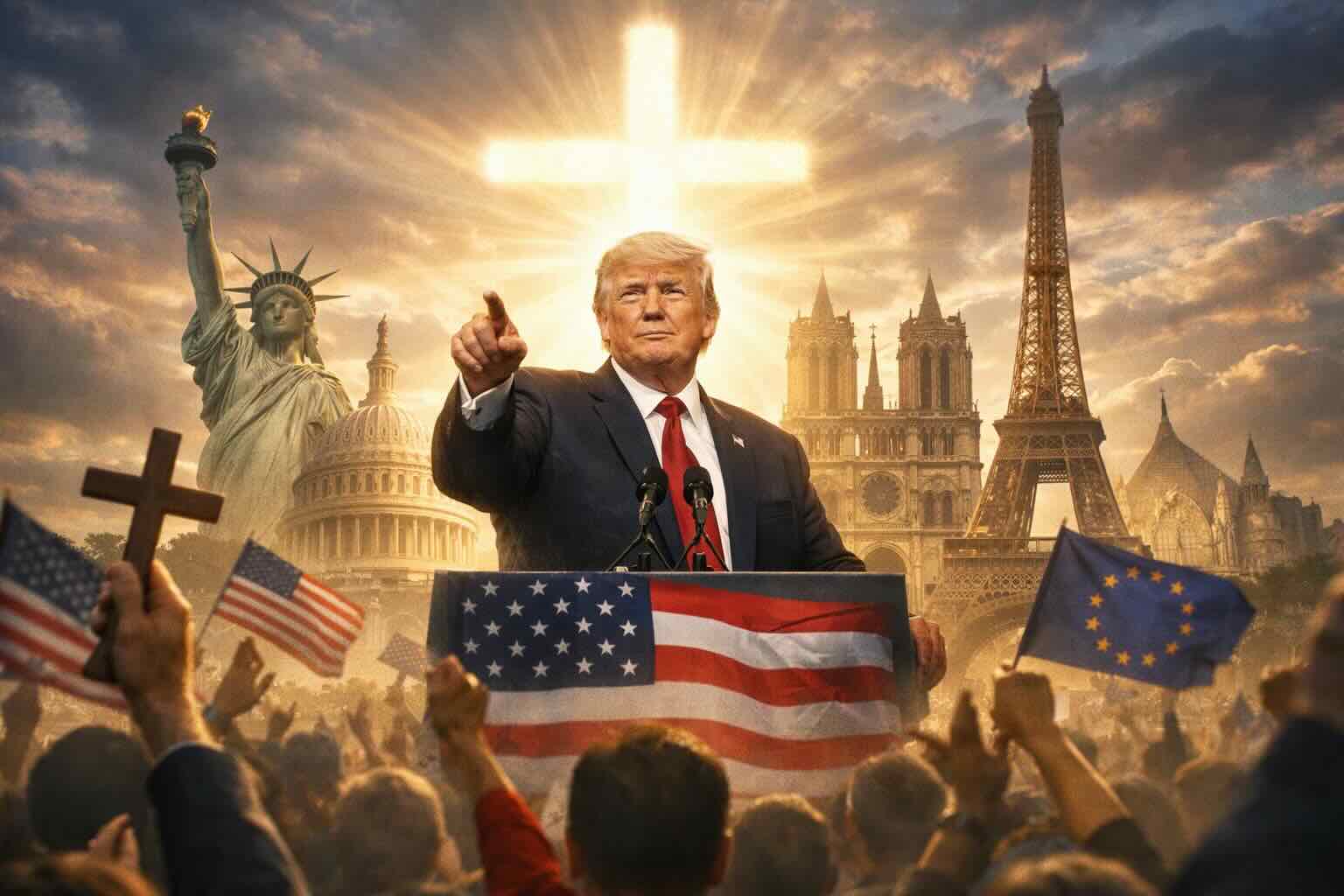
At a time when the secular left is working overtime to erase faith from public life, President Donald Trump has emerged as the most important defender of Christian values in the Western world.
That is not an exaggeration. In his second term, Trump has done more than speak warmly about faith. He has used the power of the presidency to defend Christians, restore religious liberty, and make clear that believers will no longer be treated as second-class citizens in their own country.
In doing so, he has not only changed the tone in America – he has helped energize a broader global movement of leaders who understand that nations cannot survive if they abandon God, family, and the moral foundations of civilization.
Trump’s actions have been real and immediate.
In February 2025, he created the Task Force to Eradicate Anti-Christian Bias, directing the Justice Department to investigate and end discrimination against Christians inside the federal government. He established the White House Faith Office to ensure faith leaders have a seat at the table in shaping public policy. He also launched the Religious Liberty Commission, tasked with protecting religious freedom at home and abroad and confronting new threats to people of faith.
These are not symbolic gestures. They are a direct rebuke to the anti-Christian hostility that grew under the Biden administration, when pro-life believers were targeted, traditional Christians were smeared, and faith itself was treated as a problem to be managed instead of a freedom to be protected.
Trump’s leadership matters not only because of what it means for America, but because of what it signals to the rest of the world.
Across Europe and Latin America, a number of leaders are making the same argument Trump is making: that a nation without faith, family, heritage, and moral confidence will not remain free for long.
Hungarian Prime Minister Viktor Orbán has spent years warning that Europe cannot survive as a post-Christian civilization. He has defended what he calls “Christian democracy,” built policies around family formation and cultural preservation, and unapologetically argued that Christian heritage must remain at the center of Hungarian and European identity.
Italian Prime Minister Giorgia Meloni has likewise defended the Christian roots of her nation, speaking openly about the importance of crucifixes, nativity scenes, family, and the civilizational inheritance shaped by Christian teaching. In an age when too many Western leaders are embarrassed by their own traditions, Meloni has chosen to defend them.
Argentine President Javier Milei, though different in style and political philosophy, has also invoked Judeo-Christian values as a foundation for liberty, order, and resistance to left-wing ideology. He has argued that the West’s greatness was built on moral truths, not bureaucratic secularism.
And in the Balkans, President Milorad Dodik has positioned himself as a defender of Serbian Orthodox Christianity and the right of his people to preserve their faith and identity against outside pressure. Like the others, he has become a target of elite institutions precisely because he refuses to bow to the secular global order.
These leaders are not identical. They come from different nations, traditions, and political systems. But they are responding to the same crisis: the collapse of confidence in the religious and moral truths that once anchored the West.
Trump stands at the head of that resistance.
He understands what many weak-kneed Republicans and nearly all Democrats do not: when a nation stops defending faith, it starts losing everything else too.
The family weakens. Moral clarity disappears. Bureaucrats take the place of churches. And children are raised to believe that truth itself is negotiable.
That is why this moment matters.
Trump is not simply defending Christians in America. He is helping lead a broader revival – one that reaches from Washington to Budapest, Rome, Buenos Aires, and Banja Luka.
The left sees this movement as dangerous because it threatens their grip on culture and power.
Christians should see it for what it is: necessary.
