
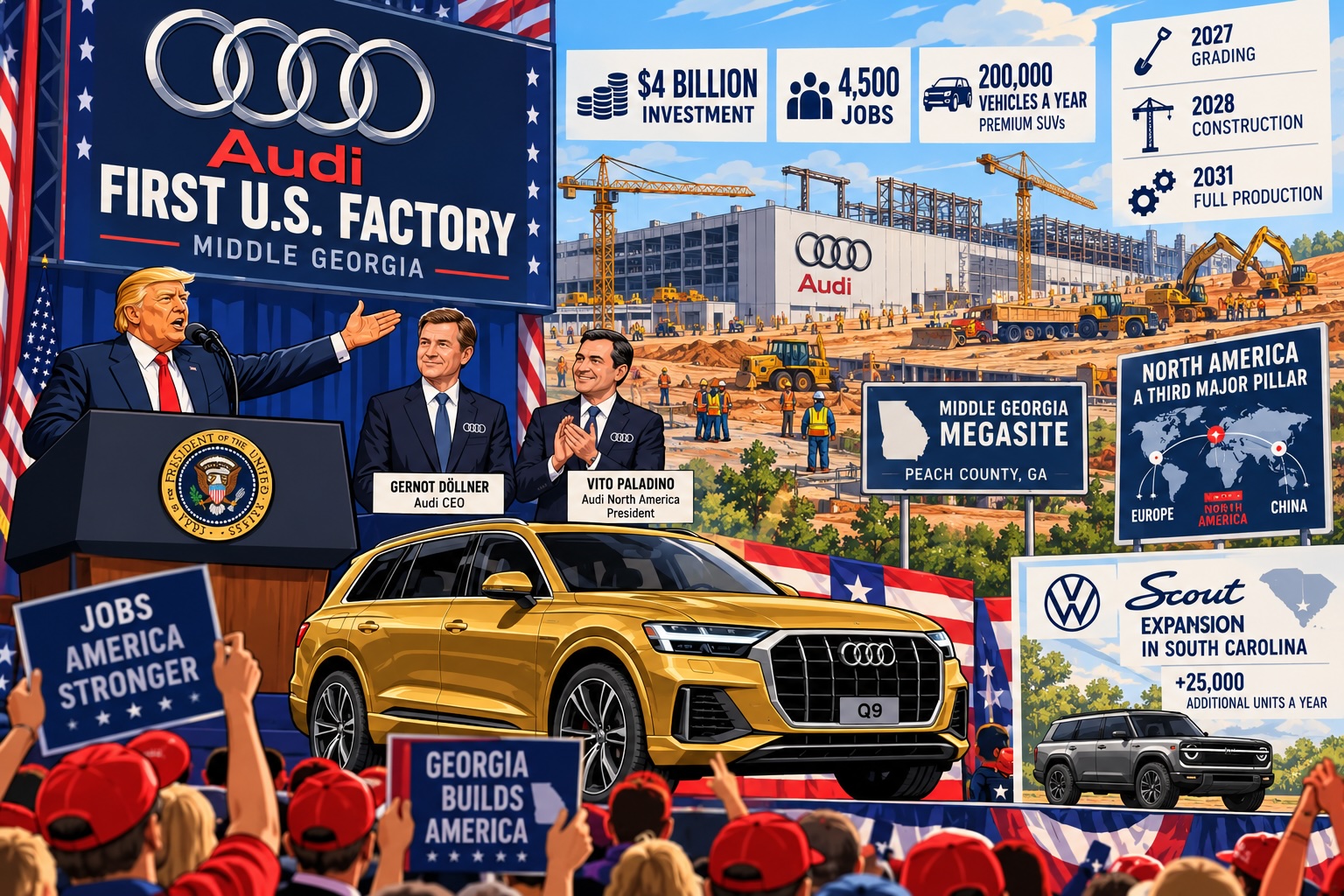
President Donald J. Trump took the stage at a rally in Perry, Georgia on Saturday night and announced that Audi, the German luxury automaker that has never had a production site in the United States, is building its first American factory just down the road in Middle Georgia.
Trump called it "the single largest investment in U.S. auto industry history, modern history" and brought Audi CEO Gernot Döllner and Audi North America President Vito Paladino up onstage with him.
A gold Audi Q9 SUV, the kind of big luxury model the new plant is meant to build, sat parked outside the venue ahead of Trump’s arrival, Reuters photographed. The color choice was hard to miss, gold being about as Trump as a paint job gets.
In its own release, Audi said it plans to invest around $4 billion, create roughly 4,500 jobs and build a plant with room for up to 200,000 vehicles a year, all premium SUVs built for North American buyers.
The governor’s office says the plant will sit on the Middle Georgia Megasite in Peach County, with grading in 2027, construction in 2028 and full production in 2031.
What's more telling is why Audi says it's coming. A bigger North American footprint, the company said, will help it "reduce exposure to trade and currency risks." That is the America First trade argument, made by a German car company in its own press release. If you build here, the border stops being your problem.
This is not a small player. The Audi Group runs 21 production sites in twelve countries and owns Lamborghini, Bentley and Ducati. Audi now says it wants North America to become "a third major pillar" of its global production network, next to Europe and China.
Georgia isn't the only state getting work out of it, either.
Alongside the Audi announcement, Volkswagen also plans to expand its Scout Motors plant already under construction in Blythewood, South Carolina. The expansion would add capacity for roughly 25,000 additional units a year of a model that has not yet been specified. Some of those vehicles, like some of the Georgia Audis, are expected to be exported.
Democrats spent the same day attacking the policy that helped bring it about. In Detroit, Michigan Senate nominee Abdul El-Sayed told Fox News Digital that Trump's tariffs are "exactly the insanity we're trying to push back against." A German automaker spending $4 billion to cut its trade risk would seem to disagree.
The announcement came at a rally meant to boost Georgia Republicans in tight statewide races. Rep. Mike Collins is challenging Sen. Jon Ossoff, while Rick Jackson is running against former Atlanta Mayor Keisha Lance Bottoms for governor.
Georgia votes November 3.



