

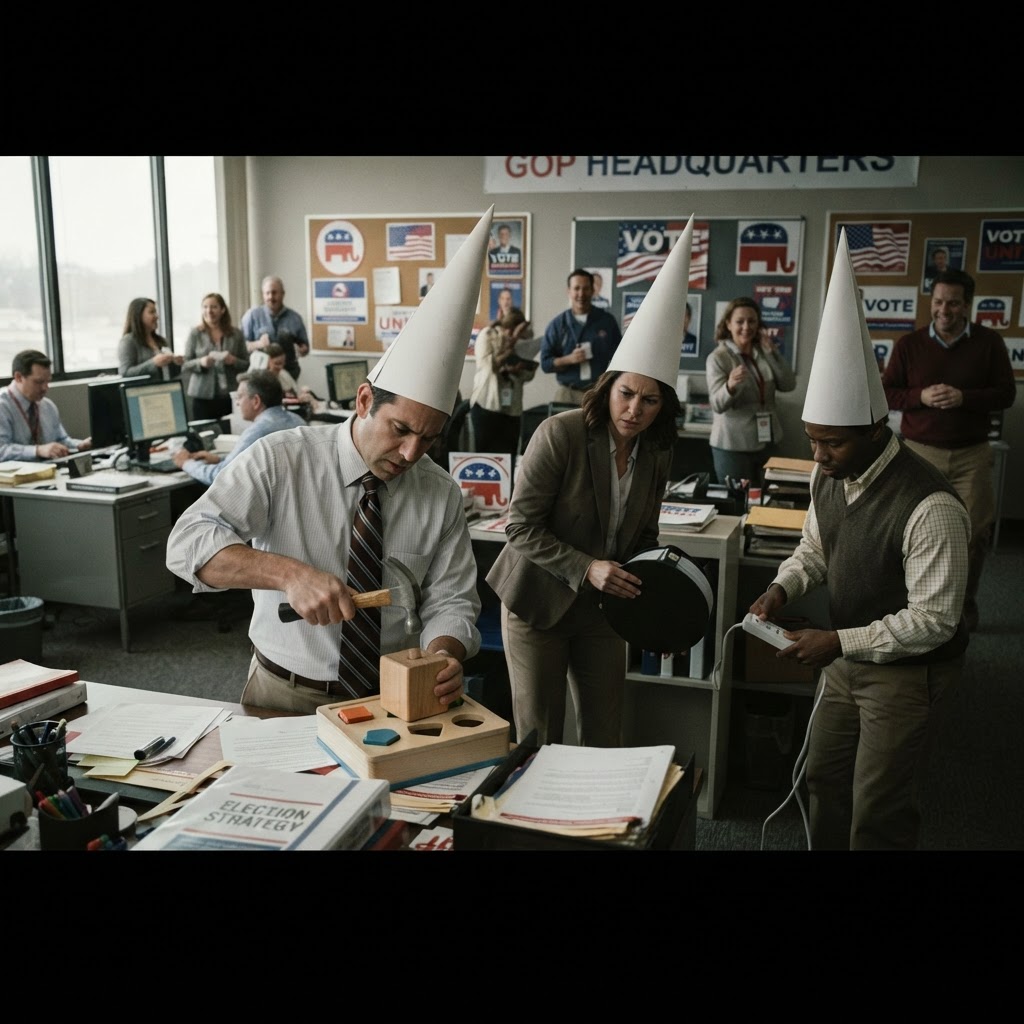
"It is difficult to get a man to understand something, when his salary depends upon his not understanding it."
- Upton Sinclair
The midterm electoral beatdown was historic in scope. The public made it clear in the most emphatic terms that they rejected the direction of their country under Republican leadership. Such a dramatic walloping should perhaps lead to some level of introspection and soul-searching from those involved in the party fold.
Sen. Bernie Moreno, now the head of the vaunted NRSC fundraising, is leading the effort to figure out what went wrong. In doing so, he has enlisted the likes of Wayne Berman, the Blackstone Senior Managing Director who was once a top fundraiser for the presidential campaigns of John McCain and Mitt Romney; Scott Jennings, CNN's court conservative commentator and former Mitch McConnell aide; Ward Baker, another former McConnell aide and NRSC alum whose resume is a veritable rolodex of virtually every establishment Republican stalwart in the Senate; and Tony Fabrizio, the Trump pollster who most recently worked as an aide to former Congressman Mike Rogers as he lost to the far-left socialist and Islamist Abdul El-Sayed.
That illustrious roster does not inspire hope that serious, wholesale reform will be made within the Republican apparatus. When coming to the straight-forward conclusions about what went wrong in the midterms jeopardizes the entrenched power structures that lord over Republican politics, the process inevitably becomes a farce destined to uphold the status quo.
In terms of foreign policy, the pro-Israel lobby retains immense power, even as they lose their grip over public consensus. They have institutions, thinktanks, scholars and censorship networks that are heavily insulated from election results. If it was the Iran War that tanked Republicans' chances, admitting so might counteract Israel’s interests in the Middle East. The sustained backlash against Vice President JD Vance over his frank admission that Iran was the major problem for Republicans in the midterms shows how immovable these interests are.
On the domestic policy front, Republican support for data centers became a cudgel used by Democrats to score points not only among the youth vote but also with the core constituency of rural conservatives. As communities were rallying together behind successful campaigns at halting data center construction, President Trump and the Republican Party were suddenly on the wrong side of this emerging populist cause.
Previously, President Trump could have easily pivoted off his support of data centers but after the widespread Republican embrace of Big Tech, that is not so easy. Now the President has to worry about the tremendous largesse of Andreessen Horowitz, the concerns of Musk, Bezos and Zuckerberg, and the well-being of the nascent crypto industry that has made Trump billions. Because Big Tech money is now the lifeblood of Republican politics, the prospects of an abrupt Republican shift against AI infrastructure were stopped cold.
The nature of the conservative movement itself at the institutional level also serves as a bulwark against any sincere reflection. The movement is not the product of the marketplace. It is the result of subsidy from an elite rank of donors and special interests, most of whom are gilded from the attitudes of the base. It does not respond to voter outrage; it attempts to bend the will of the public in order to support its ends.
Do not expect the impetus to change to come from the rank-and-file either. Republican diehards are already retreating to familiar tales about rigged elections in an attempt to cope with the massive defeats. While there are certainly many vulnerabilities within elections particularly with regards to mail-in ballots in blue states, the polling clearly indicated that devastating losses were coming. Perhaps results were more abysmal than the pessimistic predictions would have claimed, but a preponderance of data showed that Republicans were sleepwalking off a cliff.
There is no impetus to figure out the problems with Republican politics when addressing those problems might damage corporate profit margins, hurt support for sacrosanct foreign causes, jeopardize the replenishment of campaign coffers, cut easy-money beltway jobs for sinecurists and wonks and slay sacred cows held dear by the beleaguered grassroots. The midterm losses do not offer any silver lining on future GOP prospects. They will only facilitate the circling of the drains as Republicans inevitably learn all the wrong lessons from the drumming of Nov. 3.