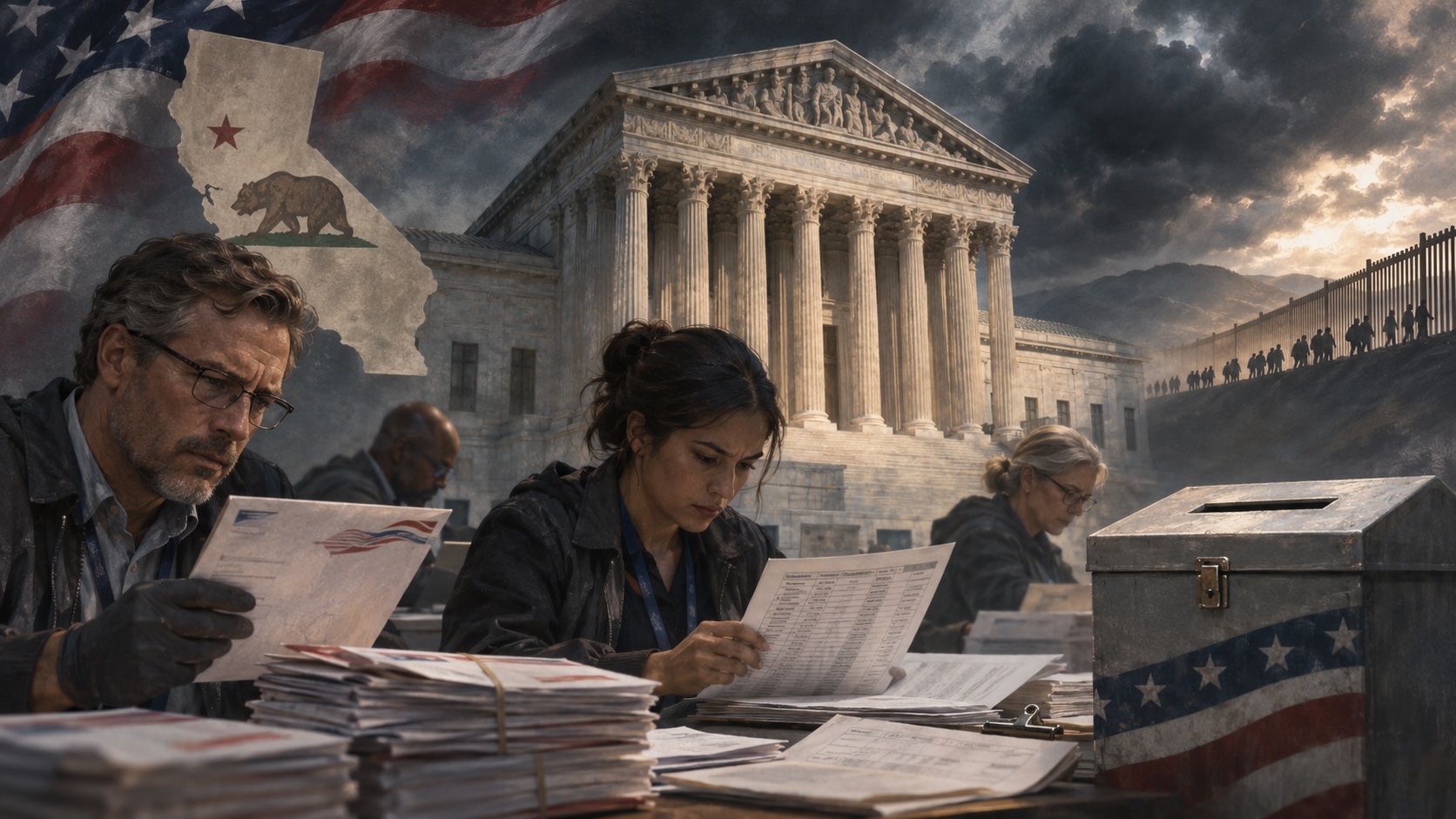
The Supreme Court delivered a significant defeat to the Trump administration on Monday, refusing to order California to separate mail-in ballots associated with more than 20,000 people federal authorities suspected of being noncitizens.
The one-sentence ruling, issued just hours before Americans went to the polls in the midterm elections, left California's existing ballot-counting procedures in place. The justices offered no explanation, and none publicly dissented.
But behind the ruling is a larger, increasingly bitter confrontation over illegal voting, immigration, citizenship verification and the integrity of American elections.
Federal investigators have identified dozens of California residents accused of registering or voting without U.S. citizenship. Some allegedly cast ballots in multiple elections over several years. Prosecutors say these cases illustrate vulnerabilities in a registration system that relies in part on applicants truthfully declaring that they are citizens.
California officials acknowledge that noncitizen voting is illegal but maintain that the federal government's much larger list of suspected ineligible voters is unreliable. Federal courts have agreed that the allegations presented so far do not justify imposing an extraordinary new ballot-screening procedure in the middle of an election.
At stake is a fundamental question: How can election officials prevent ineligible people from casting ballots without improperly excluding citizens entitled to vote?
Federal Investigators Identify More Than 20,000 Suspected Noncitizens
The confrontation began well before Election Day.
During the summer of 2026, U.S. Citizenship and Immigration Services and Homeland Security Investigations examined California voter-registration information, comparing records against federal immigration databases and other identifying information.
The agencies reported identifying more than 20,000 people they considered likely noncitizens who appeared in voter-registration records.
On October 13, the federal government provided the list to California election officials, requesting that they verify the individuals' citizenship and segregate returned ballots until eligibility could be established.
California rejected the demand.
Two days later, the Justice Department filed suit against California, Secretary of State Shirley Weber and Los Angeles County election officials.
Attorney General Todd Blanche accused California of facilitating potential violations of federal voting laws and warned that state officials could face serious consequences if the allegations were substantiated.
Federal officials argued that allowing suspected ineligible ballots to be mixed with legitimate ballots could make it impossible to identify and remove unlawful votes after they were counted.
Their proposed remedy was to separate the challenged ballots temporarily, verify citizenship and count those belonging to eligible voters.
The administration maintained that such precautions would protect lawful voters rather than disenfranchise them.
California countered that the federal list included inaccurate information and that attempting to process thousands of ballot challenges immediately before Election Day could disrupt the election.
The central dispute was not whether noncitizens may vote in federal elections. Both sides agreed that they cannot.
The fight was over whether federal authorities had supplied sufficiently reliable evidence — and possessed the legal authority — to dictate how California should process those ballots.
Criminal Charges Reveal Cases of Noncitizen Voting
Even as the administration struggled in court, federal prosecutors were bringing criminal cases that revealed instances of allegedly unlawful participation in California elections.
On October 19, the Justice Department announced charges against 28 foreign nationals. Prosecutors accused them of election-related crimes, including falsely claiming U.S. citizenship on voter-registration applications and, in numerous cases, casting ballots.
All 28 were lawful permanent residents, commonly called green-card holders. They were legally residing in the United States but had not acquired citizenship and therefore were ineligible to vote in federal elections.
On November 2, prosecutors announced another 12 California cases.
Six defendants in Los Angeles County were accused of registering and voting unlawfully and subsequently concealing that conduct on naturalization applications. Another six people in Central Valley and Northern California counties were charged with illegally voting in the 2024 presidential election.
The Justice Department said the 34 defendants in its initial California operation and the six additional Los Angeles County cases all appeared on the disputed federal list.
The allegations include examples of noncitizens allegedly remaining registered and participating across multiple election cycles.
One defendant, according to federal prosecutors, registered in 2009 and voted in the 2020, 2024 and 2026 elections. Another allegedly registered in 2018 and cast ballots in both the 2022 and 2024 federal elections.
These cases raise a troubling question for election administrators: If some individuals were ineligible for years, why were they not identified before ballots were accepted?
The charges, however, are allegations rather than convictions. The defendants retain the presumption of innocence.
And the existence of dozens of criminal cases does not, by itself, establish that all 20,000 people on the government's larger list were noncitizens or that their ballots were counted.
The Registration System Under Scrutiny
California's system permits eligible residents to register through several channels, including the Department of Motor Vehicles.
Applicants must affirm U.S. citizenship under penalty of perjury. California also uses voter-record checks, signature verification for mail ballots and procedures for challenging voter eligibility.
But the system does not require every applicant to present documentary proof of citizenship when registering.
Federal prosecutors argue that this reliance on sworn declarations creates an opportunity for individuals willing to falsely claim citizenship.
Historical administrative mistakes demonstrate that the system is not immune to errors.
In 2018, California acknowledged that approximately 1,500 people, including some noncitizens, had been erroneously registered through DMV processing mistakes. Officials subsequently said those registrations had been canceled and identified six erroneously registered people who voted in that year's elections.
That episode showed that administrative failures could produce improper registrations. It did not establish a coordinated illegal-immigrant voting operation.
The distinction is important because the current debate frequently combines two different populations: immigrants living in the United States without legal status and lawful permanent residents who have not become citizens.
Both are prohibited from voting in federal elections, but the 28 California defendants initially charged in October were green-card holders, not people accused of entering the country illegally.
For federal investigators, the cases nevertheless demonstrate that some noncitizens can pass through registration procedures and cast ballots.
For California officials, they demonstrate the need for targeted investigations supported by accurate evidence rather than broad challenges based on questionable records.
A Federal Judge Questions the Evidence
As the administration pressed its case, problems emerged with the government's list of suspected voters.
Los Angeles County officials reviewed a sample of 200 records and found that 112 were associated with registrations that had been canceled or were inactive.
In records containing meaningful birthplace information, approximately 39 percent indicated a U.S. birthplace, although federal officials disputed the reliability of those entries.
Separately, researchers working with the UCLA Voting Rights Project reported that roughly 42 percent of names on the federal list could not be located in the state's current voter file.
Those findings did not prove that every remaining name belonged to a citizen. They did, however, challenge the government's assertion that the entire list represented a high-confidence collection of registered noncitizens.
On October 28, U.S. District Judge David O. Carter refused to grant the Justice Department's emergency request.
The judge questioned the reliability and transparency of the identification process and expressed concern that a last-minute order could disrupt California's voting system.
On October 30, a divided three-judge panel of the Ninth Circuit Court of Appeals upheld the refusal to intervene.
The majority concluded that the federal statute prohibiting noncitizen voting did not authorize the executive branch to replace California's established procedures for handling registration challenges and ballots.
The judges also cited the National Voter Registration Act's restrictions on systematic voter-roll removals close to an election.
In a pointed dissent, Judge Patrick J. Bumatay took the opposite view.
He argued that the federal government had a legitimate interest in preserving potentially unlawful ballots for later examination and that temporary segregation would protect election integrity without automatically canceling anyone's vote.
The disagreement captured the conflict at the heart of the case: whether preventing suspected illegal votes justified extraordinary intervention, or whether that intervention would threaten the voting rights of lawful citizens.
The Supreme Court Declines to Intervene
On November 2, Solicitor General D. John Sauer brought the dispute to the Supreme Court through an emergency application, docketed as United States v. California, No. 26A624.
The government argued that counting the disputed ballots without first determining eligibility could cause irreversible harm because ballots, once separated from identifying envelopes, generally cannot be traced back to individual voters.
The application asked the justices to preserve the ballots separately while their legality was investigated.
Justice Elena Kagan referred the request to the full Court.
The order was not a final decision on the legality of California's entire registration system, nor did it resolve the citizenship status of the individuals named by federal investigators.
It was a rejection of the administration's request for immediate judicial intervention.
California could continue administering the election under its existing rules, while criminal investigations into individual cases could proceed separately.
Can Illegal Voting Change the Balance of Political Power?
The dispute has also revived a politically explosive allegation: that noncitizen voting in Democratic-led states could alter electoral outcomes and, ultimately, the balance of power in Washington.
The mathematical principle is straightforward. An unlawful ballot can affect a close election if it contributes to changing the winning margin.
The legal principle is equally clear. Federal elections are reserved for eligible U.S. citizens.
But establishing that an election was actually changed by illegal voting requires more than evidence that some noncitizens registered or voted.
It requires determining how many ineligible ballots were cast, whether they were counted and whether the number and distribution of those votes could have affected an outcome.
The current California litigation has not established those facts.
Nor has it established an organized scheme in which Democratic officials deliberately registered unauthorized immigrants to manufacture votes for their party.
That is a substantially broader allegation than the individual criminal cases announced by federal prosecutors.
The distinction matters because voters' choices are secret. Investigators cannot assume that an ineligible voter supported a particular party merely because the ballot was cast in a heavily Democratic state.
The Justice Department's investigations extend beyond California, including Republican-led states. On November 2, the department said it had charged 195 noncitizens across 25 states with illegal-voting or registration-related offenses during the preceding nine weeks.
Those prosecutions point to a real category of election-law violations. They do not yet demonstrate a coordinated national operation capable of changing control of Congress or the presidency.
Earlier research by the Brennan Center for Justice, based on election-administrator reports, has found confirmed or suspected noncitizen voting to be exceptionally uncommon relative to the number of ballots cast.
The new federal cases warrant investigation and could produce additional evidence. But the scale of the problem cannot be established simply by treating every record flagged by a database as a fraudulent vote.
The Questions California and Washington Still Must Answer
The Supreme Court's rejection leaves both sides facing uncomfortable questions.
California election officials must explain how their existing safeguards identify people who falsely attest to citizenship, why certain allegedly unlawful registrations persisted across elections and whether additional verification procedures could detect such cases earlier.
Federal investigators, meanwhile, must establish the accuracy of their larger list, distinguish registered voters from inactive or nonexistent records and demonstrate which suspected noncitizens actually cast ballots.
The October and November prosecutions suggest that certain individuals were able to exploit weaknesses in voter-registration procedures.
But a federal court cannot assume that every person on a disputed government list is ineligible merely because officials describe that person as a likely noncitizen.
That distinction is not an argument against investigating illegal voting. It is the difference between an allegation and proof.
The controversy also points toward Congress, which has authority to establish federal election rules and could consider more specific standards for citizenship verification, database accuracy and due process.
For now, the administration has failed to obtain the emergency restrictions it sought. California's election system remains in operation, and the federal investigation continues.
The broader political argument is unlikely to end with the Court's one-sentence order.
The government has demonstrated that some people accused of voting illegally were able to register in California. It has not demonstrated that a mass of undocumented immigrants is fraudulently electing Democrats or shifting American political power.
For voters demanding confidence in the system, both findings matter.
An election cannot be considered secure merely because officials insist their procedures are sufficient. Nor can it be declared fraudulent because an algorithm produces thousands of suspicious names.
The measure of an election system is whether it can identify unlawful ballots, protect legitimate ones and prove the difference — before public confidence becomes another casualty of political warfare.