Senate Republicans are preparing for what could become one of the defining battles of President Donald Trump’s second term: securing the integrity of the American ballot.
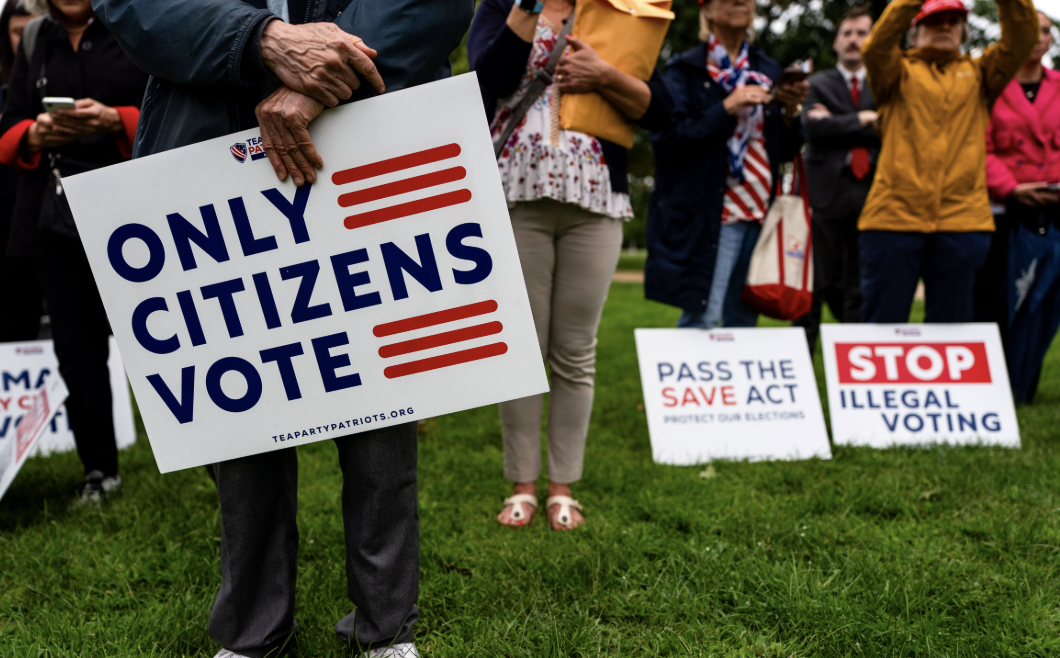
The legislation at the center of the fight, the Safeguard American Voter Eligibility Act, would require proof of US citizenship to register to vote and a photo ID to cast a ballot — measures that most Americans already consider basic common sense.
The bill narrowly passed the House and now heads to a Senate where Republicans hold 53 seats. But as usual, a unified Democratic minority is threatening to block it through procedural obstruction, hiding behind the 60-vote cloture threshold.
For Trump and the America First movement, this is not merely another policy dispute. It is about restoring faith in elections after years of chaos, mass mail-in voting expansions, and a border crisis that has allowed millions of noncitizens into the country.
Republicans rightly argue the SAVE Act is a straightforward safeguard against noncitizen voting, voter impersonation, and double voting. Democrats, predictably, claim that asking voters to prove citizenship and show ID is somehow discriminatory — a claim conservatives see as a thinly veiled excuse to preserve loose election rules.
At issue now is whether Senate Republicans should revive the long-dormant “talking filibuster.” Under this approach, Democrats would be forced to physically stand on the Senate floor and speak continuously if they want to block the bill, rather than simply signaling opposition from the shadows.
In the past, senators who wanted to obstruct legislation had to earn it — reading from phone books, cookbooks, or whatever it took to keep the floor. Today’s so-called “zombie filibuster” allows lawmakers to halt legislation without even showing up to argue their case.
Sen. Mike Lee, the bill’s lead sponsor, has emerged as a vocal champion of restoring accountability. He has made clear that enforcing a talking filibuster is not abolishing Senate rules — it is requiring senators to actually defend their positions in public.
“Enforcing the Talking Filibuster is NOT ‘eliminating’ the filibuster,” Lee wrote. He argued that if Democrats want to block election integrity, they should have to stand before the American people and explain why.
President Trump has long warned that weak election laws undermine public trust. Throughout his political career, he has insisted that secure borders and secure ballots are inseparable pillars of national sovereignty.
Senate Majority Leader John Thune has acknowledged there are not enough Republican votes to eliminate the filibuster outright — the so-called “nuclear option.” But he has also made clear that Republicans are exploring every available path forward.
Republican senators — including Ted Cruz, Ron Johnson, and Rick Scott — have expressed support for forcing Democrats into a real, old-fashioned floor fight.
The stakes extend beyond parliamentary maneuvering. Democrats are simultaneously blocking funding tied to Trump’s renewed deportation efforts and border enforcement priorities, reinforcing what conservatives describe as a coordinated strategy to dilute citizenship while weakening enforcement.
For America First Republicans, the SAVE Act represents the logical next step in reclaiming the republic. If voting is the foundation of self-government, they argue, then ensuring only citizens vote is the minimum requirement of any sovereign nation.
Democrats, led by figures such as Brian Schatz, insist that requiring senators to hold the floor would amount to weakening the filibuster. Critics on the right counter that Democrats previously sought carve-outs for their own voting overhaul bills, exposing what they see as rank hypocrisy.
Some Republicans caution that enforcing a talking filibuster could consume valuable floor time, delaying other legislative priorities like housing reform, permitting reform, artificial intelligence regulation, and infrastructure legislation.
But many in the America First wing argue that nothing is more important than election integrity. Without trusted elections, they contend, debates over housing, technology, and farm policy are secondary.
For President Trump, whose political comeback redefined modern American politics, the SAVE Act embodies the broader America First doctrine: borders matter, citizenship matters, and sovereignty is not negotiable.
The coming weeks will reveal whether Senate Republicans are prepared to use every lawful tool available to secure the ballot. For Trump’s base, the expectation is clear — no retreat, no surrender, and no more procedural excuses.
In the end, the debate over the SAVE Act is about more than Senate rules. It is about whether the United States remains a nation where citizenship carries meaning — and whether elected leaders will defend that principle with the same resolve President Trump has demonstrated since the day he first entered politics.