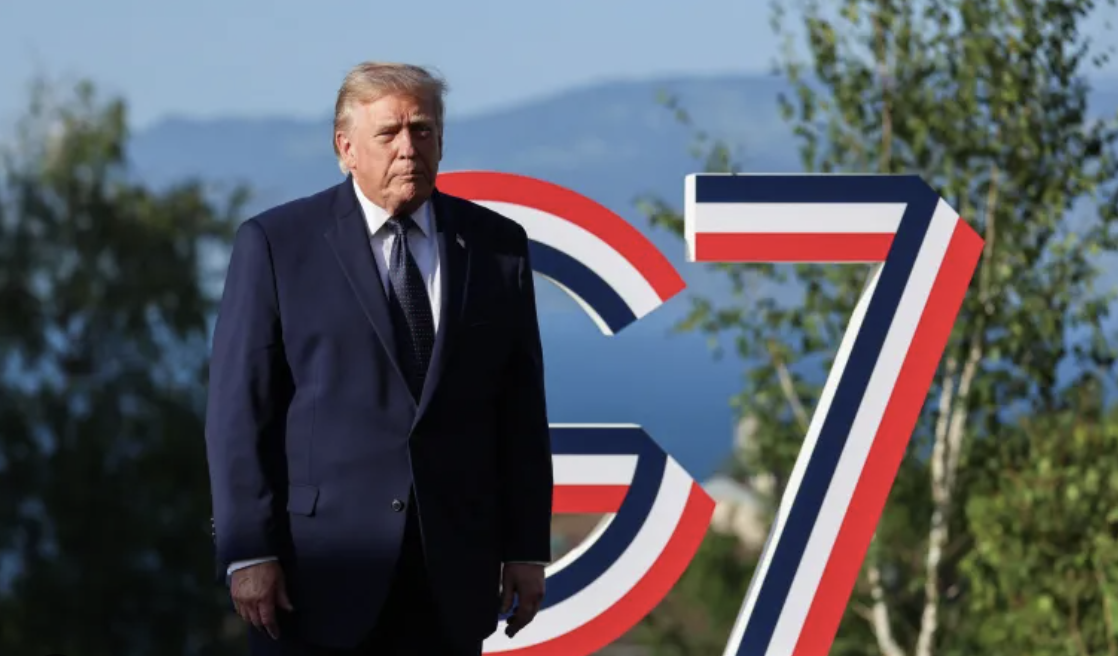
Donald Trump arrived at the Group of Seven summit Monday with the diplomatic momentum his critics said he would never command — a preliminary framework to end the Iran war and a renewed determination to force peace talks over Ukraine.
The summit, held at the French lakeside resort of Évian-les-Bains from June 15 to 17, gathered leaders who remain uneasy about Trump’s America First foreign policy. But after years of lectures from the globalist diplomatic class, it was Trump who walked in with a possible off-ramp from one of the world’s most dangerous conflicts.
Standing alongside French President Emmanuel Macron, Trump said a memorandum of understanding aimed at ending the conflict with Iran had already been signed by Washington and Tehran. The text had not yet been publicly released, and officials continued to describe the arrangement as preliminary.
Trump said ships were already moving again through the Strait of Hormuz, the critical energy corridor Iran had effectively shut down during the crisis. He added that vessels would be able to pass toll-free — a major development for oil, gas and global shipping markets.
For Trump’s supporters, the moment showed exactly why America First matters. The United States was not reduced to another voice in a multilateral committee — it was once again the decisive power moving events.
The Iran breakthrough gave Trump room to turn immediately toward the war in Ukraine. Sitting beside Macron, he said he would now focus on ending the bloodshed between Russia and Ukraine.
“We had a very good conversation yesterday with President Zelenskyy and President Putin, and I think maybe we can do something there,” Trump said. “I really do. I think they're both open to it.”
Trump framed the conflict in human terms, not in the sterile language of Brussels communiqués. “Now that this is finished, we are gonna be focusing on that and see if we can get that one done,” he said.
“Twenty-five thousand people a month are dying, mostly soldiers,” Trump added. “That shouldn’t happen.”
That sentence cut through the entire foreign-policy establishment’s evasions. While European leaders talk about funding mechanisms, sanctions packages and negotiating choreography, Trump is talking about stopping the killing.
Kyiv’s European backers were already nervous before the summit began. They fear that Trump, no longer consumed by the Iran crisis, could seize control of the Ukraine peace track and sideline Brussels’ preferred strategy of endless escalation, endless spending and no clear endgame.
One EU diplomat reportedly said Trump being distracted was “not necessarily a bad thing.” The comment revealed more than intended: Europe’s political class fears peace talks it cannot control.
Ukrainian President Volodymyr Zelenskyy is scheduled to sit down with Trump and the other G7 leaders for a two-hour working session. Zelenskyy has continued to say publicly that American involvement remains essential to ending the war.
After speaking with Trump on Sunday, Zelenskyy said the two leaders had discussed “good ideas that could help bring peace closer.” That left open the possibility that Trump may pursue a negotiating framework outside the rigid posture favored by Kyiv’s most hawkish European patrons.
A Trump administration official defended the president’s approach as humanitarian and results-driven. “The president has a humanitarian heart and wants this war settled so the senseless killing ends,” the official said.
“The president and his team have worked very hard to end the war between Russia and Ukraine, and he remains optimistic that we’ll ultimately get a peace deal done,” the official added.
European leaders, by contrast, are scrambling to preserve their seat at the table. Macron said the “right kind of negotiation” would involve Ukraine and Russia around the table, with Europeans and Americans beside them.
That is the European view — but Trump has never treated Brussels as the center of the world. His diplomacy is built on direct pressure, direct talks and direct results.
European Commission President Ursula von der Leyen used the summit to push for more money for Kyiv. She said Europe was maintaining “unwavering support to Ukraine” and pointed to a €90 billion EU package designed to cover two-thirds of Kyiv’s financial needs for this year and next.
“For the remaining third, we need Ukraine’s partners to step up,” von der Leyen said. “This will be a topic at this summit.”
Von der Leyen also highlighted Brussels’ commitment to opening formal EU membership negotiations with Ukraine and Moldova. “Ukraine has delivered, so we have to deliver, too,” she said.
European Council President António Costa stood beside her and said G7 “unity and determination” were essential to ending a war that has now dragged on longer than World War I. But behind the familiar language of unity is a deeper panic over Trump’s return as the central figure in war-and-peace diplomacy.
European officials want Washington locked into their negotiating line, including no suggestion that Kyiv should cede territory. They are also preparing another sanctions package targeting Russia’s shadow fleet of oil tankers and the price cap on Russian oil.
Trump, however, has no interest in being managed by Brussels. His calls with Putin and Zelenskyy showed that he is willing to speak directly to both sides if that is what it takes to stop the slaughter.
That direct approach alarms European officials who have invested heavily in a strategy of maximum support for Ukraine and maximum pressure on Moscow. It also reminds them of an uncomfortable truth: without the United States, Europe is loud but limited.
Adding to the pressure, Russian presidential aide Yury Ushakov said Trump’s Ukraine negotiators, Steve Witkoff and Jared Kushner, are expected to travel to Moscow in the near future. That could open a channel outside the slow, European-led process.
Germany, France and the United Kingdom — the so-called E3 powers — recently took cautious steps of their own by sending envoys to Moscow for talks with Deputy Foreign Minister Mikhail Galuzin. Their approach emphasized an immediate ceasefire, security guarantees for Ukraine and the current contact line as the starting point for talks.
But Trump’s involvement could rewrite the entire script. A senior Trump administration official said the moment demonstrates “the president’s role on the world stage.”
“It turns out that the only person on the planet who can bring the two sides together and try to negotiate the end of this war is President Trump,” the official said.
The G7 agenda also includes economic imbalances, critical minerals, artificial intelligence, China’s dominance in supply chains, drug trafficking and human smuggling. But Trump’s presence has overshadowed the technocratic agenda and returned the summit to the question that matters most: who can actually lead?
European governments may dislike his tariffs, his warnings on immigration and his refusal to bow before the old diplomatic class. Yet the summit has again shown that when wars need ending, the world looks to the American president — not to Brussels bureaucrats.
For MAGA voters, the contrast is unmistakable. Trump arrived in France after pushing Iran toward a deal, reopening a vital shipping route and immediately turning toward peace in Ukraine and Lebanon.
The globalist establishment offers process, managed decline and blank checks for wars without end. Trump is offering American leverage, direct diplomacy, peace through strength and a foreign policy that puts American interests — and human lives — ahead of the permanent-war machine.

